


 Francais
 Deutsch
 Italiano
Refine Your Search
New Mexico United States 1946 stock footage and images
- Showing 19297 to 19302 of 30776 results more
more Hide
Hide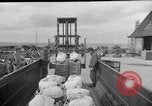
Combat cargo is loaded into trucks and unloaded from trucks onto a C-119 Flying Boxcar at Ashiya Air Force Base in Japan.
Cargo is loaded at Ashiya Air Force Base in Japan during the Korean War. A supply dump area. The cargo is loaded into trucks with a parachute attachment. A fork lift, personnel and storage area. A tarpaulin is placed over the supplies as a protective measure against weather. The cargo is unloaded from trucks onto a United States Air Force Fairchild C-119 Flying Boxcar.
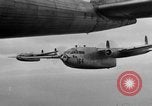
A USAF C-119 Flying Boxcar in flight behind a camera ship in East Asia.
A United States Air Force Fairchild C-119 Flying Boxcar in East Asia during the Korean War. The Flying Boxcar on the way to a cargo drop zone. The tail of a camera ship and two C-119 Flying Boxcars behind the camera ship. A C-119 Flying Boxcar against the cloudy sky. A C-119 Flying Boxcar in flight. Interior of the cockpit shows a pilot and a co-pilot in position.
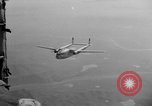
USAF C-119 Flying Boxcars drop cargo, parachutes open and cargo descends in Korea.
Combat cargo airdrop from a United States Air Force Fairchild C-119 Flying Boxcar in Korea during the Korean War. The C-119 Flying Boxcar in flight. Views of rugged Korean terrain. Cargo hatch showing crew readying the cargo to be-dropped. Interior of the aircraft shows doors as the cargo drops. The Flying Boxcar drops cargo: parachutes open and the cargo descend. Three C-119 Flying Boxcars in flight over water. The three C-119s flying low over an airfield and peeling off for landing.
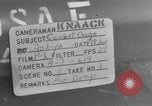
A USAF C-119 Flying Boxcar lands at Ashiya Air Force Base in Japan.
A United States Air Force Fairchild C-119 Flying Boxcar at Ashiya Air Force Base in Japan during the Korean War. The C-119 approaches for a landing. The Flying Boxcar's engine starting. The C-119 taxis.
USAF C-119 Flying Boxcars land and taxi at Ashiya Air Force Base in Japan.
United States Air Force Fairchild C-119 Flying Boxcars at Ashiya Air Force Base in Japan during the Korean War. C-119 Flying Boxcars approach for landing and land. A C-119 Flying Boxcar taxis.

Japanese delegates reach Ie Shima, Ryukyu Islands and then advance towards Manila, Philippine Islands in the South East Asia.
Japanese surrender in Southeast Asia during World War II. Airplanes in formation flight. Two Japanese Mitsubishi G4M-1 'Betty' twin-engine bombers painted white with green crosses on their wings, fuselage and tail land at Ie Shima Ryukyu Islands near Okinawa carrying Japanese delegates. The planes land at Nichols Field at 1813 hours. The planes are dubbed 'Bataan number 1' and 'Bataan number 2.' Lt. Gen. Torasirou Kawabe, the vice chief of the Japanese Army's General Staff and his surrender party disembark from the airplanes. Members of the surrender party include Rear Admiral Ichiro Yokoyama Representative, Imperial Japanese Navy Staff., Colonel Yashima Terai General Staff, Colonel Orato Yamoto General Staff, Mr. Morio Yakawa Secretary, Japanese foreign office. Kawabe leads the surrender party. Army C-54 transport airplanes parked. Japanese surrender delegates board the airplanes which take off for Manila, Philippines. United States Army General Douglas MacArthur speaks to his troops from a balcony at the war damaged Manila City Hall (Padre Burgos Ave, Ermita, Manila, 1000 Metro Manila) on 20 August 1945. He notes that he is hopeful that they will all be able to return home soon.
CRITICALPAST.COM: About Us | Contact Us | FAQs - How to Order | License Agreement | My Account | My Lightboxes | Shopping Cart | Advanced Search | Featured Collections | Website Terms & Conditions | Privacy Policy ©2026 CriticalPast LLC.
License Agreement |
Terms & Conditions |
Privacy Policy
©2026 CriticalPast LLC.