


 Francais
 Deutsch
 Italiano
Refine Your Search
New Mexico United States 1946 stock footage and images
- Showing 1951 to 1956 of 30776 results more
more Hide
Hide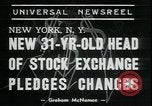
President of the New York Stock Exchange William Martin addresses the reorganized board of the exchange in New York, U.S.
William Martin is appointed as the President of the New York Stock Exchange in New York City, United States. Exterior of New York Stock Exchange building on Wall Street. Men gathered inside the building on the trading floor during busy trading activity. Officials standing in a balcony of the building. 31 year old William Martin address men from a podium. He addresses the first meeting of the reorganized board of the stock exchange. He speaks about capital requirements and need for stability and security, and contribution of the stock exchange to fulfill the requirements and help emerge from the Great Depression.
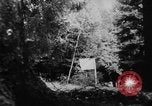
Cold War commences in Europe and UN takes military action against North Korean aggression
Opening scenes show people of East Germany escaping from the Soviet-controlled zone, to the West, through forests. Whole families are seen carrying whatever they could in back packs and suitcases. Early in Korean War period: An animated map is inserted showing a map centered on Korea, with the 38th Parallel dividing Communist North Korea from South Korea. View of a line scratched in a dirt road, designating the 38th Parallel, leading to a temporary border with guard post, established for administrative purposes. View of Ducksoo Palace, in Seoul, Korea, headquarters of the United Nations (UN) Commission on Korea. Diplomats inside its chambers, trying (in vain) to negotiate the withdrawal of Soviet forces from North Korea. United States troops are seen evacuating from South Korea, after the establishment of the Republic of Korea. Carrying duffel bags and all their gear, they board trains to evacuation ports. General scenes of landscape and South Korean people going about their normal activities, under the new government. Smoke rising from surprise attacks by North Korea against the South. Republic of Korea (ROK) troops march to defend against the North's aggression. ROK troops in trucks and trenches fire small arms against the invaders. Huge numbers of refugees are shown fleeing the North. Soldiers raise international flags at the headquarters of the United Nations, in Lake Success, Long Island, New York. Inside, diplomats meet to deal with the crisis. View of empty place at the table labeled "Union of Soviet Socialist Republics." Warren Robinson Austin, U.S. Ambassador to the UN is seen as well as other UN representatives. (Narrator states that after its cease fire order had been ignored by the Communists, the Security Council voted for united military action against the aggressor, and provided for a unified command of United Nations forces.) View of the delegates voting with raised hands. U.S. General Douglas MacArthur is seen receiving the first UN battle flag. Aerial views of the Port of Pusan, Korea. The U.S. Navy transport ship, USS Pickaway (APA-222) is seen being moved by tug boats in the port. View of the troop ship loaded with American troops headed to the port of Pusan, Korea. Color guards waving flags of the UN, the U.S. and the Republic of Korea, as they lead a military brass band marching along the pier. Change of scene to American troops marching along opposite sides of a road in Korea, as jeeps drive in the middle. Troops, including ROK soldiers, engage North Koreans with small arms, mortars, machine guns and artillery field pieces. Back in America, troops parade along Constitution Avenue in Washington DC, with capitol building seen in background. American soldiers boarding a train. Camera focuses on shoulder emblem of a Canadian officer boarding a train and then shows Canadians marching to a port of embarkation. Turkish troops pass in review on their way to Korea. Troops of the Netherlands on the march. Australian troops assembled before sailing to Korea. Swedish doctors and nurses boarding a ship to Korea, where they will set up hospitals to treat the wounded. British sailors boarding ships for action in Korean waters. Glimpse of a British Colossus class aircraft carrier, underway in Korean waters. Views of other UN forces headed to Korea. The UN General Assembly building in Lake Success, Long Island, New York. View of delegates inside the building. Film ends showing a rotating globe of the world, with flags of Nations participating in UN actions in Korea, being shown as the globe passes their respective countries.
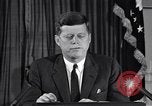
John F. Kennedy talks about the the New 18-Power Conference to be held on 14th March in Geneva, Switzerland
United States President John Fitzgerald Kennedy delivers a speech in Washington DC. President Kennedy seated on a podium as he delivers his speech. He speaks into the microphone. A flag of United States on the stage. He talks about the New 18-Power Conference on nuclear disarmament, scheduled for the14th of March, where the U.S. will present a statement of agreed principles that has been worked out with Soviet Union and endorsed by United Nations.
First Atomic submarine USS Nautilus underway and at sea in 1956; also scenes of SSM-N-8 Regulus cruise missile
United states Navy submarine SSN-571, the USS Nautilus, introduced in 1956. The nuclear powered USS Nautilus submarine underway at sea in United States. Men at controls as the first nuclear submarine is tested. SSN-571 in New York Harbor with Manhattan Island skyline of New York City in background. Next scene shows the guided cruise missile SSM-N-8 Regulus, also introduced in 1956, being fired from a ship, and an aerial view is seen of the Regulus guided missile in flight.
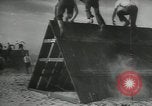
Training of American draftees before World War II; also Japanese attack on Pearl Harbor and Roosevelt's request for declaration of war.
United States soldiers and new recruits at a camp in the U.S. before outbreak of World War II. New recruits and U.S. Army soldiers in training run obstacle course. Soldiers in their uniforms march through the camp area. Tents in the background. Newly drafted U.S Army soldiers learn to fire weapons on firing range using artificial wooden rifles. U.S. soldiers seen training with wooden replica machine guns and using empty Adelphi beer cans as substitute artillery ammunition for training purposes. Teams of soldiers compete in moving a giant ball. They compete in blindfolded boxing on their knees. Lacking adequate war materiel for training, they make do by pretending that trucks are tanks and labeling them with such signs. They pretend with wooden guns and throw flour sacks instead of grenades. Scenes of the Pearl Harbor raid by the Empire of Japan on December 7, 1941. Views of the USS Arizona being hit and various ships on fire soon after the attack. United States President Franklin D. Roosevelt is seen addressing Congress, where he asks for a declaration of war against Japan.
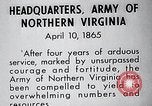
Damaged plantation homes after Civil War, barren land, and African American family migration
Activities around the Mississippi river in the United States in the early 1900s, in areas still affected by the Civil War. Text of General Robert E. Lee's announcement about surrendering the Army of Northern Virginia, April 10, 1865. Image of flames and fire burning a town or city. United States Civil War aftermath in the South. Scenes of several different empty and burned down plantation homes in the southern United States. View of the barren land and effects of erosion. Poor African American family with their belongings in a horse drawn wagon, walking on foot during the "Great Migration," moving to a new area of the United States in the north or west. View of the Mississippi River as seen from a moving boat at water level.
CRITICALPAST.COM: About Us | Contact Us | FAQs - How to Order | License Agreement | My Account | My Lightboxes | Shopping Cart | Advanced Search | Featured Collections | Website Terms & Conditions | Privacy Policy ©2026 CriticalPast LLC.
License Agreement |
Terms & Conditions |
Privacy Policy
©2026 CriticalPast LLC.