


 Francais
 Deutsch
 Italiano
Refine Your Search
New Mexico United States 1946 stock footage and images
- Showing 2005 to 2010 of 30776 results more
more Hide
Hide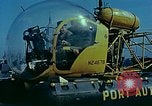
Statue of Liberty at Liberty Island, New York and ships in New York harbor.
A New York Port Authority helicopter with pontoons is seen as it takes off. Aerial views of the New York City skyline in the late 1950s, the Statue of Liberty, the George Washington Bridge over the Hudson River, tugboats in the water, the ocean liner SS United States, and view approaching the Greek freighter Isbrandtsen on a small boat, with a uniformed port worker or officer preparing a docking throw rope.
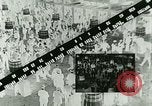
Stock Market trading activity on the floor of the New York Stock Exchange in New York City
American traders and other officials at the New York Stock Exchange in New York, United States. Traders on the exchange floor. Image of stock ticker tape runs across. People and officials gathered at the Stock Exchange. Discussions among the people. A clock strikes 10. An official starts trading, speaking from the balcony of the exchange. Traders hurry around the busy, exchange floor, packed with people. People trading. Officials gathered around in several groups.
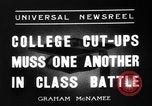
Get together of members of the Class of Forty at New York University and sophomores in New York City.
University students get together in New York City, United States. Members of the Class of Forty at New York University during a get together with the sophomores. The two teams battle it out in friendly fights. Other students cheer them. Students duck others in fountain water.
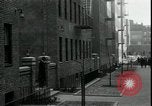
The First Lady of the U.S. Anna Eleanor Roosevelt arrives for the inauguration of a new housing project in New York City
The inauguration of a new housing project in New York City during the Great Depression. Apartment buildings along densely populated streets. People gather on a street. Clothes and pillows hanging on a line in front of the buildings. The First Lady of the United States, Anna Eleanor Roosevelt, along with Mayor Fiorello La Guardia and other officials is seen at the ceremony. Mrs. Roosevelt cuts a ribbon.
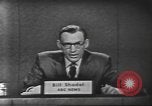
During an election debate in the US, Kennedy and Richard Nixon talk about a hypothetical invasion by the Chinese Communists.
The third Kennedy-Nixon Presidential Debate in the United States. Charles Van Fremd from CBS News asks Republican candidate U.S. Vice President Richard M. Nixon that if he were the president would he launch a war if the Chinese Communists began an invasion of Quemoy (Kinmen) and Matsu Islands and if he would authorize the use of nuclear weapons if regular conventional forces failed to halt the invasion. Nixon answers and states that it is irresponsible for a presidential candidate to indicate the course of action and the weapons he would use in the event of such an attack. He states that he would not say in advance how the U.S. would respond. He states that the Chinese Communists do not want just Quemoy and Matsu or Formosa (Republic of China or Taiwan), but the world. He concludes that defense of the free world territories and not surrender will lead to the path of peace. Democratic candidate Senator John F. Kennedy talks about a treaty to defend Formosa (Taiwan) and the Pescadores Island. He states that the U.S. would meet its commitment to Formosa. He disagrees with Nixon's suggestion that the United States should go to war if Quemoy (Kinmen) and Matsu islands are attacked as the treaty does not include these two islands. He concludes and says that the U.S. would defend if Formosa (Taiwan) or the Pescadores Island is under attack.
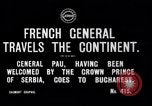
Crown Prince of Serbia welcomes French General Pau; Pau in Bucharest; Italians parade in Lewisohn Stadium, New York
Crown Prince Alexander of Serbia welcomes French General Pau at a ship in Serbia. They shake hands. They talk amongst themselves. General Pau meets officials on a railway station in Bucharest. He salutes the officials. Next scene is in the United States two months later: Boys and young men march in a crowded Lewisohn Stadium, at the College of the City of New York (CCNY) on June 23, 1917, during a ceremony to honor Prince Ferdinando of Udine, head of the Italian War Commission to the United States.
CRITICALPAST.COM: About Us | Contact Us | FAQs - How to Order | License Agreement | My Account | My Lightboxes | Shopping Cart | Advanced Search | Featured Collections | Website Terms & Conditions | Privacy Policy ©2026 CriticalPast LLC.
License Agreement |
Terms & Conditions |
Privacy Policy
©2026 CriticalPast LLC.