


 Francais
 Deutsch
 Italiano
Refine Your Search
New Mexico United States 1946 stock footage and images
- Showing 1999 to 2004 of 30776 results more
more Hide
Hide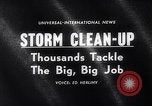
People and snowplows remove snow from roads and New York's Kennedy Airport after heavy snowstorm
Snow storm from Eastern States to Mid West cities in United States. Heavy snow on roads. Cars beside the road covered with snow. Only outline of structure of car visible due to snow. Man removes snow with snow shovel. A child, man and woman remove snow with shovels. Snow plows and snow blowers being used at Kennedy Airport in New York to clear roads and runways so airplane travel can resume.
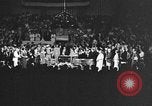
U.S. President Franklin Delano Roosevelt gives an address about Good Neighbor policy, in Chautauqua, New York
U.S. President Franklin Delano Roosevelt speaking at Chautauqua, New York. People gather inside an auditorium. President Roosevelt at a podium. People cheer and applaud. The President addresses the gathering. He speaks about the policy of good neighbor followed by America. He says that the United States will respect the rights of other countries, their agreements and obligations. He talks about the unity of the countries. The crowd applauds. He further states that America will cooperate and help other countries. He talks about the cooperation of America in social work in Geneva.
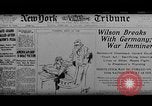
U.S. President Wilson declares war against Germany and U.S. General Pershing arrives in France during World War I.
America declares war against Germany during World War I. A report in ' New York Tribune ' is pictured. President Woodrow Wilson at his desk in his office in Washington D.C., United States as he declares war against Germany. A copy of Joint Resolution declaring war against Germany. General Pershing reaches England and then France where he visits Napoleon's tomb, Les Invalides along with other French officers. United States Secretary of Navy, Josephus Daniels and Assistant Secretary of Navy Franklin D. Roosevelt as America joins the war. Allied ships underway at sea. United States battleship New York at sea. Sailors aboard a ship. Admiral Rodman addresses the crew aboard a ship.
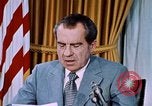
President Richard Nixon gives an energy crisis statement from the Oval Office of the White House in Washington DC.
U.S. President Richard Nixon addresses the nation from the Oval Office of the White House in Washington DC, United States. President Nixon says that lack of energy supplies would bring temporary shortages in fuel supplies and some increase in fuel prices. He says that if energy resources were properly developed they could fulfill American energy requirements for centuries. He says that his administration was going to end quantitative controls on oil imports and establish a national energy office in the United States. He talks about increasing the ability of the United States to prevent oil spills. The President proposes that the Congress should remove government regulations which discouraged the growth of domestic natural gas industry. Secondly, the Congress should help to establish research and ground work for developing new forms of energy for a long range future (alternate sources of energy). Thirdly, the Congress should permit the licensing of new deep water ports to open the way for long delayed Alaska oil pipeline.
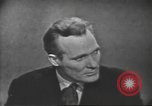
John F Kennedy and Richard Nixon comment on need for labor laws during a presidential election debate in the U.S.
The third Kennedy-Nixon Presidential Debate in the United States. Frank McGee from NBC News asks Republican candidate U.S. Vice President Richard M Nixon to comment on the need and purpose of new laws to protect the public against labor unions' power. Nixon talks about his speech on this topic. He disagrees with Kennedy's statement favoring compulsory arbitration as a President's weapon to stop national emergency strike. He states that in Steelworkers Union speech Kennedy had indicated government seizure as the best way to stop a strike. Nixon states that he does not believe in either compulsory arbitration nor seizure. He says that the management should be involved in dispute settlement. He concludes and urges the need for the greatest cooperation possible between labor and management. Democratic candidate Senator John F Kennedy states that he has never suggested compulsory arbitration as the solution of national emergency disputes. He talks about seizure. He states about president's course and setting up of a fact-finding committee.
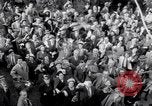
Ceremony at Jewish Agency office in Washington DC, on occasion of United States recognition of Israel as an independent state.
Crowd gathered around 6:00pm on May 14, 1948, outside the Washington DC office of the Jewish Agency, at 2210 Massachusetts Avenue, NW, Washington DC. View of happy, waving crowd from camera position in an upstairs window. View on building steps of dignitaries including Eliahu Elath (later the first Israeli Ambassador to the United States), Rabbi Novak of the Washington Mizrachi leaders, Sumner Welles, and New York Congressman Sol Bloom. View of a boy (Oren Zinder, son of Zvi and Honda Zinder) standing in the upstairs window, preparing to unfurl the flag of Israel in front of the building. View of the flag in position, and the crowd waving.
CRITICALPAST.COM: About Us | Contact Us | FAQs - How to Order | License Agreement | My Account | My Lightboxes | Shopping Cart | Advanced Search | Featured Collections | Website Terms & Conditions | Privacy Policy ©2026 CriticalPast LLC.
License Agreement |
Terms & Conditions |
Privacy Policy
©2026 CriticalPast LLC.