


 Francais
 Deutsch
 Italiano
Refine Your Search
New Mexico United States 1946 stock footage and images
- Showing 20743 to 20748 of 30775 results more
more Hide
Hide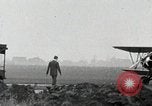
An aircraft piloted by aviator Charles Lindbergh takes off from a field in Hicksville, New York.
American aviator Charles Lindbergh takes off in an aircraft from Hicksville, New York. At an airfield, Charles Lindbergh walks towards a 1930 Perth Amboy Bird BK aircraft with registration number N727Y. He examines the aircraft. Men gathered around the plane. Propellers of the biplane aircraft rotate as engine starts. Lindbergh taxis and takes off in the aircraft and the plane is seen climbing.
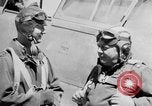
New P-40 aircraft at Curtiss Aircraft Company in Buffalo, NY during World War II
Two pilots stand in front of a P-40 airplane at the Curtiss Aircraft Company in Buffalo, NY. The pilots are H. Lloyd Child, Curtiss’ chief test pilot (at left) and apparently a USAAF major (at right). They are performing acceptance flight tests on new planes during World War II. Another pilot is in the cockpit of the plane behind them. A P-40 is seen taxiing rapidly on the ramp near the Curtiss hangars at the Buffalo Airport. A shiny P-40 being taxied. The first P-40 takes off and climbs out with landing gear extended. The shiny one does likewise. The first P-40 is seen circling high overhead, with landing gear still extended. Next, it is seen over the runway on final approach, about to land. Curtiss employees move aircraft parts in an open stake truck, next to a building, in the foreground.
Insignia and flag of United Nations.
Close-up of insignia of United Nations. Flag of United Nations fluttering in the breeze.
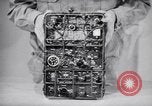
Signal Corps Radio 694 radio set internal construction with transmitter and receiver units shown.
Guards of transmitter and receiver units are removed by the radio engineer to show the internal construction and the panel guard of SCR 694 radio set. Transmitter unit is removed. Power cable and connectors are shown. Tube circuit and crystal compartment on transmitter is shown by radio engineer.
The use of colored grenades by a unit cut off from its headquarters during combat in WW2.
The types, uses and importance of colored smoke grenades during combat in WWII. An enactment shows a unit in a forest which has been cut off from its headquarters. The leader of the unit sights a friendly reconnaissance plane and throws a green smoke grenade to signal their position. Another grenade burns indicating their immediate need. The pilot of the aircraft throws a sign grenade. He signals them the way to be followed by throwing a red smoke grenade along the road to be followed.
United Auto Workers Union (UAW) initiate 1939 Tool and die workers strike against General Motors that spreads to other General Motors workers.
Opening Slate reads: "International Union United Auto Workers (UAW) of America " over-layed on medalion reading: "Affiliated with C.I.O."This is followed by the title of the film: "United Action Means Victory, Story of the General Motors Tool and Die Strike 1939." This is followed by numerous credits, and a foreward signed by UAW President, R. J. Thomas and Secretary-Treasurer, George F. Gaddes. Next, Camera shows Walter Reuther, Director of the General Motors Department of the UAW, seated behind Union President R.J. Thomas, as he speaks to members of the union executive board. Camera pans over the board members. Views of a tool and die makers at work, in measuring and in machine shops, using grinders, drilling machines, welding equipment and other machinery. Walter Reuther is seen meeting with Union officials after they decide to strike. Actors supposedly brawling outside an auto plant. (They all pull their punches.) Newspapers announcing peaceful settlement of labor complaints. Walter Reuther insists on waiting for General Motors response to the Union's demands. Strikers marching outside an auto plant. One carries a sign calling for Fisher Pontiac workers to strike. Most of these are women. View of a Chevrolet plant with picketers marching in a courtyard. Slate reads:"Chevrolet Gear and Experimental." More views of picketers. One wears a hat reading: "UAW-CIO Picket Captain." Building with sign reading: "Chevrolet Engineering Laboratory." Engineers from the Lab shake hands with strikers and join them. More views of pickets. Some receiving drinks from folks supporting the strike. Union members seen paying their dues to union cashiers.
CRITICALPAST.COM: About Us | Contact Us | FAQs - How to Order | License Agreement | My Account | My Lightboxes | Shopping Cart | Advanced Search | Featured Collections | Website Terms & Conditions | Privacy Policy ©2026 CriticalPast LLC.
License Agreement |
Terms & Conditions |
Privacy Policy
©2026 CriticalPast LLC.