


 Francais
 Deutsch
 Italiano
Refine Your Search
New Mexico United States 1946 stock footage and images
- Showing 223 to 228 of 30772 results more
more Hide
Hide
The Pre-Christmas parade during Christmas celebrations in New York City in 1946.
Crowds watching the Macy's Thanksgiving Day Parade with many big helium-inflated balloon floats in New York City. A panda balloon float passes by. A pilgrim balloon float besides a Camel billboard. View of crowd and parade floats in Times Square. Young girls wearing frilly dresses waving from an eagle shaped float. Girls watching the parade. Animated lion with his master in a boat. People in costume dance and a big ice cream shaped float goes by. Other floats include a Pilgrim, a baseball player (modified Bobo the Hobo), a Panda bear, and a candy cane. People watch the parade and cheer. Santa Claus wave from a decorative float.
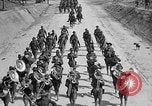
New Jersey National Guard units return from Punitive Expedition to Mexico and arrive at Camp Fielder in Sea Girt, during Fall of 1916
Film opens showing New Jersey National Guard soldiers returning to their training camp (Camp Fielder) at Sea Girt, New Jersey. Led by an army band, they march in formation along a sandy road with high berms on both sides.Glimpses of the marching troops from the side. As they proceed, toward the camera, they reach a point where they begin to march double-time. Scene shifts to a gate of the camp, where family, friends, and well wishers are gathered and a banner reading "Welcome" is stretched across the entrance. Led by officers on horseback, and the colors, the troops march through the gate. Next, soldiers are seen greeted by women family members. One soldier standing beside a tent, lifts his daughters, one at a time, and kisses them. He motions to his wife to pose with them. She does and he kisses her. Next, soldiers are seen briefly, with shouldered rifles, marching in formation. Scene shifts to another area of the Camp (named Camp Fielder for then Governor James F. Fielder). Here, army officers assist President Woodrow Wilson, to mount a horse. The President is dressed formally, including top hat. He poses for the camera. The President then rides with officers to review the National Guard troops drawn up in formation. He salutes with his top hat over heart, as they pass a color guard. He is next seen seated on horseback next to a commanding officer (possibly Colonel Daniel T. Mather) as they review the New Jersey National Guard troops passing in review.
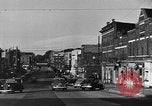
Traffic in business section of unidentified U.S. town; brief view of riverboat; then views of shops on West Main Street in Madison Wisconsin
Majority, but not all of clip shows Madison Wisconsin circa 1946. Clip opens with views of an unidentified town in the United States. Automobile traffic on street of the town. Long views in distance suggest possibly western United States. Next scene is a very brief view of a riverboat or steamboat on a river. Next scene is Main Street in Madison Wisconsin, with cars and trucks on street. Capitol building dome in Madison is visible in distance. Point of view from a moving vehicle of shops and businesses on West Main Street in Madison, Wisconsin. Businesses include The Drake; Fashion Shop; Chris Eckert; Edward Eckert at 125 and 127 W. Main Street. Next is "W. H. Hanger Plumbing and Heating at 123 West Main Street, Madison, Wisconsin. Then a Steak and Fried Chicken restaurant. Next is Margaret's Beauty Salon; Goodyear Tires; J.C. Penney Company. Scene changes to a house. A man comes out of a house carrying a fishing pole. Brief scene of two young men in a library.
Effects of the atomic bombing of Hiroshima, Japan, in World War II, and early international efforts to control atomic weapons
Film showing city of Hiroshima, Japan, before and after the August 6, 1945 dropping of the atomic bomb over the city in World War 2. Sequence opens on what the narrator says is August 5, 1945, the day before the event (but the footage is likely from before that date). Camera pans over the city of Hiroshima before the atomic bomb destroyed the city. Japanese air raid lookouts are seen on watch for allied bombers. View of atomic bomb detonation as seen from aircraft high overhead (this is actually a view of the Nagasaki blast, not the Hiroshima blast despite narrator's comments). Next, the complete destruction of the city of Hiroshima is seen from camera at low altitude showing the four and one half square miles of the city flattened and burned. A Japanese hospital still functioning, with red cross flag on it. Hospital workers retrieving wounded victims of the bombing. Ambulatory victims clustered in doorways and halls. Shadow image of a large industrial valve wheel burned onto wall behind it. Similar image of a ladder burned onto a wall. The decorative pattern on a woman's dress burned onto skin of her back. Japanese physicians treating victims of thermal and radiation burns. Views of various victims, including some children, and their respective injuries. Scene shifts forward one year, to August 6, 1946. Children are lined up outside a school building, and then seen inside their classroom. Disfiguration and wounds on children resulting from injuries are still evident on the children at their desks. Sequence shifts again, this time to an early United Nations meeting with delegates grappling with the issue of controlling nuclear power and atomic weapons. Closeup view of American delegates, including James F. Byrnes (Secretary of State)and James B. Conant, President of Harvard University in the assembly. Closeups of representatives from South Asian nations. Closeup of USSR delegation, headed by Foreign Minister, Vyacheslav Molotov. Signs identifying delegates from Colombia, Egypt, Iraq, Bolivia, China. Final sequence shows several U.S. atomic scientists in their respective laboratories, including Enrico Fermi and Vannevar Bush. United States representative to the UN, Warren Austin, speaking about the so-called Baruch Plan, for international control of atomic weapons. (Principal author, Bernard Baruch, is standing behind speaker's left shoulder.) USSR delegation, headed by permanent representative, Andrei Gromyko, who is seen presenting the Soviet plan. View of explosion and mushroom cloud during U.S. Operation Crossroads atomic bomb test in the Pacific.
Adolfo Lopez Mateos inaugurates the Alliance of Progress exhibition in Mexico.
Alliance of Progress initiated by U.S. President John F. Kennedy to establish economic cooperation between North and South America. The exhibition of the program is inaugurated in Mexico City. Aerial view of the historical monuments in Mexico city. Aerial view of the Opera House, Torre Latinoamericana, Angel of Independence and other landmarks in the City. Traffic on streets. People crowd outside the exhibition hall. A poster of U.S. President John F. Kennedy at the entrance. President of Mexico Adolfo Lopez Mateos inaugurates the exhibition. Other dignitaries stand in the background. People stand in front of the Kennedy's poster. 'USA' hanged in between two poles. The dignitaries standing in front of the poster. A flag of Mexico flutters in the breeze. People inside the exhibition hall. A sign reads 'Alliance for Progress'. The poster of the President of Mexico Adolfo Lopez Mateos, U.S. President and other people the visitors look at the posters that are exhibited. The visitors looking at the posters. A model of an aircraft. Two women explaining to the visitors. A sign reads 'Visit United States'. People look at the U.S. from a screen. Two women distribute pamphlets. They promote tourism. A dignitary inaugurates the tourism department. People crowd outside the U.S. tourism department. A dignitary looks into a paper and speaks. A wall map in the background. The dignitary speaking and people listen to him. Posters on a revolving structure depicting the places that can be visited in the United Sates. Mexico President with other dignitaries look at the exhibition. The visitors visitors in the hall look at several things displayed.
United States Army 187th Airborne Regimental Combat Team returns to Japan from Korea and is welcomed by City of Beppu, Oita
Clip opens with rapid changing scenes: American troops in trench in Korea during the Korean War. American tank on street in Germany. American Ski troops in Alaska. Amphibian assault training in Puerto Rico. Rotating Globe shows: U.S. Army on alert to defend against aggression. Sergeant Stuart introduces episdoe and states that U.S. Army has come to Japan to know their culture and make friends after war and occupation. U.S. Army troops of the 187th Airborne Regimental Combat Team, are seen arriving by railroad train at a train stateion near their base near Beppu,Oita on the island of Kyushu, Japan. U.S. Army soldiers, including white and African American soldiers, exit train cars. They receive a warm welcome from Japanese population. Banner reads:" Welcome Pala Troop comin back from Korea, City of Beppu."[sic] Women holding flowers and families with small children waving American and Japanese flags, welcome them on the train station. A sign over the train station platform reads: "Welcome 187 Para Troop Coming Back From Korea, City of Beppu." The troops stand in formation on the platform while the unit's officers receive the flowers from the women. Japanese men in fraternal uniforms and the general population all join in the welcoming ceremonies. The troops march off the train station under another sign reading: Welcome Home 187 RCT." and march down the main street of Beppu under a swirl of paper confetti. Next scenes are from autumn of 1945, as U.S. soldiers march through streets of Japan during occupation following the end of World War 2. U.S. troops seen marching behind Japanese police to occupy Japan, in 1945, amidst the aftermath of suffering and destruction of the war. The local population standing at road sides and watching with worry and concern. Scenes of postwar destruction in Japan. Rubble of bombed buildings. Scene of simple wooden dwelling shacks and wreckage nearby. A Japanese boy with his baby brother on his back. The baby is crying. Next scene moves again to circa 1950 in streets of a Japanese city, possibly Tokyo, rebuilt and with busy scenes of traffic on streets and commerce. Large outdoor rally with a Communist speaker addressing large crowd of Japanese people who sit and listen. Scenes from a what the narrator describes as a Communist rally in Japan, against America, which turns violent. Protestors running in streets during demonstration, with signboards and police and fire fighters extinguish flames at scene of an overturned, burning car. Flashback again to 1945 or 1946 as U.S. Army soldiers use tractors and heavy equipment to clear and level an area of war rubble and debris during rebuilding efforts after World War 2. Japanese citizens look on, watching the machines at work.
CRITICALPAST.COM: About Us | Contact Us | FAQs - How to Order | License Agreement | My Account | My Lightboxes | Shopping Cart | Advanced Search | Featured Collections | Website Terms & Conditions | Privacy Policy ©2026 CriticalPast LLC.
License Agreement |
Terms & Conditions |
Privacy Policy
©2026 CriticalPast LLC.