


 Francais
 Deutsch
 Italiano
Refine Your Search
New Mexico United States 1946 stock footage and images
- Showing 229 to 234 of 30772 results more
more Hide
Hide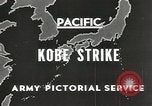
United States B-29 bombers drop incendiary bombs over Kobe, Japan
"Kobe strike" shows United States B-29 bomber aicraft dropping 3200 tons of incendiary bombs over industrial targets in Kobe, Japan during World War 2. Firebombing causes pillars of smoke to rise up. Narrator speaks of strikes on other Japanese cities also and relates statement by General Arnold that beginning July 1945, industrial Japan will be hit by bombs at the rate of 2 million tons per year, or 5480 tons per day, adding that "by the end of 1946, Japan will have ceased to exist as a bombing target."
Citizens campaign in Mexico City for Mexico to declare war against the Axis powers in World War II
Thousands of citizens march in Mexico City demonstrating for Mexico to declare war against the Axis powers in World War 2. They converge on the main plaza (Zócalo) where President Manuel Ávila Camacho stands on the balcony of the Presidential Palace, with his wife, Doña Soledad Orozco García de Ávila Camacho, and members of his staff. View from a high point overlooking the plaza, showing thousands massed with the Mexico City Cathedral in the background. Narrator states that citizens protest against axis sinking of unarmed mexican ships. Flags of the United States, and allied flags are displayed. Flags are waved in salute for their dead comrades, by Survors of the SS Potrero del Llano, a Mexican ship torpedoed by the German submarine, U-564, on May 13, 1942. Camera pans over the square filled with people and banners. Next, President Camacho is seen asking the Mexican Chamber of Deputies for a declaration of war. People on the streets (some sitting on street lamps) listen to the broadcast over loudspeakers. Mexican Army soldiers seen in helmets. Uniformed troops line a sidewalk. Deputies applaud after unanimously approving the declaration of war.
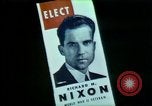
Prior to U.S. Presidential Election of 1968, Richard Nixon recounts his past and tells how he got into politics.
Self-portrait of Richard Nixon aired during his 1968 presidential run against Hubert Humphrey and George Wallace in the United States. An interviewer asks Richard Nixon that how he got into becoming a member of U.S. House of Representatives in 1947. Nixon replies that soon after World War II ended some Whittier Republicans approached him about running for a seat in the United States House of Representatives and he accepted. A picture of Nixon during his campaign in 1946. He says America is a great country because American people are competitive and it does not mean competition in the destructive sense. He considers America a great country in terms of competitive people and says that competitive spirit is a great driving force in any nation. And he says it is the reason why politics appeals to him.
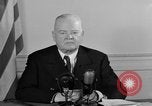
Comments by former President Herbert Hoover, serving as honorary chairman of the Famine Emergency Committee
Former United States President Herbert Hoover seated at a desk and delivering comments for the media. The U.S. flag behind him. The 71 year old Hoover is speaking in his role as honorary chairman of the Famine Emergency Committee, appointed by President Truman after World War II. President Hoover speaks of difficult conditions and suffering of people in post-war Europe and England, but also discusses the balance needed between relief and rehabilitation over the world, and the need to prevent starvation, without putting too much drain on the American economy. He calls for providing only what is needed for "the bare maintenance of human life." He notes how difficult the difficult winter of 1946 has been for all of Europe and the UK.
U.S. Air Force Strategic Air Command aircraft stationed in various parts of the world.
Klaxon horns sound alert signals and U.S. Air Force Strategic Air Command (SAC) flight crews, on alert, stop what they are doing and rush from their quarters to jeeps, that take them to their aircraft. They are seen clambering aboard their bomber aircraft. Closeup of a B-47E-30-LM Stratojet bomber, tail number 52-264, taxiing. Closeup of its wheels. The B-47 taking off from a base in the continental United States. In Alaska, a B-52 bomber taxis on a plowed taxiway in a snowy airfield. Local people watch as two B-52 bombers take off from a SAC base in Africa. Formations of B-52 bomber in flight. View of Air Force personnel inside the SAC headquarters Command and Control Center at Offutt Air Force Base, Nebraska. Scene shifts to a B-47 bomber flying directly overhead and an Atlas missile being launched. Glimpse of pilot and copilot inside the cockpit of a SAC bomber in flight. A nuclear bomb dropping from an open bomb bay viewed from inside the aircraft. An atomic explosion during one of the tests conducted by the United States, in the Pacific, from 1946 to 1958.

Television discussion on WorldNet about the United States support to cause of revolutionaries in United States.
Television discussion about United States- Latin American relations in United States. Frank Carlucci answers the questions of people regarding this topic. Maria C Siccardi presents the show. A question from Mexico City regarding the United States support to cause of revolutionaries. Frank gives the answer. A caller from Mexico again asks a question. Frank responds.
CRITICALPAST.COM: About Us | Contact Us | FAQs - How to Order | License Agreement | My Account | My Lightboxes | Shopping Cart | Advanced Search | Featured Collections | Website Terms & Conditions | Privacy Policy ©2026 CriticalPast LLC.
License Agreement |
Terms & Conditions |
Privacy Policy
©2026 CriticalPast LLC.