


 Francais
 Deutsch
 Italiano
Refine Your Search
New Mexico United States 1946 stock footage and images
- Showing 24325 to 24330 of 30777 results more
more Hide
Hide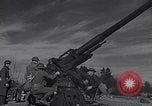
Eddie Rickenbacker, President of Eastern Airlines, hosts Cyrus R. Smith, President of American Airlines, after both airlines acquire DC-3 airplanes
Glimpse of U.S. Army gun crew operating a 3-inch M3 Anti Aircraft gun. Glimpse of 1st Lt Joseph H. Eastman and Captain Eddie Rickenbacker standing beside Rickenbacker's SPAD S.XIII #1 parked in front of a hangar at Foucaucourt Aerodrome, France, 1918. Sequence shifts to 1936, and office of Rickenbacker, now President of Eastern Airlines. A poster on the wall contains memorabilia from the 94th Aero Squadron, with which Rickenbacker flew in World War I. Camera pans over photographes bordering the poster. Next, Rickenbacker is seen conversing with his guest, Cyrus R. Smith, President of American Airlines, as they look at a picture of Rickenbacker and his Spad airplane, signed by numerous pilots who also served with the 94th Aero Squadron. A mounted model of a Douglas DC-3 airplane sits atop a table in the foreground. Rickenbacker and C.R. Smith, both hold onto the DC-3 airplane model as they shake hands. Closeup of the DC-3 model as Rickenbacker rotates it before the camera. (Note: Both Smith and Rickenbacker, presidents of their respective airlines, had mutual admiration for the Douglas DC-3 airliner. In 1934,Smith arranged to purchase 20 new DC-3 airplanes from the Douglas Aircraft Company. American's first DC-3 "Flagship Illinois," had its maiden flight on June 25, 1936. Eastern Airlines took delivery of its first DC-3 in December 1936.)
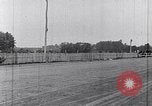
Parade of 1926 model Ford cars, trucks, and buses at a race track
A motorcycle policemen leads a parade of new (1926 models) Ford motor vehicles, on a race track. A long line of Ford cars, trucks, and buses follow slowly on the race track. A man in one of the first vehicles is speaking toward the the camera and spectators, with a large megaphone.
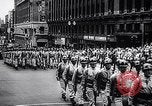
President Harry S Truman marches in parade during a reunion in Omaha; and Truman during 1948 presidential campaign
President Harry S Truman during his mid-Western visit. The 35th Infantry Division troops march on the streets in Omaha, Nebraska. Civilians stand on either sides of the road and cheer. The President's motorcade. President Truman marches with the troops during the reunion. President Truman and Mrs. Bess Truman greet soldiers at the White House. Aerial view of trailer park. President Truman seen signing a bill or documents as three officials stand behind him. During post-war housing boom, a new suburban residential neighborhood housing project in seen under construction. An apartment building also being built. Prices of eggs, meat and cheese are all shown rising at a market produce stand. The President at his desk in the Oval Office. Car drives along street with sign saying: "Veto Hartley-Taft, Slave Labor Bill" (the Taft-Harley bill on labor relations). President holding a document entitled, "Report of President's Committee on Civil Rights." Roman Catholic Bishop Francis J. Haas, a member of the the President's Committee, is seen in his office talking with another person.
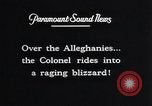
Charles Lindbergh lands an air mail plane in Columbus after the test run from Newark.
Aviator Charles Lindbergh on an inspection tour of the new coast-to-coast express from Newark to Columbus. Lindbergh in the air mail aircraft cockpit as they fly over the Allegheny Mountains. He looks out at the grey clouds as they fly into a raging snow storm. Tree covered mountains. They fly over fields. Aerial views of landmarks in city in Columbus Ohio. View of airfield in Columbus. The plane lands at Columbus, Ohio after the test run. Colonel Lindbergh and his copilot, Robert S. Leroy (Bob Leroy), exit the plane and pose for the camera.
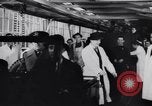
Ford Motor Company delivers first of 1500 jeeps to the U.S. Army in World War II
Opening scene shows U.S. Army Brigadier General Charles H. Bonesteel, Commander of the VI Corps Area, seated in a new jeep with Ford Motor Company President, Edsel Ford, at the wheel in a Ford Motor Company factory in during World War 2. This jeep is the first in an order for 1500 jeeps being delivered by Ford to the U.S. Army. Ford Company executives in business suits, covered by white lab coats are in the background, along with regular factory workers. One executive signals for the jeep to be moved ahead, out of the factory. Next, the film shows jeeps being demonstrated at the Ford Motor testing ground. Army officers and Ford Company executives line a ridge overlooking the test ground as drivers take several jeeps through their paces in demanding circumstances. Scene shifts to Fort Benning, Georgia, where jeeps of the Army's 4th Division are seen driving along a dirt road towing small field artillery pieces. Several are also seen driving (without artillery pieces) through dense woods and other obstacles at the Army base.
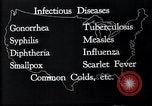
Animated map-exemplifying the route of disease in U.S.
It exemplifies the spread of disease from New-York to California with the help of an animated map of U.S. 1922.
CRITICALPAST.COM: About Us | Contact Us | FAQs - How to Order | License Agreement | My Account | My Lightboxes | Shopping Cart | Advanced Search | Featured Collections | Website Terms & Conditions | Privacy Policy ©2026 CriticalPast LLC.
License Agreement |
Terms & Conditions |
Privacy Policy
©2026 CriticalPast LLC.