


 Francais
 Deutsch
 Italiano
Refine Your Search
New Mexico United States 1946 stock footage and images
- Showing 24643 to 24648 of 30777 results more
more Hide
Hide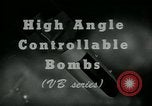
Control system in the tail section of a high angle controllable bomb or Azon Bomb.
High angle controllable bombs or the Azon Bombs (VB-1 and VB-2) of the U.S. Army Air Corps. An Azon Bomb covers aerial route to strike at a target. Azon Bomb kept in a laboratory. Airmen removes the tail section which contains control units. Airman checks the movement of glide controllers in tail section by control unit. Attaching tail to an Azon Bomb placed on a cart. (World War II period).
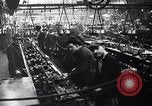
Labor Union movement grows significantly, but labor strife also continues during 1930s in the U.S.A.
Men work assembling transmissions on an automobile production line. John L. Lewis, President of the United Mine Workers Union, giving a speech supporting formation of the Congress of Industrial organizations (CIO). Group of workers gather to listen to a union speaker. Many wear miners hats. Cheering Union workers march in street carrying posters reading: "Long-Live the C.I.O." and "Forward with C.I.O." Leaders of the early C.I.O., Sidney Hillman, President of the Amalgamated Clothing Workers of America (ACWA); Philip Murray, Vice President of the C.I.O.; and John L. Lewis, C.I.O. President, circa 1938. David Dubinsky, President of the International Ladies' Garment Workers' Union (ILGWU); along with Sidney Hillman, and John L. Lewis, are seen mingling with clothing workers. View of a steel mill from workers' residential street on a snowy day. Steel worker in a mill. Deckhand and an engine man aboard a merchant ship. Roustabouts and riggers at an oil well. Nonferris metal miner in rail car. Worker in tire factory. Electrical worker. Union leader speaking to group of workers carrying banner reading: "Shirt workers, Local 128 Allentown, Pennsylvania Joint Board." Labor organizers passing out leaflets to workers leaving a factory. Labor discussions with workers at lunch tables. Draftsman preparing labor organization protest signs calling for "Sanitary Conditions" and "Fair Play." Working women singing a union song. Union workers marching and carrying signs for various causes. Man riding a bicycle displaying sign:"Don't Scab." Car overloaded with people with sign: "Come To Lafollette Labor Rally Monday, July 5, 1937." ACWA workers of Local 95, Atlas Plant. UMWA members of Lafollette, Tennessee. Miners playing cards and playing musical instruments. Miners on strike below in mine for 5 days, cheer leader. Poster encouraging Americans to travel and visit in the USA. Police with batons or billy clubs and military units repel, combat, beat, and arrest striking and protesting workers during labor disputes. Scenes of military uniformed men throwing tear gas grenades into crowds of workers as workers disperse. People assisting injured protesters. Police firing various weapons at protesting workers during labor protests and strikes in San Francisco. U.S. Army soldiers arresting a civilian and throwing tear gas grenades.
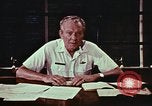
Activities of the U.S. Air Force Security Service to defend against communications intercepts by enemies
A USAF Colonel speaks about the Air Force Security Service. A group of Security Service communications specialists planning a communications security survey. The survey leader is seen discussing results with the a Colonel, the Commander of the unite that was surveyed. Security Service personnel conducting a simulated enemy intelligence gathering effort in a Communications Security Surveillance unit. They employ sophisticated eavesdropping equipment to ferret out potential problems. A mobile van that can be airlifted to anyplace needed. Technicians inside the van, using monitoring equipment to intercept telephone and radio communications. Closeup of Airman wearing headset. Tape decks recording the monitored communications.The Colonel, narrator, describes a monitored communication that revealed details of a planned air strike. He shows and mentions reports of other communications leaks. View of an SR-71 aircraft taking off. Aerial views of it in flight, from various angles. A USAF F-111 aircraft in flight, viewed from various angles. A model of the F-15 fighter plane, and an illustration of the B-1 bomber.
Spring offensive launched by the Chinese forces on UN troops during the Korean War.
Spring offensive during the Korean War. An animated map of Korea shows the position of United Nation forces behind the 38th Parallel. Events and attack from 20th April, 1951 to May 20th 1951. Chinese forces launch a Spring offensive on 23rd April, 1951. Another Red offensive is launched around the Hwachon Reservoir area. United Nation forces are forced back and move towards south. Later they recover some ground around Seoul. Second phase of Spring offensive being launched around Chunchon in the Central sector of Korea. Later the UN forces strengthen their position in Central part of Korea.
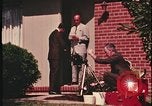
Detective make plaster cast of shoe print at crime scene, FBI lab examines door strike plate and plaster casts.
Police detectives outside home examining crime evidence. Detective with camera on tripod photographs a shoe print. Detectives examine a wooden door. Close up of metal striker plate from door as it is marked by detective as evidence. Close up view hands of forensic expert examining door strike plate. Technician at Tool Marks Unit of the Federal Bureau of Investigation (FBI) laboratory with comparison microscope behind him. Forensic expert notes that "tool mark identifications are similar to the identification of a bullet that has been marked by the barrel of a gun. In both cases, a comparison microscope is used." Forensic expert uses a comparison microscope. Police detectives create a plaster cast of a shoe’s footprint at crime scene. Plaster cast placed in box containing other evidence to be sent to the FBI laboratory. At the FBI Tire and Shoeprint Unit, a tire print cast is displayed. Technician removes shoe print cast from forensic package.
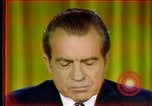
U.S. President Nixon addresses U.S. citizens on the Watergate scandal in Washington DC.
U.S. President Richard Nixon's speech on the Watergate scandal in Washington, DC. The President states that some people will find that the Watergate scandal demonstrates the bankruptcy of American political system, but this is not true. He states that the Watergate issue represents a series of illegal acts and their judgment by people, a system which will bring the guilty to justice and it includes a grand jury, honest prosecutors, courageous Judge John J. Sirica and vigorous free press. The President sates that it is essential to have faith in American judicial system and they should not be distracted to that extent where the vital works get neglected. He states that he will give his complete attention to his office duties irrespective of the case situation. The President expresses his faith in Attorney General Elliot Richardson responsibilities. He mentions about his meeting with the Chancellor of West Germany Willy Brandt which is scheduled the next day. He states that they are preparing for the Soviet American Summit meeting. He talks about the negotiation for mutual and balanced reduction of their forces in Europe in order to reduce the defense budget. U.S. and Soviet negotiators will work on limiting the nuclear arms so as to reduce the danger of nuclear wars. He states that a lot of work has to be done: to maintain peace in southeast Asia, to ensure prosperity, jobs, better life and to control inflation.
CRITICALPAST.COM: About Us | Contact Us | FAQs - How to Order | License Agreement | My Account | My Lightboxes | Shopping Cart | Advanced Search | Featured Collections | Website Terms & Conditions | Privacy Policy ©2026 CriticalPast LLC.
License Agreement |
Terms & Conditions |
Privacy Policy
©2026 CriticalPast LLC.