


 Francais
 Deutsch
 Italiano
Refine Your Search
New Mexico United States 1946 stock footage and images
- Showing 24673 to 24678 of 30777 results more
more Hide
Hide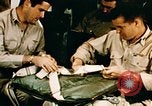
Sailors and crewmen work on weapons and load bombs into aircraft aboard the USS Yorktown in the Pacific.
U.S. Navy documentary highlights functions, duties and crew activities aboard 'The Fighting Lady', pseudonym for the USS Yorktown (CV-10) in the Pacific Theater during the Battle of the Philippine Sea. The carrier advances towards the Mariana Islands. Sailors work on weapons and special devices including magazines, bullets. They work on the bomb line. Sailors prepare the torpedo planes. Aircraft lined on the flight deck. Crewmen arm planes with 500, 1000, and 2000lb bombs, torpedo Iincendiaries, anti-personnel bombs called Daisy Cutters. Sailors pull trolleys with bombs towards the bombers, load the bombs including armor piercing bombs and bombs with delayed action fuses. A crewman pushes new rockets on trolley to be loaded onto the planes. (World War II period).
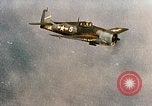
Crippled U.S. Navy bombers and fighters return and land aboard the USS Yorktown near the Mariana Islands in World War 2
'The Fighting Lady', pseudonym for the USS Yorktown (CV-10) in the Pacific Theater during the Battle of the Philippine Sea. The U.S. Assault Force battleships including USS Yorktown, USS Colorado, USS Tennessee and USS Pennsylvania advance towards the Mariana Islands. 'The Fighting Lady' crew watches as crippled U.S. Navy Grumman F6F Hellcat aircraft make landing attempts on their return after bombing the Tinian Island. The Landing Officer signals. Wrecked planes land on the flight deck. The flight deck emergency crew, fire fighters, rescue details and medical foremen rush towards the plane on fire. A torpedo plane on fire lands. Officers and crewmen watch as the emergency crew tries to DOUZE out the fire. Intelligence officers question the pilots in a Ready Room. Radio operators in the Radio Plotting Room send news about approaching Japanese torpedo planes and dive bombers from enemy aircraft carriers. The alarm sounds, crew activity on flight deck, sailors rush to their battle stations. Activity in the engine room and boiler room as USS Yorktown advances on guard. Commander Dixie Kiefer gears himself for action. The ship dog mascot named Scrappy is seen wearing a life jacket.
U.S. Signal Corps officers and soldiers use mine detectors, modern radars, and meteorological equipment during World War II.
The role and contribution of the U.S. Army Signal Corps in combat and war. U.S. shuttle ships loaded with signal communication supplies for U.S. and Allied troops in the European Theater make their way in the Atlantic ocean. The Squier Laboratory at Camp Alfred Vail in Fort Monmouth, New Jersey. A technician works on signal communication equipment in the laboratory. U.S. soldiers use mine detectors in the European Theater during World War II. The mine detectors detect metallic, non-metallic mines, wooden box mines, and mines in glass containers. Artillery soldiers bury large microphones into the ground in advance zones. The microphones relay back information on enemy artillery. Soldiers receive the information on radio sets. U.S. aircraft on a training flight simulating real combat situation: The aircraft lost in heavy rain and rough weather, looking for the location of Boston. The pilot switches on a modern advanced radar. The radar waves pierce thick clouds, are reflected by Earth's surface and display an image on the scope. The image shows the clear location of Boston harbor directly under the aircraft. U.S. bombers attack over the Channel coast on D-Day (6 June, 1944). U.S. soldiers employ meteorological equipment for long range weather forecast in the European Theater during World War II. Soldiers release a hydrogen balloon into the sky. Another soldier uses an apparatus to take readings of atmospheric conditions behind enemy lines. An aircraft drops an automatic weather station called SCM-18-TI by parachute into enemy territory. The timed mechanism sends out weather data in codes. The interior of the automatic weather station lying open in a field.
The invasion of Poland, Dunkirk evacuation, Second Armistice, and London Blitz during World War II.
'50 Years of Cinematography' depicts the role of military and news cameramen during World War II. Germany starts the War. Invasion of Poland in 1939: German Nazi Luftwaffe bombers in flight over Warsaw. Explosions due to the bombardment. Burning and damaged buildings in the war torn city. Civilians amidst rubble and ruins. Soldiers and civilians look at corpses on a sidewalk. A woman with her child cries. A man walks on a street. Dunkirk Evacuation in 1940: Allied troops evacuated from the Dunkirk coast. Allied troops on ships. Smoke rises from a ship under German attack. Soldiers wade through the water towards waiting ships. Burning ships. The Second Armistice at Compiegne after the German victory in the Battle of France, 1940: German troops stand at attention. German Fuhrer Adolf Hitler, President of the Reichstag Hermann Goering, German Field Marshal Wilhelm Keitel and other German officers arrive at the venue. The leaders and officers walk past the soldiers at attention. Hitler gives the Nazi salute. The Blitz, London in 1940-1941: Bomb damaged buildings. Cars and pedestrians amidst ruins and rubble on the streets. A train over a collapsed wall. Civilians in a horse cart. A wrecked bus in a damaged building. Rescue workers among the rubble. Clouds over the city.
British troops fight Italians in Libya; Germany opens Eastern Front Campaign during World War II.
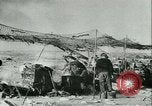
Images taken by military and news cameramen during World War II. The North African Campaign, 1940: Convoy of British tanks, trucks, and infantry advance over the Libyan Desert. British soldiers fire artillery. Masses of Italian prisoners marched by British soldiers. Next shown is campaign on the Eastern Front, 1941, as Germany attacks Russia: Nazi tanks advance under Luftwaffe air cover into the Soviet Union. Aerial view of German Junker Ju 87 aircraft in flight. German tanks and armored vehicles rolling. Wide view of many German tanks rolling east. German soldiers leaping down from a hill with smoke all around as they battle in a Russian town. Russian Pe-2 bomber aircraft in flight. Interior view of pilot and crew in Soviet Pe-2 bomber while in flight. Soviet soldiers on tanks during a battle. Burning tanks. Soviet soldiers run toward battle front and pass a dead German soldier on the battlefield.
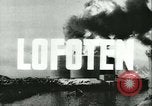
British Commandos raid Lofoten Islands, Spitsbergen Island, and Vaagso Island during World War II.
Pictures taken by military and news cameramen during World War II. Operation Claymore, March 1941: British Commandos raid Lofoten Islands in assault boats. They destroy a fish oil refinery off the coast of Norway. Soldiers and civilians on the docks. Burning refineries and buildings. Clouds of black smoke. 1941: British and Canadian troops on Spitsbergen Island. They destroy Soviet coal mines to prevent the Germans from occupying them. Black smoke clouds due to the explosions. Operation Archery on Vaagso Island, 1941: British Commandos raid the Island. Soldiers walk in the snow. Nazi prisoners surrender and marched by British soldiers. Battle ensues on the Island. Soldiers walk past a fence. Burning buildings in the background.
CRITICALPAST.COM: About Us | Contact Us | FAQs - How to Order | License Agreement | My Account | My Lightboxes | Shopping Cart | Advanced Search | Featured Collections | Website Terms & Conditions | Privacy Policy ©2026 CriticalPast LLC.
License Agreement |
Terms & Conditions |
Privacy Policy
©2026 CriticalPast LLC.