


 Francais
 Deutsch
 Italiano
Refine Your Search
New Mexico United States 1946 stock footage and images
- Showing 25495 to 25500 of 30777 results more
more Hide
Hide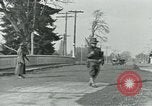
National Guard troops are deployed in streets and at jail where anarchists are held in Centralia, Washington.
Washington State National Guard troops maintain order in Centralia, Washington, following Armistice Day deaths involving the Industrial Workers of the World union (I.W.W.). Soldiers, armed with rifles, patrol a roadway, as cars pass. Armed soldier moves several men from street to sidewalk. Contingent of soldiers march to police station, where they stop and fix bayonets to their rifles. A soldier posted in a vacant lot outside the Centralia jail where 37 anarchists are being held pending trial following the Centralia Massacre. A derelict wagon sits in the lot and a dog sniffs about. A group of men gathers outside building where slate states: " I.W.W.s maintained headquarters and from which they opened murderous fire that resulted in death of four ex-soldiers." (The headquarters was attacked by members of the American Legion during the Armistice Day parade.) Slate states: "Members of the American Legion demolished the headquarters of the anarchists and destroyed their seditious literature." Several men are seen rummaging through papers strewn about in front of the building beside the Roderick Hotel. A final slate quotes statement by Representative Johnson, Chairman of the U.S. Immigration Committee: "The Country must be purged of seditionists and revolutionists, and if this means war, the quicker it is declared the better."
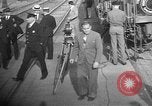
U.S. President Franklin D. Roosevelt speaks to a crowd during his drought inspection trip to Bismarck, North Dakota.
President Roosevelt’s drought inspection trip to Bismarck, North Dakota, during the Great Depression. A motion picture cameraman sets up his camera at a railroad station. Crowd of residents stands by waiting for the President's arrival. A steam locomotive pulling the presidential train arrives at the station. President Roosevelt stands on the rear platform of his train, assisted by his son, Franklin Jr (Franklin D. Roosevelt Jr.), and accompanied by the Governor of North Dakota, Walter Welford, who introduces the President. The President's daughter, Anna, stands at back of the platform. President Roosevelt addresses the crowd and assures them that they will win over problem of drought very soon. He says that plan of cooperation with nature should be worked out. The crowd applauds. The President gives an example of the economic interdependency of the U.S. states, by noting that steel factories in Indiana and other eastern states could not run under full capacity unless the agricultural states bought farm machinery and other equipment from them.
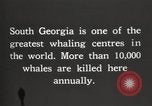
Members of Sir Ernest Henry Shackleton's Antarctic expedition accompany a Norwegian whaling vessel during hunt in waters off South Georgia Island.
Opening slate states that "South Georgia is one of the greatest whaling centers in the World." It notes that more than 10 thousand are taken annually. View from a whaling vessel of a pod breaking the surface of the water. Flocks of birds follow them closely. Slate states that "A whaling trip was a delightful experience for the crew. (This alludes to members of the Shackelton Antarctic expedition who are aboard the whaler for the experience.) Slate states, "The gunner stands on a forward platform to direct the movements of the boat." View of the gunner in the ship's bow. Next, he is seen manning a harpoon gun and directing the ship''s movement. Slate reads: "The harpoon hits the bulls eye and away goes the whale under water at a terrific speed." View of heavy line in the rigging that is attached to the harpoon. (Slate says it is a quarter of a mile in length.) View of the whale being hoisted aboard the ship by its flukes. Whaling crew members use wooden poles with harpoon points to maneuver the whale. The whale is tagged with a Norwegian flag and released. Another view of the gunner in the ship's bow preparing to harpoon another whale. He fires the harpoon gun, twice, at this whale. Closeup of the whale next to the ship's starboard side, where crew members are retrieving it with a line.
President Harry S Truman awards Congressional Medals of Honor at the White House to Carl Sitter and Reginald Myers
President Harry S Truman awards Congressional Medals of Honor at the White House in Washington DC. A gathering at the White House. Officials and awardees with their families. The recipients are Marine Captain Carl Sitter (standing left of the President when all three men are together) and Reginald Myers (standing right of the President). The President awards the Medal of Honor to each of the two officers. The officers shake hands and pose with the President. Officers with their families after receiving the Medals. Sitter holding his son and pictured with his wife. Myers' wife, Margaret, and daughter, Susan, and son, Scott. Myers holding his son, Scott. Major Myers was awarded the Congressional Medal of Honor while serving as Executive Officer, 3rd Battalion, 1st Marines, in the vicinity of HAGARU-RI, KOREA, November 29, 1950, while commanding a group of 80 men who were stragglers and missing from other units during the Korean War. Major Myers' makeshift unit successfully denied the Chinese Communists the possession of EAST HILL, which dominated the key crossroads in the withdrawal -- attack in another direction -- by U.S. Marines and Army units from the Chosin Reservoir. Captain Sitter's unit relieved Major Myers' unit in the same battle. Sitter received e medal for his actions as a commanding officer during a two-day battle at Hagaru-Ki, Korea in November 1950. The fighting lasted 36 hours, and Sitter endured grenade burns to his face, arms and chest. He refused to evacuate as the fight continued. More than half of his company was killed, wounded or captured, but a successful defense of the area was mounted by U.S. soldiers.
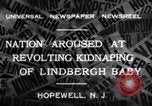
Newsreel 'Nation aroused at revolting kidnapping of Lindbergh Baby, Hopewell N.J'
Message telling about the kidnapping of Lindbergh Baby. State troopers search in adjacent woods for the baby. Clues and evidence are sought during the search for the infant. Suspects are questioned and autos are inspected. Recording of the baby seen. Ladder which was used for the kidnapping and footprint of kidnapper seen. Parents of the kidnapped baby seen. Message received from the kidnapper.
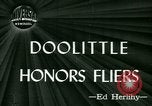
General Doolittle and General Spaatz honor the USAAF389th Bombardment Group for completing 200 heavy bombardment missions during World War II in Europe
Ceremony honoring the USAAF 389th Bombardment Group, on completion of 200 missions in the European theater during World War 2. U.S. Lieutenant Generals Carl A. Spatz, Commander of the U.S. Strategic Air Forces in Europe, and James Doolittle, who is about to assume command the 8th Air Force, stand together with officers representing several World War 2 Allied nations. A large formation of B-24 Liberator bombers flies overhead. Closeup of two soldiers looking up at the formation. Aerial view of the B-24 formation, from an accompanying aircraft. A color guard with the American flag. Representatives of various Bombardment Squadrons stand holding their unit flags. General Doolittle makes brief remarks on the merits of the 389th Group, which draw chuckles from the audience, including a smiling Soviet officer, Standing to the far left in the picture, behind Doolittle. (He has been identified as Major Timofey Samarin, assigned as Air Force assistant to the Soviet Ambassador, and also as Military Attache to the United Kingdom.)
CRITICALPAST.COM: About Us | Contact Us | FAQs - How to Order | License Agreement | My Account | My Lightboxes | Shopping Cart | Advanced Search | Featured Collections | Website Terms & Conditions | Privacy Policy ©2026 CriticalPast LLC.
License Agreement |
Terms & Conditions |
Privacy Policy
©2026 CriticalPast LLC.