


 Francais
 Deutsch
 Italiano
Refine Your Search
New Mexico United States 1946 stock footage and images
- Showing 25501 to 25506 of 30777 results more
more Hide
Hide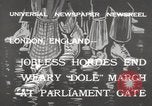
Unemployed people march on the roads to London, England.
Unemployed men and women from Scotland, Wales, Midlands and the South march to London during the Great Depression. Signs seen include, 'Scotland vs. London,' 'National Hunger March,' 'Revolutionary United Mineworkers of Scotland,' and 'We are Against Starvation.' Slate at head of film reads, 'Jobless Hordes End Weary Dole March at Parliament Gate.' Sign in background within village reads, 'The Castle Restaurant.' Research suggests this is the The Castle Restaurant on Norwich Road, Caister-on-Sea, Great Yarmouth Norfolk, NR30 5JN This section of film ends with views of Parliament Building and Clock Tower in London. (Background to the next section of film: In Ireland a so-called Outdoor Relief Strike, supported by the Falls and the Shankhill united, Catholics and Protestants, was launched by the unemployed of Belfast. On Oct 3, 1932, 60 thousand attended a torchlight meeting at the Customs House in Belfast Ireland, to protest relief levels. Sporadic looting and rioting ensued in the following days and more mass demonstrations were planned for Oct 11th.) Film picks up on Wednesday October 5, 1932 as the Royal Ulster Constabulary (RUC) attempt to maintain order. A series of street scenes is shown in which the RUC has begun patrolling. Officers are seen patrolling in Lancia armored car No. 105, with a machine gunner on top. Another Lancia armored car (No. 33) patrols near a park at the corner of Stage Street, Belfast. Boys are seen running across cobblestone streets where they have piled up stones for use in rioting. An RUC Crossly tender truck, carrying several police officers, drives along a Belfast street. View of an empty street where piles of stones and slates obstruct the roadway. Pedestrians appear to be going about their daily affairs as usual. (The primary mischief makers seem to be youths.) Final scene is that of a funeral. (In the course of the week's troubles, two of the rioters were shot dead by the RUC.) A horse-drawn hearse carries at least one. But behind it is a group of pallbearers also carrying a coffin. The street behind is filled with masses of mourners.
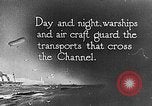
British warships protecting shipping and convoys in the English Channel during World War I
British Royal Navy efforts to protect shipping and convoys in the English Channel during World War 1. Boats are seen behind a breakwater on coast in United Kingdom, during World War 1. A British two-stacker I- class destroyer underway with black smoke pouring from its funnels. British soldiers with weapons and personal gear at a rail yard, with train in background. They descend stairs to a pier and board a crowded troop ferry ship. Two troop ferries underway in the English Channel. View of the British Monitor ship, "Marshal Soult" mounting two 15-inch guns. British soldiers loaded aboard two troop ships departing the United Kingdom (one is a side-wheeler). Women on the pier waving goodbye. A British gunboat underway. View from stern of a boat putting out a good wake. A dirigible low over the water and a steaming warship seen in background. Workmen marching across the mole protecting the German submarine (U-boat) base at Zeebrugge, Belgium (Slate says before it was blown up by the British). (World War I; World War 1; WWI; WW1)
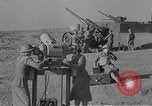
Women of British Auxiliary Territorial Service operate kinetheodolite and march
British women of the Auxiliary Territorial Service (A.T.S.) engaged with coastal artillery unit. Two women are operating a Kinetheodolite, next to a woman communicating on a field telephone. Antiaircraft guns and crews are in position beind them. An obsolete biwing aircraft is catapulted out over the water as a practice target for the shore battery, which commences firing. A contingent of women (ATS) marching on a road, followed by regular British soldiers. Officers review the marching units as they pass. (World War II period).
Retired famous Marine Corps horse, Sergeant Reckless, decorated for combat service during the Korean War.
Camera from hilltop, pans over an outdoor corral and collection of buildings (some quonset style) at U.S. Marine Corps Camp Pendleton, California. In the middle background, what appears to be a firing range, can be seen. Other buildings sit atop hills in the far background. Scene shifts to close view of a chestnut mare, in a private stable. A sign on the gate reads "Reckless." The mare wears a blanket displaying a staff sergeant's stripes and service ribbons. The words "Sgt. Reckless 1st Mar. Div." also appear on it. Sgt. Reckless is contentedly eating from a trough of hay set up in the pen. Closeup of her horse blanket. (Note: Sgt. Reckless is seen here in retirement. She was bought by U.S. Marines in Korea, in 1952, during the Korean war, and trained to be a pack horse for the Recoilless Rifle Platoon, Anti-Tank Company, 5th Marine Regiment, 1st Marine Division. Her decorations include: Purple Heart w/ 1 award star; Navy Presidential Unit Citation w/ 1 service star; Navy Unit Commendation; Marine Corps Good Conduct Medal; National Defense Service Medal; Korean Service Medal w/ 3 bronze service stars; Korean Presidential Unit Citation; United Nations Korea Medal; and French Fourragère. Sergeant Reckless died in 1968.)
President Poincaré reviews Polish Regiments raised in France, during World War I.
President Poincaré and other officials attend the official commissioning of Polish Regiments (Blue Army) raised in France, during World War 1. Polish troops stand in formation with their respective unit colors. A Catholic Priest blesses the Polish units and sprinkles holy water. (Some falls on a small dog standing nearby, causing it to move away.) Polish Commanders of the units stand in center of a field and raise their hands in sign of allegiance, and troops do the same . Officials walk on the field. Polish Soldiers lower their flags, in salute, as they pass. Mounted Polish artillery units, followed by cavalry, pass in review before the President and officials.
North Korea invades South Korea.
Invasion of South Korea. The 38th Parallel and the North Korean invasion of South Korea after crossing the parallel. Soldiers in trenches fire rifles. General Douglas MacArthur arrives in South Korea to counter the aggression of North Korea. Artillery fired and an injured soldier given blood plasma. Dead soldiers buried and other soldiers pray at the burial. Canadian soldiers and soldiers from other countries leave for Korea War under the flagship of the United Nations. The United Nations soldiers bid adieu to their dear ones. Soldiers make an amphibious landing and move inland in trucks. Soldiers move along the Manchurian border. Planes drop bombs and smoke rises. The Chinese Army attacks the United Nation forces and they are forced to retreat. The United Nation forces move ahead under extreme climatic conditions. (Korean War)
CRITICALPAST.COM: About Us | Contact Us | FAQs - How to Order | License Agreement | My Account | My Lightboxes | Shopping Cart | Advanced Search | Featured Collections | Website Terms & Conditions | Privacy Policy ©2026 CriticalPast LLC.
License Agreement |
Terms & Conditions |
Privacy Policy
©2026 CriticalPast LLC.