


 Francais
 Deutsch
 Italiano
Refine Your Search
New Mexico United States 1946 stock footage and images
- Showing 25549 to 25554 of 30777 results more
more Hide
Hide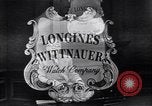
Petroleum Advisor Max W Thornburg talks with Henry Hazlitt and William Bradford Huie in Longines Chronoscope.
Host Frank Knight speaks in a television program Longines Chronoscope. Max W Thornburg, Petroleum Adviser, Department of State, interviewed by Henry Hazlitt and William Bradford Huie. Thornburg talks about his experience in the Middle East oil industry and credentials as Petroleum Adviser, causes of the oil nationalization crisis in Iran and British interference in Iranian politics. Further he speaks about failure of effective Anglo-Iranian oil policy, and lack of U.S. corporate initiatives in developing realistic oil agreements in the Middle East.
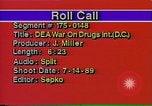
An interview on Drug Enforcement Administration's War on Drugs
A film titled 'Roll Call' with subtitle 'DEA War on Drugs Int. (D.C.) '. A correspondent from LETN office interviews Terrance Burke, Deputy Assistant Administrator for operations of Drug Enforcement Administration (DEA) in terms of, War on drugs in front of The State Capitol.
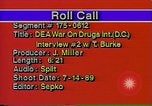
An interview about the Drug Enforcement Administration's War on Drugs.
A film titled 'Roll Call'. A correspondent from LETN office interviews Terrance Burke, Deputy Assistant Administrator for operations of Drug Enforcement Administration (DEA) in front of The State Capitol. The interview focuses on the Administration's War on Drugs.
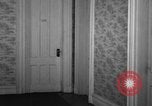
John Lomax and Lead Belly reenact events from their relationship. Lead Belly released from prison asks to work for Lomax
Lead Belly (Huddie William Ledbetter) and John Lomax reenact scenes from the past in their relationship. Lead Belly walks down a hall and knocks before he enters a room carrying a guitar. Lomax is working at a typewriter. He is coached regarding his lines. There is a knock on the door and Lomax says "come in." Lomax is coached some more about his lines. Scene shifts. Knock at door, and Lead Belly enters, saying "Boss, here I is." He states that the Governor pardoned him because Lomax sent him a recording of his songs, and he asks Lomax to employ him for life. Lomax declines, calling Lead Belly "a mean boy" because he killed two men. Lead Belly claims that he has changed and promises to be his driver and to sing for him. Lomax hires him.
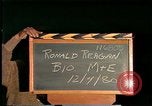
A film sketch about U.S. President Ronald Reagan and tracing his personal history and career leading to the Presidency in the 1980 election.
Opening scene shows U.S. President Ronald Reagan holding a little girl, and then standing with officials and Secret Service agents, as he prepares to enter a car. Closeup of him smiling. Closeup of President Reagan signing his autograph for spectators in a crowd. Next, Reagan and his wife Nancy are seen on November 4, 1980 waving to supporters at the Century Plaza Hotel, celebrating his election victory as the 40th U.S. President. The President elect says a few words of thanks to them. Views of the crowd cheering. Adopted son, Michael Reagan holds his son Cameron as he and his wife, Colleen Reagan, join Ronald and Nancy Reagan on the stage, followed by daughter Patricia Reagan and son Ron Reagan. The crowd cheers the President elect and his family. At this point the film begins showing images about Ronald Regan's life, starting with baby pictures; his parents; Tampico, Illinois, where he was born; Dixon, where he is seen in a school picture and with boyhood friends. A photograph of "Dutch" Reagan President of his High School Class. Reagan in photo with other members of the Eureka College football team, in Eureka, Illinois. The seal of the college. Pictures of Reagan with college classmates and teammates. Reagan posing in bathing suit when he was swimming team coach. Young Reagan, after graduation, as a sports announcer, sitting at a microphone labeled: "WHO" in Davenport, Iowa. The broadcasting tower of that radio station. A Track and field event taking place. Reagan posing with a pipe in his mouth, at the WHO radio station in Des Moines, Iowa. A baseball game in progress before a full stadium of spectators. In 1937, a Chicago baseball team is seen boarding a ship to a Spring training camp in California. (Narrator states Reagan accompanied them.) Aerial view of buildings at the First National Studios (home of Warner Brothers) in Hollywood. Ronald and Nancy Reagan, circa 1952, being applauded at a gathering when he was President of the Screen Actors Guild. Views of Reagan in U.S. Army uniform. A U.S. Army C-47 aircraft taking off from a field under attack, with fires burning and smoke rising (possibly during Japanese December 7, 1941 attack on installations in Pearl Harbor, Hawaii). U.S. Airmen standing on a ramp next to a Douglas C-47B-1-DL transport aircraft (tail number: 43-16145). What appears to be a ViP version of a B-50 aircraft parked on a ramp with an honor guard at the stairway. Ronald Reagan, in uniform, signing up for active duty. Later, Captain Reagan, U.S. Army Air Forces, is seen with other uniformed men at a gathering in Warner Brothers studios. The entrance of Paramount Pictures studios in Hollywood. A large group of studio employees walking between buildings. Reagan speaking, as President, of the Screen Actors Guild, at an outdoor gathering. Actor Robert Young and film industry executives stand nearby. Reagan, as Chairman of the Motion Picture Industry Council, addresses a dinner gathering of that organization. He is also seen testifying before he House Committee on Un-American activities Committee (HUAC) on October 23, 1947.
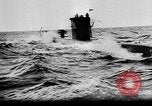
Period before U.S. formal entry into World War II. German submarines torpedo American ships and Japanese attack Pearl Harbor
Preface to U.S. in World War 2. German U-boat on surface. Crew climbing down into submarine and at duty stations while submerged. Torpedo trails bubbles underwater. Ship hit and explodes. Newspaper headlines report torpedoing of American ships: SS Robin Moor, SS Lehigh, SS Sessa, SS Steelfarer, and SS Montana, by German U-boats. Secretary of War, Henry L. Stimson calls on U.S. Navy to secure sea lanes. Wendell Wilkie agrees. U.S. Congress repeals Neutrality Act, November 17, 1941. Deck guns being placed on U.S. Merchantmen. Japanese warships docked and troops entering Indochina, as local people watch.Japanese troops by Dong Dang, near Chinese border. Situation described by animated illustrations.Japanese Special Envoy, Saburo Kurusu, is dispatched to Washington. Pan American Boeing 314 flying boat taking off. Japanese Naval Task Force of warships underway. Kurusu arriving in San Francisco, on November 14, 1941. He steps from the aircraft and makes statement to reporters. Japanese Ambassador, Kichisaburo Nomura, and Special Envoy Kurusu escorted into the White House by Secretary of State Cordell Hull, on November 17, 1941. Japanese troops in China bombarding Chinese city with artillery. November 26, 1941, View of Executive Office Building with statue of Victory atop U.S. Army First Division Monument. Secretary Hull announcing proposal to Japan.The Japanese representatives leaving the White House. Japanese aircraft carriers steaming toward Pearl Harbor. Japanese flight crews getting briefed on December 7,1941. Nakajima B5N (Kate) torpedo bombers taking off and in formation. Secretary Hull at his desk. The aloha tower and aerial view of Honolulu. Sailors at outdoor Sunday service, and relaxing at Pearl Harbor. Vehicle entering Hickam Field. Japanese airplanes bombing Pearl Harbor. Explosions on U.S. warships. USS Arizona (BB-39) suffers direct hit and explosion, as filmed from the deck of U.S. Navy Hospital Ship, USS Solace (AH-5). Shots of pilots and point of view from pilots inside Japanese bomber and attack aircraft, through a mix of dramatized segments from Japanese propaganda films about the Pearl Harbor attack, and real footage from the Pearl Harbor attack. View from Japanese planes bombing and strafing Ford Island. U.S. sailors firing antiaircraft and machine guns down Japanese planes. Secretary Hull describes memorandum from Japanese.
CRITICALPAST.COM: About Us | Contact Us | FAQs - How to Order | License Agreement | My Account | My Lightboxes | Shopping Cart | Advanced Search | Featured Collections | Website Terms & Conditions | Privacy Policy ©2026 CriticalPast LLC.
License Agreement |
Terms & Conditions |
Privacy Policy
©2026 CriticalPast LLC.