


 Francais
 Deutsch
 Italiano
Refine Your Search
New Mexico United States 1946 stock footage and images
- Showing 25663 to 25668 of 30777 results more
more Hide
Hide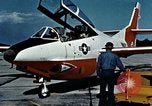
Air impingement and pre taxi check of a U.S. Navy T2J-1 Buckeye trainer aircraft.
Pre-flight inspection and pre taxi check of a U.S. Navy T2J-1 Buckeye trainer aircraft. The plane captain near the plane. Pilot in cockpit. The pilot gives the thumbs up plug in signal for air impingement. The captain takes the hose and attaches it to the plane. He checks the starting unit and returns the thumbs up signal when ready. The pilot checks and adjusts the fuel shut off valve, engine master switch, engine start switch, tachometers, advance power control lever, and the oil pressure gauge. He gives the captain the unplug signal. The captain removes the hose. The pilot now performs the pre-taxi check: radio equipment, captain removes the 3 landing gear safety pins, flaps extended, speed brakes opened, take off trim, circuit breakers and the altometer. He then conducts the inverter check, operates controls to check freedom of movement, retracts flaps and speed brakes, and closes the canopy. He calls for taxi clearance, gives the captain the signal, adjusts friction on power and control lever. The captain gives clearance, the pilot releases brakes and taxis maintaining steady speed. He completes the take off checklist before getting onto the duty runway. Receives clearance, aligns the plane and taxis. He checks the exhaust gas temperature, rpm, fuel flow and oil pressure. Raises nose of the plane off ground, raises landing gear when airborne, raises flaps, levels off and accelerates.
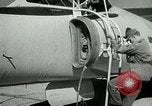
Pre-flight inspection of the U.S. Air Force F-102A Delta Dagger interceptor aircraft.
Pre-flight inspection of the U.S. Air Force F-102A Delta Dagger interceptor aircraft. The crew chief checks the air intake surfaces, nose boom, dome and holes in the tip. He inspects the forward electronic compartment, fluid tank, filler cap and access door. He checks the landing gear including tires, nose steering unit, taxi light and nose gear door. Inspection of the battery, ground safety pins, circuit breaker panel, armament door, turbine blades, hydraulic reservoirs and gauges. Inspection of the wing surfaces, wing tips and position light. The tail inspection includes the skin, navigation light, vertical stabilizer and rudder, speed brake area, tail pipe nozzle and drag chute area. The crew chief climbs onto the plane and inspects the upper surface, dorsal fin, fuselage panels, fuel intake covers and the fuse. He then climbs back down.
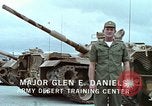
U.S. troops, armored vehicles, tanks and helicopters transported by U.S. Air Force Military Airlift Command aircraft.
Major Glen E Daniels of the Army Desert Training Centre in California. He stands in front of U.S. tanks and talks about movement of large units to combat zones by C-5 Galaxy aircraft of the U.S. Air Force Military Airlift Command. Soldiers load Cobra helicopters into a C-5. MAC C-5 Galaxy aircraft Interior of a C-5 showing two rows of M113 armored personnel carriers stowed inside. The troops accompanying them are seen climbing stairs to an upper deck of the C-5 where they will travel. Quick closeup view of a C-5 headed toward the camera during landing. Paratroopers jumping from MAC C-141 and C-130 aircraft. First Sergeant William Lawrence Jr, of the U.S. Army 82nd Airborne Division, stands in front of a camouflaged C-130 aircraft and talks about his experience in 20 years of parachute jumping. He extols MAC's efficiency in transporting paratroopers and comments on resulting improvement of drop zone times.
How the Civil Reserve Air Fleet, contract carriers, and U.S. Reserve and National Guard augment active U.S. military airlift capability.
Views of civilian airlines and examples of how they and U.S. Air Force Reserve and National Guard aircraft augment the active U.S. military airlift Command capability in time of emergency. Civilian narrator speaks from inside the U.S. Air Force Military Airlift Command (MAC) Headquarters Command Center, at Scott Air Force Base, Illinois. Next scene shows U.S. commercial airline passenger airplanes parked on a ramp. United Airlines, Delta Airlines, American Airlines, and Pan American aircraft are seen, some taxi, some parked, some taking off. A Boeing 727 jet taxis on the ramp. A Western Airlines 727 taxis behind a set of baggage carts being pulled by a tractor. The Narrator is discussing the Civil Reserve Air Fleet (CRAF) to which most U.S. airlines belong, and which can be activated by the Secretary of Defense, for airlift support in the event of a national defense emergency. The Western 727 aircraft takes off. A TWA 727 aircraft takes off. U.S. military personnel and dependent women and children are seen descending a stairway from a commercial airliner contracted by the Department of Defense. Military supplies are seen being offloaded by U.S. Airmen, onto a traveling cargo carrier, from a Flying Tigers Boeing 707 aircraft. Refugees from Southeast Asia are gathered and processed at an airport and then board an American Airlines Boeing 747 aircraft. Refugees from Vietnam and Cambodia boarding an Overseas National Airways Boeing 747. An American Airlines 747 taking off. A glimpse of the narrator in MAC headquarters, at Scott Air Force Base, is followed by a mix of private and military aircraft on a parking ramp, including a, presumably privately owned, Japanese Nakajima B5N Navy Type 97 Carrier Attack Bomber (Kate) with Japanese markings. U.S.Air National Guard C-130 and C-123 aircraft are seen taxiing, and taking off from this civilian airfield.
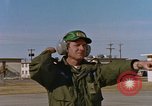
AF pilot narrator explains ground handling operations of C-5 Aircraft.
Pilot narrator explains ground handling operations of C-5 Aircraft. Ground crewman gives hand signals as aircraft turns. Crew member disembarks from the aircraft and hooks up communications wire. Airmen wearing ear protection place safety pins in landing gear and chock the wheels. Board reads 'Warning Stand clear APU Exhaust'. Narrator warns of noise hazard from sounds of engines,and auxiliary power units running at same time. Ground crewman attaches static ground wire from aircraft to fixture on tarmac.
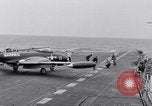
Deck crews aboard a U.S. Aircraft Carrier handle aircraft and prepare them for catapulting.
U.S. Marine Corps McDonnell F2H Banshee jet airplane being guided by a Yellow shirt. Scene shifts to animated diagrams interspersed with actual pictures. They show narrower tires used on jets giving lower braking friction and less lateral stability. One is shown in sketch, being blown over by jet blast. Sketch illustrates jet intake suction and reward blast. Deck crewman removing loose tools from pockets and fastening chin strap and goggles on his helmet, to avoid loose items being sucked up or blown about on deck and protect himself from jet blast. A Marine Corps Captain, pilot, climbs aboard his F2H airplane and deck crewman moves out of line of fire from plane's weapons. Next, a Navy F2H of Attack Squadron 12 (VA-12), Carrier Wing One (Tail code "T") is seen being readied to depart. Deck crew has already pulled the duct covers and pilot is in the cockpit. A 3-wheeled starting "jeep" containing an auxiliary power unit provides power for engine start and then pulls away. Fire fighter standing by in protective gear is seen. Deck crew pull chocks and aircraft taxis guided by yellow shirt who gives signals to spread wings and lower flaps. Yellow shirts guide jets to catapults for takeoff. Yellow shirt Plane Director uses various hand signals to guide pilot. Deck crew scramble underneath the aircraft an set it on the catapult.
CRITICALPAST.COM: About Us | Contact Us | FAQs - How to Order | License Agreement | My Account | My Lightboxes | Shopping Cart | Advanced Search | Featured Collections | Website Terms & Conditions | Privacy Policy ©2026 CriticalPast LLC.
License Agreement |
Terms & Conditions |
Privacy Policy
©2026 CriticalPast LLC.