


 Francais
 Deutsch
 Italiano
Refine Your Search
New Mexico United States 1946 stock footage and images
- Showing 26185 to 26190 of 30777 results more
more Hide
Hide
Korean hardships under Japanese occupation and official Japanese annexation of Korea in 1910
Korean propaganda film depicting Japanese involvement in Korea, from end of Russo-Japanese war through post annexation in 1910. Landscape scenes of Korea. A 4-stacker Japanese troop ship, in a Korean harbor, flying the rising sun flag. Japanese troops disembarking, and marching off the pier. Japanese atrocities committed against the Korean people. Still pictures of Japanese officers. Slate highlights August 10, 1910, the date that Japan officially annexed Korea. Images show Korean flag being replaced by that of Japan. Panning views over rooftops of residential neighborhood and buildings in Nam San Dong, Seoul. Scene shifts to poorer rural area village with straw-roofed huts. Men till rice fields and irrigate fields by manpower alone. Views of various farm crops in the fields. Women are seen harvesting crops. In village, peasants thresh grains by hand. Officials arrive to weigh and take rice from village.Narrator states that the Japanese were everywhere and treated the Korean people very badly.Burlap bags of grain piled on cart. Korean workers load farm products for shipment to Japan. Various cargoes of Korean products being moved by rail to ports for shipment to Japan. Korean women and some children at work in fabric mills. Korean men at work in smelting plant. Many Korean men laboring on rock piles, and carrying heavy logs. One man collapses. Another collapses while working in surface mining. Supervisor chases others who try to assist him. (Note:This film, which contains some very old historic footage, is attributed to the War Department Military Intelligence Division, and was probably produced circa 1940. It is listed as 1910 because Japanese annexation and related events are included herein.)
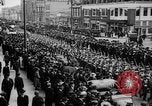
World War I military equipment and troops parade during Liberty Bond Drive in Richmond, Virginia.
Liberty Loan bond drive parade in Richmond, Virginia, during World War 1. The parade uses half the street with traffic moving on the other half. Spectators line the center of the roadway as well as the sidewalk. Military cadets parade followed by U.S. army soldiers with military equipment from the "Liberty Loan Train." A Holt tractor pulls a heavy artillery piece followed by a small contingent of soldiers. They are followed by two Holt tractors and a mobile searchlight. Several army trucks bring up the rear of the parade. Confederate Civil War veterans wave with their canes as the parade passes.Military cadets of the Virginia Military Institute (VMI) parade The two Holt tractors perform circular spins as they approach the edge of the Capitol grounds. The State capitol building is in the background. An equestrian statue and monument is prominent on the capitol grounds. It depicts George Washington, surrounded by smaller statues of Revolutionary era figures: Andrew Lewis, Patrick Henry, George Mason, Thomas Jefferson, Thomas Nelson and John Marshall. A long line of army trucks brings up the rear of the parade.
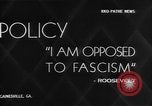
President Franklin D Roosevelt advocates for higher wages and compares feudalism with fascism during a speech in Gainesville, Georgia.
President Franklin D Roosevelt addresses a large gathering in Gainesville, Georgia. He expresses concern regarding the poor economic condition of southern states during the Great Depression and advocates for higher wages and against a system like feudalism. He says the problems are caused by selfishness on the part of a few, leaving one third of the nation ill fed, ill clad, and ill housed. He says "Georgia and the lower south may just as well face facts." He says most wage earners get wages that are far too low, and that "there is little difference between the feudal system and the fascist system" and that he is opposed to both.A large number of people gathered outside a building as they listen to the President.
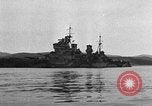
Atlantic Conference scenes: Prime Minister Winston Churchill and Sir Alexander Cadogan aboard the HMS Prince of Wales.
Atlantic conference during World War II. Views of the British Battleship, HMS Prince of Wales, anchored in Placentia Bay, off Argentia, Newfoundland. Views from the U.S. Cruiser, USS Augusta, as it approaches the Prince of Wales. World War 2 British sailors aboard the British Battleship, handle lines to hold the two ships close together. View of Prime Minister Churchill and Sir Alexander Cadogan, Permanent Under Secretary of State for Foreign Affairs, returning to the Prince of Wales. The weather is rainy.

President Roosevelt visits the Royal Gorge in Pueblo, Colorado.
A large crowd gathers at a station in Pueblo, Colorado to welcome President Roosevelt during his visit to the state. Aerial view of the train passing through the Royal Gorge. Roosevelt looks at the Gorge.
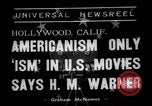
Hollywood studio mogul Harold Morris Warner delivers a speech in Hollywood, California.
Events prior to World War II. Harold Morris Warner during a speech in Hollywood, California. Harry Warner (of Warner Brothers fame) states that Hollywood is against communism, fascism or any other ism. He says that it is only dedicated to Americanism. He highlights the role played by motion pictures in promoting American way of life.
CRITICALPAST.COM: About Us | Contact Us | FAQs - How to Order | License Agreement | My Account | My Lightboxes | Shopping Cart | Advanced Search | Featured Collections | Website Terms & Conditions | Privacy Policy ©2026 CriticalPast LLC.
License Agreement |
Terms & Conditions |
Privacy Policy
©2026 CriticalPast LLC.