


 Francais
 Deutsch
 Italiano
Refine Your Search
New Mexico United States 1946 stock footage and images
- Showing 2659 to 2664 of 30776 results more
more Hide
Hide
German Operation Barbarossa on the Eastern front in World War II.
View of the city, Pskov, on the Veilakaya river. A steel bridge is seen and city across it with smoke rising. German troops march in loose formation over a bridge in Novogorod. Views of German camouflaged tank (with shrubbery) and other armor and troops entering Soviet cities of Brest-litovsk, Minsk, Mogilev, and Vitebsk. View of German Panzer III tank heading toward the camera as it enters a narrow street in Smolensk. Animated map shows progress of these German advances and highlights German forces under German Field Marshal Gerd Von Runstedt cutting deep into the Ukraine. Headline on Chicago Daily News reads: "Nazis Claim Knock-out Victory" with subtitle line reading,"Moscow line cracks." Other newspapers reflect conviction that Soviet forces face imminent defeat by Germany. Slate shows communique issued by the German High Command, stating: "The issue in the East has already been settled. Smolensk is the last halt on the road to Moscow." More views of marching German troops. A battery of Soviet artillery firing from a snow-covered field. Animated map shows German forces moving close to Moscow. Foreign diplomats are moved from Moscow to the city of Kuibyshev. Hitler speaking on October 3, 1941, saying "This enemy is broken and will never rise again." Animated map depicts 500 thousand square miles of Soviet territory occupied by December, 1941, and compares it to the entire west central United States encompassing the states of : South Dakota, Iowa, Nebraska, Kansas, Missouri, and Oklahoma. Fires raging in agricultural area of the Soviet Union. Destroyed Soviet industrial plants, and huge numbers of Soviet citizens under German occupation. Views of destroyed Soviet armor, aircraft and artillery pieces. As season changes, German forces are seen in rain gear moving slowly through cold rainy weather. Some walk beside horses and other ride on horse-drawn caissons along with artillery pieces. Segments of film show contrast between the German military strategies. The German forces would plunge deep into enemy territory and create an area of conquest. This is illustrated by a slate bearing Adolf Hitler's statement that, "A single blow must destroy the enemy, without regard for losses, a gigantic destroying blow." An animated map illustrates the success of this approach by the Germans in Poland, France, and the Balkans. German Generals seen planning the same "Blitz" strategy against the Soviets. Film shifts to the Soviet strategy, showing their idea of building stronger defense, as they fall back, taking advantage of the great size of their territory. Views of Soviet troops on the move. View of Shells knocking out a German tanks. Panzer III tanks advancing. Panzer VI tanks completely covered by German troops catching rides. Soviet field artillery and machine guns firing in cities, forcing German soldiers to leave their vehicles. Soviet cities bombed out and burning, with debris and obstacles limiting the ability of armor to navigate in them. Montage of battle scenes cities of Rostov, Kharkov, Kiev, Kursk, Smolensk, all thwarting the Nazi blitz into the Soviet Union. Battles being waged in cities. (World War II; WW II; World War 2; World War Two)
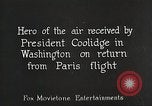
U.S. President Calvin Coolidge presents the Distinguished Flying Cross to Charles Lindbergh in Washington D.C.
American aviator Colonel Charles Lindbergh's flight from New York to Paris. Colonel Lindbergh returns to the United States after completing his flight on June 11. A large crowd gathers in Washington D.C. to greet him. U.S. President Calvin Coolidge arrives at the ceremony to welcome him. President arrives at the podium. Crowd applauding. He addresses the people and speaks about the flight of the aviator. He talks about the history of airplanes and their flight. He states that the airplanes were first used for the purpose of transportation of passengers and for national defense. They had a limited flying radius in the beginning. But now the area has been extended. He states about the historic flights of many U.S. Navy personnels. Then he talks about another historic flight of Lindbergh and bestows the Distinguished Flying Cross upon him. People cheer and applaud as he makes the announcement. Lindbergh arrives at the podium and being greeted by the cheering crowd.
German Operation Barbarossa invasion of the Soviet Union is successful at first but then fails to defeat the Soviets
German forces overrunning Soviet cities and towns during Operation Barbarossa of World War II. View of the city, Pskov, on the Veilakaya river. A steel bridge is seen and city across it with smoke rising. German troops marching in loose formation over a bridge in Novogorod. Views of German armor and troops entering Soviet cities of Brest-litovsk, Minsk, Mogilev, and Vitebsk. View of German Panzer III tank heading toward the camera as it enters a narrow street in Smolensk. Animated map shows progress of these German advances and highlights German forces under German Field Marshal Gerd Von Runstedt attacking deep into the Ukraine. Headline on Chicago Daily News reads: "Nazis Claim Knock-out Victory" with subtitle line reading,"Moscow line cracks." Other newspapers reflect conviction that Soviet forces face imminent defeat by Germany. Slate shows communique issued by the German High Command, stating: "The issue in the East has already been settled. Smolensk is the last halt on the road to Moscow." More views of marching German troops. A battery of Soviet artillery firing from a snow-covered field. Animated map shows German forces movement close to Moscow and Foreign diplomatic representatives being moved from Moscow to city of Kuibyshev. Hitler speaking on October 3, 1941, saying "This enemy is broken and will never rise again." Animated map depicts 500 thousand square miles of Soviet territory occupied by December, 1941, and compares it to the entire west central United States encompassing the states of : South Dakota, Iowa, Nebraska, Kansas, Missouri, and Oklahoma. Glimpse of fires raising much smoke in agricultural area of the Soviet Union, destroyed industrial plants, and huge numbers of Soviet citizens under German occupation. Destroyed Soviet armor, aircraft and artillery pieces. With winter coming on, views of German forces in rain gear moving slowly through cold rainy weather. Some walk beside horses and other ride on horse-drawn caissons along with artillery pieces. Segments of film show contrast between the German military strategies. The German forces would plunge deep into enemy territory and create an area of conquest. This is illustrated by a slate bearing Adolf Hitler's statement that, "A single blow must destroy the enemy, without regard for losses, a gigantic destroying blow." An animated map reminds the viewer of the success of this approach by the Germans in Poland, France, and the Balkans. German Generals seen planning the same "Blitz" approach against the Soviets. Film shifts to the Soviet strategy, showing their military planners idea of defense in depth, with multiple lines of successively stronger defense, taking advantage of the great size of their territory. Views of Soviet troops on the move. View of Shells knocking out a German tanks. Panzer III tanks advancing. Panzer VI tanks completely covered by German troops catching rides. Soviet field artillery and machine guns firing in cities, forcing German soldiers to leave their vehicles and seek them out. Soviet cities bombed out and burning, limiting the ability of armor to navigate in them. Montage of battle scenes cities of Rostov, Kharkov, Kiev, Kursk, Smolensk, standing in the way of the Nazi blitz into the Soviet Union. Battles being waged in cities. (World War II; WW II; World War 2; World War Two)
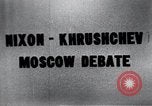
Richard Nixon and Nikita Khrushchev debate on economic systems of countries in Moscow, Russia.
Television broadcast of so-called "Kitchen Debate" between then U.S. Vice President Richard Nixon, and Soviet Premier Nikita Khrushchev, at the opening of the American National Exhibition at Sokolniki Park in Moscow on July 24, 1959. Ron Cochran, news journalist, introduces the event. Nikita Khrushchev states that Russia wants to live in peace. He states the level of development Russia has reached in 42 years and compares it with American development of 150 years. He speaks on the economic system of capitalism. They discuss communism and capitalism. Khrushchev expresses his gratitude for the presence of Richard Nixon at the event. Nixon points to the growth in color television. They discuss development in communication. He says that everything Nikita Khrushchev says will be broadcast in the United States in English.
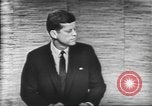
During a presidential election debate in Washington DC, Kennedy comments that its proper to express regrets to nations.
The second Kennedy-Nixon Presidential Debate in Washington DC, United States . Edward P. Morgan of ABC News asks Democratic candidate Senator John F Kennedy about sending apologies or regrets to General Secretary of the Communist Party of the Soviet Union Nikita S Khrushchev over the U-2 reconnaissance aircraft incident. Kennedy answers that if it could save the summit conference it would have been proper to express regrets. He speaks that the U-2 flights were proper from the point of view of protecting their security. But they were not in accordance with the international law. He speaks about the regrets expressed to Castro, to Southern Russia and to Eastern Germany under the Eisenhower Administration during the past years. He mentions the regrets expressed by the Soviet Union and the Chinese Communists to the U.S. over incidents. He states about they should have a stronger military force and should increase their strength all over the world. Republican candidate U.S. Vice President Richard M. Nixon presents his views and states that Senator Kennedy is wrong in thinking that Khrushchev might have continued with the summit conference if the U.S. had expressed regrets. He disagrees with Kennedy's analogies that the U.S. is a strong country and can express regrets for any wrong doings. He also disagrees in expressing regrets to anybody for doing things which has the support of the Congress and which is right from point of view to protect the security of the U.S. (This 4 part debate is sometimes called the Great Debate)
United States Navy training film on 'Disorientation Crashes' in United States.
United States Navy training film on 'Disorientation Crashes'. Animated film describes disorientation and how instruments solve the problem when flying.
CRITICALPAST.COM: About Us | Contact Us | FAQs - How to Order | License Agreement | My Account | My Lightboxes | Shopping Cart | Advanced Search | Featured Collections | Website Terms & Conditions | Privacy Policy ©2026 CriticalPast LLC.
License Agreement |
Terms & Conditions |
Privacy Policy
©2026 CriticalPast LLC.