


 Francais
 Deutsch
 Italiano
Refine Your Search
New Mexico United States 1946 stock footage and images
- Showing 27361 to 27366 of 30777 results more
more Hide
Hide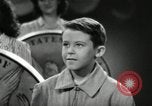
Segment of World War 2 film promoting sales of War Bonds and stamps to aid the war effort and stimulate postwar recovery
Film opens with singer on stage singing that he is a "double-duty dollar." He is backed by showgirls costumed as silver dollars. He explains that American dollars are now purchasing guns ammunition, planes, and tanks, to win the war. He alludes to how dollars will be used to fund the peace, after the war. An illustration shows schools, homes, and similar postwar investments in the country's infrastructure. Another shows futuristic cars, helicopter, and television sets. Scenes of pre-war highways filled with moving automobiles. Men playing golf. Gun club members in an outdoor shooting competition. A factory parking lot filled with automobiles and workers leaving the building at end of shift. (Message is that dollars no longer spent on war will revive private sector industry, again.) Film ends with appeal to "Buy an EXTRA War Bond TODAY!"
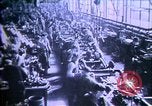
U.S. President Warren Harding dies. Calvin Coolidge becomes President. Good times in America and Hyperinflation in Germany
America and Europe during post World War 1 period of 1920s Sketches: American workers in factories. The U.S. President Warren Gamaliel Harding converses with a friend. President with other officials signs a paper. President Harding dies and the Nation mourns. Pallbearers carry coffin of the President. Sketches depict the various scandals under the Harding administration, including the Tea Pot Dome scandal. Vice President John Calvin Coolidge becomes President. Several sketches of the President . Sketches of rich people in America. People in a car. Automobiles driven out of a Ford factory. Sketch of the workers building a road. Various labor saving electrical devices. Sketches depict a housewife relaxing and people becoming better off economically. Ordinary people gamble on the stock market. Various pictures of American farmers suffering, as demand for food falls in the wake of World War 1. Economic and financial crises affect Germany. Hyperinflation and riots occur in Germany. The unrest gives rise to future leaders like Adolf Hitler in Germany and Benito Mussolini, in Italy.
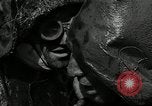
Oil drilling crew in protective clothes with goggles. Plume of water and steam shoots up through drilling derrick
View of oil drilling roughnecks in protective gear, including goggles. View from short distance of an oil drilling derrick, in wetlands, where plume of water and steam is shooting up explosively through the derrick structure. . A person is seen close to the derrick. Building and lake in background.
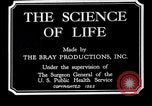
Transmission of disease causing micro-organisms.
Illustration of how disease causing micro-organisms spread during day-to-day events. It is exemplified with the exchange of money with a cab driver. Transmission can also take place while turning the pages of book. The documentary is called - The Science of life, made under the supervision of the Surgeon General of U.S. Public Health Service. 1922.
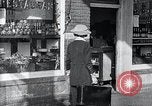
Some careless habits causing spread of disease causing bacteria in U.S.
Transmission of disease through some careless habits of the disease carrier is illustrated. Disease causing bacteria can be seen spreading through water glass and greeting each other. 1922.
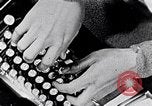
People performing various jobs in late 1930s U.S: Typing, filing, window washing, driving.
Close-up views of hands of various workers performing jobs and tasks in the 1920s. Female hands working on typewriter. View of hands of a woman operating a manual typewriter. Hands of a man who is busy stacking, shuffling, and stapling papers with a large stapler. Hands of a man putting papers, post, or mail into mail slots in a mail room operation. A restaurant waiter carrying a tray on his shoulder. Hands at work washing windows and using a small squeegee tool to clean the windows. Hands operating the lift mechanism for a Haughton elevator in a building. View from inside moving car of hands on steering wheel of car as it parks.
CRITICALPAST.COM: About Us | Contact Us | FAQs - How to Order | License Agreement | My Account | My Lightboxes | Shopping Cart | Advanced Search | Featured Collections | Website Terms & Conditions | Privacy Policy ©2026 CriticalPast LLC.
License Agreement |
Terms & Conditions |
Privacy Policy
©2026 CriticalPast LLC.