


 Francais
 Deutsch
 Italiano
Refine Your Search
New Mexico United States 1946 stock footage and images
- Showing 29467 to 29472 of 30776 results more
more Hide
Hide
Coast Artillerymen unpack a barrage balloon and its accessories during a demonstration at Camp Davis in North Carolina (WW2)
Coast Artillery troops at Camp Davis in North Carolina demonstrate how to handle a barrage balloon in World War II. Two types of barrage balloons. Army Soldiers lay a canvas cover on a balloon bed. A compact wooden box in which a balloon is transported. Men lift the box and bring it to the edge of the cloth on the ground. They remove a lid. A balloon and its accessories are unpacked. Men remove their shoes and spread the balloon. Men put an inflation tube into an appendix of the balloon and the other end is attached to an air blower. The balloon is partially inflated. A man enters a gas chamber through the appendix and takes an inspection lamp. Men prepare cylinders of helium for inflation the balloon. The inspection is complete and the man comes out from the appendix. Men walk on the balloon to remove the air.
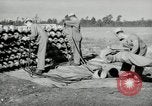
Coast Artillerymen fill a balloon with helium gas and raise the balloon during a demonstration at Camp Davis in North Carolina (WW2)
Coast Artillery soldiers at Camp Davis in North Carolina in World War II. demonstrate how to handle a barrage balloon. The manifold of the balloon is connected to a helium gas cylinder by means of a rubber tube. Men connect one end of an inflation tube to the manifold. The end of the tube is connected with the appendix of the balloon. The envelope is inflated A soldier opens cylinder valves. The balloon gradually rises. Men install a rudder. Men hang sand bags on the balloon to control its rate of rise. Men move the balloon to a winch. The second balloon inflated in the same manner. Men remove the sand bags. A man operates the winch. The balloon rises. The second balloon rises. The balloons are raised up. A balloon is hauled down and anchored. Men hang the sand bags. The Army personnel march off from the field.
U.S. 82nd Airborne Division paratroopers land on rugged terrain and maneuver as jets strafe in North Carolina.
U.S. 82nd Airborne Division makes preparation and maneuvers showing defense strength in North Carolina. Air Force personnel and aircraft at air base. Heavy equipment are loaded onto aircraft. Paratroopers of U.S. 82nd Airborne Division wear military gear and prepare for maneuver under Commander Thomas P. Hickey. Paratroopers board the aircraft. The paratroopers seated in the aircraft. The aircraft in flight. Parachutists jump from the aircraft. The parachutists descend and land on a rugged terrain. Several paratroopers get wounded due to failure landing. The paratroopers move into action and get alert. They fire artillery and army tanks. Troops maneuver and face attacks as jets strafe.
101st Airborne Division troops and equipment are loaded onto C-119Fs aircraft during Operation Swift Strike in North Carolina.
Operation Swift Strike in North Carolina. Troops and equipment of the U.S. 101st Airborne Division are loaded onto U.S. Air Force C-119Fs Flying Boxcar transport aircraft. USAF B-57 Canberra bomber aircraft in flight. USAF KC-135A Stratotanker aerial refueling aircraft takes off. Men work at communications console and plot boards. USAF F-105s Thunderchief fighter aircraft peel off. USAF F-100Ds Super Sabre and RF-84F Thunderstreak fighter aircraft peel off. F-100 and RF-84F aircraft in flight overhead. F-100 aircraft in steep climb. C-119Fs aircraft take off and retract landing gear. C-119Fs in flight drop paratroops. USAF Chief of Staff General Curtis Emerson LeMay,USAF Major General Maurice Arthur Preston and U.S. Army Lieutenant General Thomas J. H Trapnell watch from spectator stands. USAF C-130 Hercules transport aircraft drop heavy equipment. Paratroopers descend and land on ground. Troops deploy and move equipment by Army mule. USAF C-123s Provider transport aircraft land and unload troops. Jeeps full of troops move past a line of parked C-123s.

Merrill Phoenix and Harold Allen break the small aircraft aloft 60 hour record by making quick ground contacts for food and fuel.
Men and women load food container on to car. Merrill Phoenix and Harold Allen break the small flying craft marathon record of 60 hours airborne by making touch-and-go ground contacts for food and fuel. Their "Flivver" plane lifts a container from top of a speeding car.
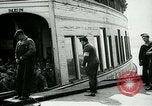
131st Infantry, 33rd Division AEF being processed as they prepare to embark to France, during World War I
A U.S. Army captain in the American Expeditionary Forces (AEF) is helped as he steps from a ferry boat to speak with a Lieutenant wearing a white armband, who is assisting with embarkation duties. Closeup of the Lieutenant, and armband reading "H.Q. STA 7." The Lieutenant holds an embarkation passenger list for Company A, 131st Infantry, 33rd Division. He discusses it with the Captain (Company A Commander). view of the embarkation passenger list. The members of Company A, in full field gear, then disembark from the ferry as the two officers watch. Scene changes to a processing center at the pier. Soldier John J. Jones shows his identification card. Next are shown closeups of his military records, including : a copy of his service record; his individual equipment record; his pay card; an application for family allowance and information for allotment of pay;application for insurance and details of his beneficiaries. An army clerk types information into the records. Next, soldiers are seen relaxing on the floor of the processing center. Glimpse of the ferry boat,"Catshill," docked at the pier. (World War i; World War 1; WWI; WW1)
CRITICALPAST.COM: About Us | Contact Us | FAQs - How to Order | License Agreement | My Account | My Lightboxes | Shopping Cart | Advanced Search | Featured Collections | Website Terms & Conditions | Privacy Policy ©2026 CriticalPast LLC.
License Agreement |
Terms & Conditions |
Privacy Policy
©2026 CriticalPast LLC.