


 Francais
 Deutsch
 Italiano
Refine Your Search
Norway 1941 stock footage and images
- Showing 211 to 216 of 1737 results more
more Hide
Hide
Tripartite (Axis) Pact signed between Germany, Italy and Japan; Nazi German invasion attacks in Yugoslavia, Russia, England
Nazi crimes against the nations of the world during World War II. View of the Peace Treaty between Germany and Yugoslavia which was signed on 1st June, 1939. The treaty breached on 6th April 1941, Germany launched a massive attack on Yugoslavia. German troops attack and advance. A map shows that most of the Europe was in the hands of Germany by 1941. View of September 27, 1940 signing ceremonies in Berlin of the Tripartite (Axis) Pact between Nazi Germany, Fascist Italy and Imperial Japan. Hitler and axis leaders shake hands and pose at pact signing table. Joachim von Ribbentrop signing the Axis Pact. Scene of German tank treads close-up rolling over battlefield and wider view of German armor and troops during Operatoin Barbarossa in June 1941, invading Russia, in violation of their non-aggression pact. German forces enter Russian territory. German Army forces setup and fire artillery at Russia. German rocket launchers fire rockets at Russian targets. Ground and aerial views of formations of German Luftwaffe aircraft on bombing runs. Between August-September 1941, Luftwaffe conducts blitzkrieg raids (blitz) on Great Britain. View of British landmarks like St Paul's Cathedral dome and Tower Bridge. Aerial views as Luftwaffe fighter aircraft roll and dive toward targets. British spotlights and search lights on the ground sweeping and catching German aircraft in their light beams. British anti aircraft batteries open fire on German planes over England. Alternating views of German plane point of view bombing England with bright flashes of light and explosions on the ground, and British anti-aircraft fire filling the air. Ground views in England, United Kingdom of buildings on fire from London blitz bombing, and British fire fighters moving to deploy fire hoses and extinguish fires. Flaming buildings collapse from bombs and fire. Whole blocks of buildings on fire. Scene change to December 7, 1941 bombing of Pearl Harbor by the Japanese. U.S. Navy ships bombed and on fire in Pearl Harbor.
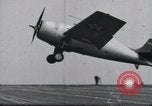
F4F aircraft crash on aircraft carrier, USS Wasp (CV-7) prior to U.S. entry into World War II
Crash of a Grumman F4F-3 aircraft from U.S. Navy Squadron VF-42, on the carrier, USS Wasp, early in 1941. In a slow motion sequence, a U.S. Navy F4F-3, with F-42-17 painted on its side (BuNo 2537) is seen rounded out too high for landing, above all arresting cables, and drifting into the carrier's island, where it impacts, losing its right wing, and flipping over to crash inverted on the flight deck. Sailors stand in the background. After the aircraft settles, a sailor runs across the deck to render aid. (Note: Navy Squadrons VF-42 and VF-71, assigned to the USS Wasp, received their F4F-3 Wildcats in January and February of 1941 under Bureau of Aeronautics contract C-68219, order number 48-020. These aircraft were painted overall aluminum with VF-42 having willow green tails and VF-71 having black tails. Later in 1941 the aircraft were repainted overall light gray.)
Attack on Pearl Harbor by Japanese, and President Roosevelt asks for war declaration on Japan in 'date of infamy' speech.
United States Government film entitled "The World At War" dealing with World War 2. Film opens showing Japanese warplanes in formation above a Japanese military installation. Slate reads: "Pearl Harbor December 7, 1941. An airfield is seen filled with parked U.S. Army Air Forces B-17 bombers. Two Boeing XB-17 (Model 299) bombers are parked next to each other on the ramp. Derricks and ships are shown at the Pearl Harbor naval base. A formation of Japanese Mitsubishi G3M bombers is seen in flight. They are seen overhead as bombs explode on the U.S. Navy Air Station at Ford Island destroying hangars and aircraft. Next, is shown the famous image of the USS Arizona burning, listing, and sinking, after being bombed. Film continues, panning over post-air raid views of destruction. On December 8, 1941, U.S. President Franklin D. Roosevelt, addresses the Congress, delivering his declaration of war message. He calls December 7, 1941 "a date which will live in infamy." Roosevelt recounts that the United States was at peace with japan and in conversation with its government and Emperor, in the interest of maintaining peace.in the Pacific. even at the time of the attack. Japanese ambassador and his colleagues seen visiting State Department offices to meet with U.S. Secretary of State prior and even during the initial attack operations by Japan.Roosevelt recounts that the United States was still in conversation with Japan even at the time of the attack. Japanese ambassador and his colleagues seen visiting State Department offices to meet with U.S. Secretary of State prior and even during the initial attack operations by Japan. Photographers take pictures of the visiting Japanese delegation. President Roosevelt asks Congress to affirm that a state of War exists between the United States and the Japanese Empire.
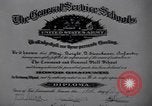
The military career of General Dwight D Eisenhower from 1926 to World War II
Film starts showing Dwight D. Eisenhower's diploma as honor graduate of the Army Command and Staff School, in 1926. Image of Major Eisenhower (in civilian clothes) Narrator says he was assigned to France, to prepare a guide book on American battlefields in Europe. Image of Eisenhower as a member of General Douglas MacArthur's staff in the Philippines, where MacArthur was Commander-in-Chief of the Philippine army. Glimpse of headquarters building there. MacArthur in his office helping the Commonwealth of Philippines work out a plan for its military defense. Image of Lieutenant Colonel Eisenhower in 1939, serving as Executive Officer of the 15th Regiment, at Fort Lewis, Washington, View of the Regiment's Headquarters building. Scene shifts to 1940, showing German forces invading Holland and Belgium. German tanks are seen in action. German Junkers 87 Stuka dive bombers and Heinkel 111 bombers drop bombs. After passing of the Selective Service draft act, President Franklin D. Roosevelt is seen at a public ceremony on October 29, 1940, where Secretary of War Henry L. Stimson drew from a bowl the capsule containing the first draft number of World War 2. Views of Lt. Col. Eisenhower as Chief of Staff of the Army 3rd Division and later as Chief of Staff of the Ninth Corps. Next, he is seen as Chief of Staff to General Walter Kreuger, who in 1941 led the Third Army in the most realistic maneuvers held by American troops (The Louisiana maneuvers). Views of American troops engaged in those maneuvers. Image of Eisenhower as a Brigadier General. Views of the Pearl Harbor bombing during Japanese attack on December 7, 1941.
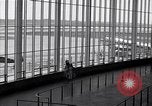
Eastern Airlines DC-3 Aircraft at newly built Washington National Airport
Interior view of people strolling at main terminal building, Washington National Airport, during its first few months of operation in 1941 (built from 1940-1941, during the Great Depression). A man can also be seen on the outdoor observation deck. A plane taxis. Numerous DC-3 passenger airplane parked at airport, some being refueled. View from tarmac shows visitors lined up on outdoor observation deck. Planes go to hangar. Passengers deplane from an Eastern Airlines DC-3 with "The Great Silver Fleet" painted on its fuselage. Cars parked on circular drive in front of the terminal. Officials at Air Traffic Control tower talk on phones. View from inside the terminal showing observation deck and Eastern Airlines DC-3 outside.
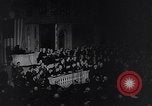
President Franklin D. Roosevelt asks Congress to declare war, after Japanese attack on Pearl Harbor (WW2)
On December 8, 1941, U.S. President Franklin D. Roosevelt, addresses the Congress, calling for a declaration of War against Japan in World War II. He calls December 7, 1941 "a date which will live in infamy." Roosevelt notes the United States was at peace and in conversation with Japan's government and Emperor Hirohito, about maintaining peace in the Pacific. Japanese ambassador and statesmen are seen visiting State Department offices to meet with the U.S. Secretary of State. Photographers take pictures of the visiting Japanese statesmen. President Roosevelt asks Congress to affirm that a state of War exists between the United States and the Japanese Empire.