


 Francais
 Deutsch
 Italiano
Refine Your Search
Ohio-State-football stock footage and images
- Showing 10849 to 10854 of 24492 results more
more Hide
Hide
AC-119K Gunship takes off on a training mission and gunners aboard load ammunition for mini guns.
Pilot and navigator walk across ramp at Lockbourne Air Force Base and board a U.S. Air Force AC-119K Gunship for a training mission. Engine, propeller and J85 jet pod as seen from cockpit of aircraft during take off. Gunners manually transferring 7.62 belt ammunition from large containers to the four mini guns
AC-119K Stinger gunship, of the 1st Special Operations Wing, Lockbourne AFB, firing guns during live fire training flight.
Cabin of USAF AC-119K Stinger gunship of the 1st Special Operations Wing, Lockbourne Air Force Base, on live fire training mission. Gunner adjusts Vulcan M61A1 20mm cannon aboard AC-119K. He sights and fires the cannon. Spent shells tumble down chute (including several unspent with light blue noses). View of GAU-2/A 7.62 minigun firing. Spent rounds dropping into container under the gun. Brief view of tracers streaming toward the ground.
Airman removes muzzle covers from guns and inspects jet pod of AC-119K gunship aircraft at Lockbourne Air Force Base
Airman of the U.S. 1st Special Operations Wing, Lockbourne Air Force Base, performs visual .inspection of AC-119K Stinger gunship. He removes muzzle covers from the GAU-2/A miniguns and 20mm M61A1 cannons. He inspects the left J-85 jet engine pod.The airman picks up the muzzle covers and walks away. A C-130 is parked on the ramp in the background.
Various aircraft and aviation tests and testing equipment used at Wright Air Development Center
Aircraft undergo various tests at the Wright Air Development Center of Wright-Patterson Air Force Base. Testing of magnesium burner attached to an aircraft flying at night for night photography. A static lightning test is done on a model of a F-84 Thunderjet aircraft, for the study of interference. A technician seated at an electron microscope instrument panel adjusts dials. Image of a highly magnified particle is shown. Two technicians work with an early computer (referred to as an"electronic brain" by the narrator) as they use it to solve calculations before an aircraft is built. Another technician is shown working on a computer instrument referred to as a "polynomial evaluator" by the narrator. A test subject in an "aero-medical" chamber is seen wearing flight clothing and oxygen mask. A technician seated at control outside chamber. Test subject in chamber and various instruments kept in side. Instrument records the altitude, pressure release valve punctured. Test shows pressurized quit inflating. A brake lining is tested an an aircraft tire, simulating a high stress, rapid stop. A human subject seated in an ejection seat experience an ejection seat test, rising rapidly upward on a twin rail system. Aerial view of air-to-air refueling of KC-97 Stratotanker and B-50 Superfortress aircraft. A pilot in cockpit as he maneuvers in for refueling. Refueling of B-50 from KC-97.

A jet-propelled back pack helps mechanics to overcome weightlessness during space maneuvers.
Officials and men gathered at a plane parked. Man wears a back pack. Plane taxis on runway for take off. Men inside the plane assist astronaut with back pack. Astronaut floats in air after using jet propelled back pack.
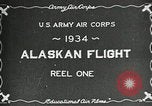
U.S. Army Air Corps airplanes and crews preparing for Alaskan Flight in 1934
Slate lists planned flight legs of U.S. Army Air Corps aircraft as: Washington DC to Edmonton, Alberta; Fairbanks Alaska to Seattle Washington; and Washington DC to San Diego California. Another slate explains that under command of Lieutenant Colonel H.H. Arnold,ten B-12 bombers demonstrate their capabilities in an 18,000 mile flight. Lt. Col Henry H. Arnold, U.S. Army Air Corps, stands in front of a large map on which planned flights are charted. Sign behind him identifies "Engineering Office," at Patterson Field. Arnold uses pointer to show the routings to another officer who has joined him. The next sequence shows Arnold describing the flight plans to more participants, using more charts. Camera pans across ten assembled Army personnel. Lt. Col. Arnold poses with 15 aviators in front of a YB-12 bomber (displaying air intake on port side of engine). Camera pans over eighteen mechanics and ground crewmen posed in front of the bomber. Symbol of eagle superimposed over map of alaska, is painted on side of forward fuselage. Arnold discussing the mission with Army officers and civilian officials, as they walk past a YB-10 (with air intakes atop the cowlings). Camera pans across Patterson field ramp, where officials, automobiles, YB-10 aircraft, and local civilian workers, including several women, are seen. Crew chief seen refueling a YB-10 with long hose from an underground fuel tank installed at edge of the ramp.
CRITICALPAST.COM: About Us | Contact Us | FAQs - How to Order | License Agreement | My Account | My Lightboxes | Shopping Cart | Advanced Search | Featured Collections | Website Terms & Conditions | Privacy Policy ©2026 CriticalPast LLC.
License Agreement |
Terms & Conditions |
Privacy Policy
©2026 CriticalPast LLC.