


 Francais
 Deutsch
 Italiano
Refine Your Search
Ohio-State-football stock footage and images
- Showing 11827 to 11832 of 24492 results more
more Hide
Hide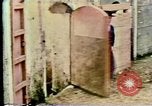
CIA and other U.S. sponsored experiments dealing with control of animals and people using various techniques during the 1960s and 70s.
In 1964, Professor Jose M.R. Delgado, of Yale University's School of Medicine, invented a device he called a stimoceiver. It was a chip that could alter the brain’s electrical impulses via radio signal. In tests sponsored by the U.S. Office of Naval Research, he implanted the device in the brain of a bull. This film opens shows that experiment and its results. A man in Cordova, Spain, opens a bull ring door to allow a fighting bull to enter. It charges a man holding a cape. Another man fires a dart to sedate the bull. Several men plant electrodes for a stimoceiver in the bull's brain. Next, the bull charges a man holding a cape, but pulls up short before hurting him. The bull chases the cape but never attacks the man as the man uses remote control to influence the animal's behavior. The bull charges around in a circle. Scene shifts to Dolley Madison Parkway (Route 123 in Mclean, Virginia, where sign points toward the CIA headquarters at Langley, Virginia. Narrator lists various techniques examined in the 60s and 70s, including brain surgery; psychosurgery; creation of amnesia; parapsychology; and manipulation of genes. Glimpse of some facilities at CIA headquarters. Change of scene to hearing of the Senate Subcommittee on Health and Scientific Research on September 20, 1977. Chaired by Senator Edward M. Kennedy, the Committee sought information about these activities by the CIA. Narrator says witnesses had agreed to limit information they would provide the Subcommittee. Former narcotics officer Charles Siragusa is seen on camera admitting that the man he reported to at the CIA wanted him not to say anything. Former CIA chemist Robert V. Lashbrook is seen testifying that he has no knowledge about the CIA running safe houses. (Narrator states he ran one of them and that a "surprise LSD experiment" was conducted there.) Scene shifts to a California tennis court, where Dr. Sidney Gottlieb is playing doubles tennis, Narrator says he oversaw those activities at the CIA but destroyed all his records when he retired in 1973. View of a letter he wrote at that time, in which he states he and his colleagues had been able to maintain contact with the leading edge of chemical and biological developments in the field of biological and chemical control of human behavior. View of Dr. Gottlieb entering an ante room where he testified before the Senate Subcommittee on Health and Scientific Research without being filmed because of what his lawyer claimed were health and cardiac problems. View of him on the tennis courts as Narrator states he declined ABC News requests for an interview. Change of scene to George White who retired from the CIA and lives in Stinson Beach, California. View of Stinson Beach from high overlooking vantage point. People jogging on the beach. Narrator states that White wrote to Dr. Gottlieb summing up his career saying, "it was fun fun fun, and where else could a red-blooded American boy lie, kill, and cheat, steal, deceive, rape, and pillage, with the sanction and blessing of the All Highest." Narrator strolls on lawn near the U.S. Capitol building and says it appears doubtful that mind control has been achieved. But work, that we don't know very much about, is continuing in this field. He asks how deeply are the Russians and other dictatorships into this. He notes that the CIA is reluctant to give information about it (such as Project MKUltra) and he questions where such a program fits in a democracy. He notes that one person working on these projects told him there are capable, conscientious, and very capable scientists working for our country, and "their work speaks for itself."
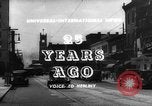
Japan denounces Washington Naval Treaty of 1922; Also: Helen Richey becomes the first woman to fly mail in the U.S.
Japanese Ambassador to the United States Hiroshi Saito calls on U.S. Secretary of State Cordell Hull In December 1934 to inform that Japan will denounce the Washington Naval Treaty on 1922 which limited the size of the Japanese fleet. A close up of the ambassador Saito. He exits the State, War, and Navy Building (later the Executive Office Building) and gets in a car. Next segment: A female pilot Helen Richey becomes the first woman to fly mail in the United States. Richey stands in front of an aircraft and shakes hand with an official. Richey in the cockpit and the aircraft takes off. From a December 14, 1959 newsreel recounting events 25 years earlier.
Oil production of the U.S. and other countries is compared and evolution of internal combustion engine is depicted.
The world struggle for oil is depicted. Oil production of the United States is compared with that of other countries. Relative production in 1900 is shown. A political map of the United States. A dot in some states represents 1 % of the world's production whereas a cross in other states represents less than 1 % of the world production. A map shows Russia, Germany, Italy, Galicia, Roumania and other neighboring countries. A box on the map shows Japan with a cross. Another map shows India, Tibet, Afghanistan and their neighboring countries. Still another map shows countries of South America. Evolution of internal combustion engines, whereby gasoline is used, is shown using diagrams.
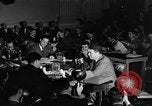
Emmet Lavery, President of the Screenwriters Guild of Los Angeles, is questioned by the HUAC members
Questioning of the President of the Screenwriters Guild of Los Angeles, Mr. Emmet Lavery, by members of the House un-American Activities Committee, including J Parnell Thomas and Robert Stripling, in October 1947. Mr. Lavery speaks into a microphone and answers questions of the Committee. He opens by saying he will break the suspense and states that he is not a Communist and has never been one (even before he is asked.) This elicits laughter from those present in the hearing. In testimony, Emmet Lavery states that he is "a Democrat who in my youth was a Republican, and if the Committee wants to know why I changed..." He is cutoff with response "No we don't want to know..." and again there is laughter. Mr Lavery concedes that there are probably communists in the Guild, but he doesn't know who, by name. He expresses concern that the questioning by the Committee may negatively affect the Guild elections that are approaching. He states that no individuals have control of the Guild. The Committee asks if Trumbo (Dalton Trumbo of the Hollywood Ten) has control of the Guild. Lavery says no. Lavery states that he agrees with J Edgar Hoover of the FBI that it would be wrong to outlaw the Communist party, especially in a time of peace.
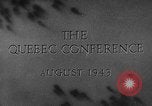
British Prime Minister Winston Churchill in many meetings before and after America's entry into World War II
Opening slate reads: "Quebec Conference August 1943." The English battleship, Prince of Wales, is seen in fog off the Coast of Newfoundland, in August 1941. View of sailor on fore-deck of the British ship. View inside engine room of the ship where sailor manipulates her power. Closeup of engine crankshaft stopping as she drops anchor in Placentia Bay. View of Prime Minister Winston Churchill, greeting U.S. President Franklin D. Roosevelt aboard the Prince of Wales. He proffers a letter to the President, from the King of England. View of Roosevelt and Churchill seated on deck with their respective military leaders standing behind them. Admiral Ernest King, U.S. Chief of Naval Operations converses with U.S. Army Chief of Staff, George Marshall, as they stand behind Churchill and Roosevelt. Wider camera view shows the larger military entourage accompanying the Prime Minister and the President. Glimpse of prisoners and enslaved workers taken by Nazi Germans in Europe. Glimpse of bombs falling from an airplane. Classic film views of the Japanese attack on Pearl Harbor in December 7, 1941. Bombs exploding along "Battleship Row." Heavy smoke rising from the bombed ships. The USS Arizona tilted heavily and burning. Camera pans along the path of destruction, as the voice of President Roosevelt is heard in the background, asking the Congress to declare that the Japanese attack created a state of War between the United States and the Japanese Empire. View of President Roosevelt speaking to the U.S. Congress. Seated behind him are Vice-President Henry Wallace and Speaker of the House, Sam Rayburn. Glimpse of Congress members applauding. Change of scene shows President Roosevelt and Winston Churchill meeting in Washington, DC, in December of 1941, during World War 2. Views of war preparations in the United States, including the building of new war production plants and facilities. A large steel ingot being forged into an artillery gun barrel. Machinist at work turning a gun barrel on a lathe in a munitions factory. Views of manufacturing plants in operation and steel being made. A railroad train carrying new Army trucks. Another meeting of Churchill and Roosevelt in Washington, D.C. June, 1942. Standing behind them is President Roosevelt's special assistant, Harry Hopkins, a British naval officer, and an American navy Captain. American soldiers boarding a troop ship, and closeups of them as they enter the ship, looking out of portholes, and waving from the ship's deck. Glimpse of Washington Monument and its image in the reflecting pool in Washington DC. Closeup of a book entitled, "Time Table for Invasion." General George Marshall with several of his generals doing preliminary planning. Series of scenes involving senior military officers engaged in war planning. A convoy of warships is seen at sea during the Operation Torch Allied invasion of French North Africa during 8–16 November, 1942. Views of Allied Navy ship guns firing. Allied troops riding in landing craft, and advancing from beached craft on shore of Algiers. Aerial view of a flight of Douglas Dauntless bombers in formation. "Bombs away" view from Allied airplane dropping bombs. Allied troops firing camouflaged antiaircraft guns from sandy positions near shore. Enemy shells or bombs exploding nearby. Two U.S. Army soldiers holding a document in French entitled, "Message from the President of the United States.
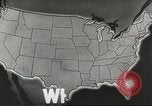
American farmers increase production of agricultural products needed during World War II
Film opens with series of animated maps of the United States, showing the States that are the typical sources of agricultural products, including wheat, corn, dairy products, beef cattle, cotton, flax, lumber, and fruits and vegetables. A woman in overalls places fresh cut corn from a truck on to a conveyor. Farmers pitch hay from trucks. Momentary glimpse of a warehouse on a waterway, with a railroad train running to it, and a large cargo ship docked beside it. A federal official briefs a group of farm state officials and farm families, about the need for increased agricultural production, during World War 2. Closeups of persons in the audience. Scene shifts to window of a modest wooden home with anchor symbol two blue stars displayed for family members in military service. Closeup of the two blue stars in the window. With many men gone in military service, women and youth fill the labor gaps. A women at the wheel of a piece of farm equipment. A boy picking fruit from a tree. View of a large vacant lot in a city being used for numerous "Victory Gardens." A girl digging with a spade in one of the gardens. Other gardeners conversing in the background. A woman storing mason jars of preserved fruits and vegetables on a shelf in her home. Farmers performing maintenance and repairs on farm machinery. Momentary view of farmers loading crates of foods onto an open truck. Women placing vegetables into cans at a factory. Cattle moving into a pen. Men loading bales of cotton onto a river boat. A large freighter being loaded at a port. A farmer treating the soil with something dispensed from a spreader behind his tractor. A farmer harvesting corn by machinery. Three dead pigs, on the ground, (victims of disease.) Cattle foraging close to one another in a pasture. Insects attacking crops as there is a shortage of insecticides during the war. Severe weather causing crop losses is seen. A farmer harvesting with a combine. A document is shown labeled PL 147 77th Congress (the Steagall Bill). (Narrator states it guaranteed prices of 90 percent of parity for war needed crops.) Brochures for alternate crops that farmers might consider because foreign supplies were cut off. A farmer removes an envelope from his mail box. (Narrator alludes to government supplied crop loans and dairy feed payments.) Corn being piled up. Pigs at feeding troughs. Men loading crates of food onto a truck. fresh cut logs rolling into a river. Complete change of scene to Piazzale Loreto, in, Milan, Italy, 1945, where Benito Mussolini and other fascist leaders are seen hanging upside down following their deaths at the hands of crowds. Adolf Hitler and Marshal Hermann Goering at Berteschgaden. Japanese Emperor Hirohito astride a white horse leading some of his senior military officers as they review assembled troops.
CRITICALPAST.COM: About Us | Contact Us | FAQs - How to Order | License Agreement | My Account | My Lightboxes | Shopping Cart | Advanced Search | Featured Collections | Website Terms & Conditions | Privacy Policy ©2026 CriticalPast LLC.
License Agreement |
Terms & Conditions |
Privacy Policy
©2026 CriticalPast LLC.