


 Francais
 Deutsch
 Italiano
Refine Your Search
Ohio-State-football stock footage and images
- Showing 11995 to 12000 of 24492 results more
more Hide
Hide
Harry S Truman, Joseph Stalin and Winston Churchill discuss the problems related to Germany in Potsdam Conference, Berlin (WW2)
Question marks on screen. Reconstruction of the buildings and denazification in Berlin, Germany after World War II. A factory in Germany. A farmer leads a horse to plow a field. Men at a farm cultivate crops. The wreckage of the IG Farben plant. Men speaking to Hermann Göring. The trial of Norwegian leader and Nazi collaborator Vidkun Quisling. The rail goes on for the criminal. People burn Nazi books and pamphlets in a bonfire. A man burns a pamphlet with a photo of Adolf Hitler. The people stand around the burning books. German civilians read a poster on a wall. General Dwight D. Eisenhower of the United States, Marshal Georgy Zhukov of the Soviet Union, and Field Marshal Bernard Montgomery of the United Kingdom sign a joint agreement. The three of them stand together. The United States Capitol building. Chongqing National Government building in No. 232 Renmin Road, Chongqing (Chungking), China. The Big Ben in London, United Kingdom. Aerial view of the Arc de Triomphe in Paris, France. General Francisco Franco saluting to marching soldiers in Spain. The delegates including United States President Harry S. Truman, General Secretary of the Communist Party of the Soviet Union Joseph Stalin, and UK Prime Minister Winston Churchill seated around a table during the Potsdam Conference in 1945. They discuss the problems. A close up view of Truman looking into some documents. Stalin smokes a cigarette. The delegates discuss problems. The funeral ceremony of President Franklin D. Roosevelt. The soldiers fire guns. President Harry S. Truman attends the ceremony. Churchill salutes from a moving vehicle. Women voting in the United States. Truman gets off an aircraft. Delegates in the Potsdam conference. Newspaper headlines read Russian declares war on the Empire of Japan in 1945. The first atomic bomb explosion over Hiroshima, Japan. The newspaper headlines about the war. Truman, Stalin and delegates at the Potsdam Conference. Soldiers advancing in the battlefield. A flag of the United States and people celebrate the victory. Newspaper headlines feature the surrender of Japan.
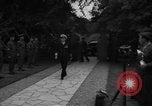
William D Leahy,George C Marshall and Georgy K Zhukov gathered for Potsdam Conference in Potsdam, Germany during World War II.
Representatives of Allied nations gathered for Potsdam Conference at Schloss Cecilienhof Palace in Potsdam, Germany during World War II. Fleet Admiral of the United States Navy William Daniel Leahy,General of the United States Army George Catlett Marshall, Premier of the Soviet Union Joseph Vissarionovich Stalin,Marshal of the Soviet Union Georgy Konstantinovich Zhukov and staff arrive by car. Guards salute as they enter the building. President of the United States Harry S. Truman and United States Secretary of States James Francis Byrnes arrive by car. Prime Minster of the United Kingdom, Winston Leonard Spencer Churchill welcomes them. Photographers take photographs. Trees seen in the background.
President Harry S. Truman reads prepared speech after dropping of atomic bomb on Hiroshima Japan during World War 2.
U.S. President Harry S. Truman delivers a speech following the dropping of the atomic bomb on Hiroshima, Japan, during World War II. U.S. President Harry S. Truman seated at desk in cabin of a ship. He reads prepared speech stating that a single American aircraft dropped one atomic bomb on Hiroshima and destroyed its usefulness to the enemy. He reminds listeners that the Japanese began the war from the air at Pearl Harbor. He speaks about the U.S. Armed Forces and the production of atomic bombs in the United States. The President states that the U.S. is now prepared to completely destroy every productive enterprise of Japan, by bombing Japanese docks, factories, and communications. Truman states that the U.S. shall completely destroy Japan's power to make war. President Truman notes that acceptance of the Ultimatum of July 26th issued at Potsdam, could have saved the Japanese people much suffering. But it was rejected by Japan's leaders. He states that the U.S. have spent more than two billion dollars on the greatest scientific gamble in history and have won. This is due to the greatest achievement of organized science in history.
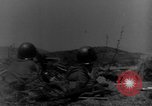
Seventh U.S. Army soldiers prepare for the Allied Invasion of Southern France during Operation Dragoon of World War 2
From a 1952 U.S. Army television program titled The Big Picture. U.S. troops in a fox hole in Korea. A U.S. tank carrying many GIs in Germany.US ski troops in Alaska. Amphibious training on beach in Puerto Rico. United States Army Sergeant James Mansfield introduces the story of United States Seventh Army in the Allied Invasion of Southern France, "Operation Dragoon." Army Colonel William Wilson Quinn seated in office, with army rifle on his desk. He refers to the "Blue Badge" which is the Army infantryman's badge. Then he introduces the story of the Seventh United States Army: On 14 August 1944 Bay of Naples is seen as an open air Marshalling area. Barrage balloons float above the area. Large landing ships sit at dock with their front loading doors open. 3rd,45th and 36th division combined into 7th United States Army. Mechanized war equipment being loaded and checked off the loading chart. 7th army soldiers march through streets. Red Cross workers distribute donuts. Soldiers board ships. Ships leave harbor to join convoy. Ships docked at the West Coast of Corsica. Officers meet for conference aboard ship. Men attend last minute details. Some pray. Animated map depicts the route of the advancement by the troops. Port Cros and Levant : French commandos landed on these islands. U.S. B-25 bombers in flight drop bombs. Fighting ships take their positions. Navigators, gunners and signal men alert. Soldiers prepare for fight. Army Air Forces C-47 aircraft fly in formation. A B-24 bomber over mountains. B-25s in flight.509th Parachute Infantry Battalion being inspected at airport. Paratroopers get into aircraft. Aircraft taxis and takes off. United States Army Air Force C-47 Skytrain and C-54 Skymaster military transport aircraft in flight toward Southern France. Paratroopers descend to ground and advance. Gliders land. Soldiers unload and ready artillery. Aerial view of rugged terrain. Ships underway at sea. Officers look through binoculars aboard ship.
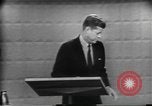
Nixon talks about the increase in GNP and average family income during the presidential election debate in Chicago, Illinois.
The first Kennedy-Nixon Presidential Debate in Chicago, Illinois. Moderator Howard K. Smith invites Republican candidate U.S. Vice President Richard M. Nixon to give his opening statement. Nixon begins his statement. He talks about the huge competition faced by the United States. He states that he disagrees with Kennedy's statement on the poor growth in national product. Instead he states that there has been a 6% growth of Gross National Product (GNP) in the past years. He compares the overall development of the country during the Truman Administration and the Eisenhower Administration. He states that there has been a continuous progress in the field of education, hydroelectric power, hospitals and highways. He discusses the improvement in Gross National Product and the average family income. He discuss effective plans and programs in the every field. He compares the effective styles of spending of the Federal government and the Democratic government. In his final point he states that his disagreement with Kennedy is not about the goals for America but only about the means to reach those goals.
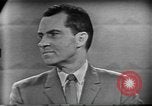
Richard Nixon talks about his executive experience and leadership during a presidential election debate in Chicago, Illinois.
The first Kennedy-Nixon Presidential Debate in Chicago, Illinois. Sander Vanocur from NBC News asks Republican candidate Vice President Richard M. Nixon about executive leadership and his governmental executive decision-making experience. Nixon answers and states that the President of the United States does not disclose instances where official family members have made recommendations. He states that he has given advice to the President whenever he has asked. He has been a part of the National Security Council, the cabinet and has met legislative leaders. He compares his experience in the executive branch with that of Kennedy's in the legislative branch. Democratic candidate Senator John F. Kennedy presents his views and states that there is no certain road to the presidency. He tells that he have met decisions on matters which affect not only the domestic security of the United States, but as a member of the Senate Foreign Relations Committee.
CRITICALPAST.COM: About Us | Contact Us | FAQs - How to Order | License Agreement | My Account | My Lightboxes | Shopping Cart | Advanced Search | Featured Collections | Website Terms & Conditions | Privacy Policy ©2026 CriticalPast LLC.
License Agreement |
Terms & Conditions |
Privacy Policy
©2026 CriticalPast LLC.