


 Francais
 Deutsch
 Italiano
Refine Your Search
Ohio-State-football stock footage and images
- Showing 12091 to 12096 of 24492 results more
more Hide
Hide
Soviet Ambassador Constantine Oumansky addresses nation and presents his views on war in Washington D.C. (WW2)
Soviet Ambassador addresses nation in Washington D.C., United States, the day after the German invasion of the Soviet Union in Operation Barbarossa in World War II. View of the Embassy of the Union of Soviet Socialist Republics building. Soviet Union Ambassador Constantine Oumansky seated at office. He addresses nation and presents his views on Hitler's German invasion of the Soviet Union. He states that Hitler has miscalculated, and that Hitler's invasion will be smashed. Under Secretary of State, Benjamin Sumner Welles, addresses a press conference stating the administration's immediate aim is to stop Hitlerism (Nazism) and Fascism. Reporters note down the points. Photographers take pictures.
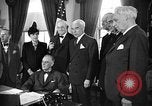
U.S. delegates meet with President Franklin Roosevelt before UN Security Conference; San Francisco city views (WW2)
United States delegates to the United Nations Security Conference meet with President Franklin Delano Roosevelt in Washington DC, United States. Seen are: Congressman Sol Bloom, of New York; Virginia Gildersleve, Dean of Barnard College; Senator Tom Connolly, of Texas; Edward Stettinius,Jr., Secretary of State,Commander Harold Stassen, USN, former Governor of Minnesota; In San Fransisco : Senator Arthur Hendrick Vandenberg, of Michigan; and Congressman Charles Eaton of New Jersey. View of Golden Gate Bridge and street scenes of San Francisco. Views of San Francisco hotels. The San Francisco Civic Center. Hotel buildings. Veterans War Memorial building. In Washington DC, U.S. delegation meets to form preliminary plan for their part in the organization of the World Security Council and International Court of Justice. Secretary of the State Edward Reilly Stettinius as Chairman of the U.S. delegation, speaks about their mission. (World War II period)
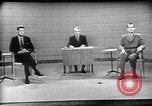
Senator John F. Kennedy and Vice President Richard Nixon face off in their first Presidential debate, in Chicago Illinois.
The first Kennedy-Nixon Presidential Debate in Chicago, Illinois. Moderator Howard K. Smith introduces the candidates-- Republican candidate U.S. Vice President Richard M. Nixon and Democratic candidate Senator John F. Kennedy. He talks about the opening and the closing statements to be given by the candidates. He talks about the questions which the panel of correspondents would ask the candidates. Senator Kennedy begins his statement. Kennedy talks about the direction of freedom for the Americans. He discusses domestic issues and the kind of society people live in. He talks about the strengths and the progress rate of the Americans. He urges people to make their country more powerful in every field. He feels disappointed about the unused steel-mill capacity, low rate of economic growth and poor educational system. He says he's not satisfied when he sees men like Jimmy Hoffa in charge of the largest union in the United States, and still free. He insists on overall infrastructural development and improvement of hydro power production where he says the Soviet Union has a lead. He states that every American should enjoy his full constitutional rights and they should meet their responsibilities. He says African American and Puerto Rican babies have much lower chances in education, work ,and advancement in the United States, and that this needs to change. He states that the government should provide effective programs and social security system for its citizens.
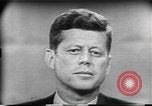
John F Kennedy talks about the importance of welfare programs during a presidential election debate in Chicago, Illinois.
The first Kennedy-Nixon Presidential Debate in Chicago, Illinois. Stuart Novins from CBS News asks Democratic candidate Senator John F Kennedy about welfare programs for education system, medical care and reduction in the federal debt. Kennedy argues that he has not mentioned about the federal debt reduction in his speeches. He states the advantages of his program for providing medical care for the aged and an effective education system. He tells that the development of natural resources will generate revenues to finance new projects. He states about the importance of a balanced budget. Republican candidate U.S. Vice President Richard M. Nixon presents his views and states that the reduction of federal debt was mentioned on the Democratic platform and not in Kennedy's speech. He presents his views on Senator Kennedy's proposal for medical care for the aged and the development of the natural resources. He states that Kennedy's proposals will result in rise in taxes and unbalancing of the budget which will lead to inflation. He favors the aid for school construction.
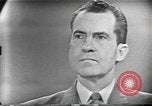
Richard Nixon argues against federal government control over education during a presidential election debate in Chicago.
The first Kennedy-Nixon Presidential Debate in Chicago, Illinois. Charles Warren from Mutual News asks Republican candidate U.S. Vice President Richard M. Nixon about the raising of education standards and the reason for his refusal to vote in favor of increase in salary of teachers in the Senate. Nixon answers and objects the potential cost in controls and states his views against federal government control over education. He talks about the role of the state and local communities towards the education system. Democratic candidate Senator John F Kennedy presents his views on the matter and states that the issue before the Senate was the money given to the state which would then decide whether to spend it for school construction or on teachers' salaries. He objects to the federal government paying teachers' salaries directly. He disagrees with the statement made by Nixon regarding unbalancing of budgets by execution of programs.
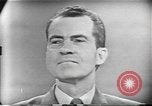
During a presidential election debate in Chicago Richard M. Nixon talks about the reasons for the financing of schools.
The first Kennedy-Nixon Presidential Debate in Chicago, Illinois. Sander Vanocur from NBC News asks Republican candidate U.S. Vice President Richard M. Nixon whether the financing of the schools and hospitals was provided by the Eisenhower Administration or by the local school districts. Nixon answers and states that they only think about the work of the federal government. Instead they should consider the joint effort by the federal, state, local government and individual enterprise. The reason the Eisenhower Administration has supported the funds to build schools, hospitals and highways is because this administration has encouraged individual enterprise. Another reason is the greatest expansion of the private sector of the economy and the overall growth of our country. Democratic candidate Senator John F Kennedy presents his views and states that the reason for the construction of schools is because of the willingness of the local school districts to increase property taxes. And also because the United States is a powerful country. He compares the country's progress with that of their adversaries and hopes an overall progress in the field of education, in health, in buildings, in homes and in economic strength.
CRITICALPAST.COM: About Us | Contact Us | FAQs - How to Order | License Agreement | My Account | My Lightboxes | Shopping Cart | Advanced Search | Featured Collections | Website Terms & Conditions | Privacy Policy ©2026 CriticalPast LLC.
License Agreement |
Terms & Conditions |
Privacy Policy
©2026 CriticalPast LLC.