


 Francais
 Deutsch
 Italiano
Refine Your Search
Ohio-State-football stock footage and images
- Showing 12097 to 12102 of 24492 results more
more Hide
Hide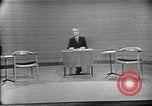
Richard M. Nixon and John F Kennedy give their summation speeches during a presidential election debate in Chicago, Illinois.
The First Kennedy-Nixon Presidential Debate in Chicago, Illinois. Moderator Howard K Smith asks the candidates to give their summation speeches. Republican candidate U.S. Vice President Richard M. Nixon starts his summation speech and compares the progress of the Soviet Union with that of the United States. And he states that in terms of the Gross National Product (GNP), the U.S. is far ahead of the Soviet Union. He compares his proposals with that of Kennedy and states that his own proposals would result in greater growth. He compares his health program which provides a choice of having either government insurance or private insurance with that of Kennedy's health program with compulsory government health insurance under Social Security. He talks about the spendings and inflation during Truman Administration. He concludes his speech and states that U.S. President's should work for every program that would mean growth. Democratic candidate Senator John F Kennedy comments on the statement given by Nixon regarding comparison of the Soviet Union and American economy. He speaks in favor of his proposed health program for aged which was an amendment to the Kerr bill and which provides assistance to all those who were not on Social Security. He thus contrasts Nixon's point on health program for the aged. He concludes his speech and speaks about the goals and responsibilities of the Americans. Moderator Smith thanks the candidates.
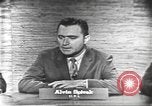
Richard Nixon and John Kennedy answer reporters' questions during a presidential election debate in Washington DC, U.S.
The second Kennedy-Nixon Presidential Debate in Washington DC, United States. Alvin Spivak of United Press International asks Republican candidate U.S. Vice President Richard M. Nixon to comment on his intentions in the field of civil rights. Nixon answers and states that progress is to be made in the field of employment by giving statutory authority to the Committee on Government Contracts. He states that in the field of schools, provisions should be laid whereby the federal government would give assistance to districts who want to integrate their schools. He speaks about presidential leadership. He concludes and says that the civil rights of the Americans should be recognized in order to protect the country from communist rule. Democratic candidate Senator John F Kennedy points that Nixon hasn't discussed what would be his policy on implementing the Supreme Court decision of 1954 and what would he do and what would be his leadership in providing fair employment, housing and education. He concludes by saying that the president must establish a moral leadership. Harold R. Levy of Newsday asks Kennedy to comment on what the President should do in racial discrimination events such as Little Rock Nine or the lunch-counter sit-ins. Kennedy says that he thinks that a president operates in different areas as a legislative leader, an executive leader and a moral leader and his functions differ in each area. He talks about the government contracts. He speaks about the standards set by the Americans which the Communists don't set. He comments on the case of Little Rock and says the U.S. President should go with the Supreme Court's decision. Nixon comments on the matter of the Committee on Government Contracts being mentioned by Kennedy. He talks about the functions of the Democratic Congress. He states that actions are required along with hopes. He concludes and says that in the field of executive leadership, U.S. president must lead and act as he talks.
Scenes of Washington DC, and people working inside various Federal buildings and government offices in Washington DC (WW2)
A World War II documentary titled 'Boomtown DC', a part of 'This is America' series, compares Washington DC to an industrial boomtown where the big business is government. 1930's and 1940's cars parked along a tree-lined street in a Washington DC neighborhood with homes visible. A cat jumps down from a wall behind a neighborhood home, with the U.S. Capitol seen in the background. Scene changes to U.S. Capitol building exterior close up. Close up views of souvenir stand trinkets in Washington DC, including banners, snow globes, and postcards of buildings and monuments of the city. View on the National Mall in Washington DC toward the Lincoln Memorial, interrupted by temporary wartime elevated walkways erected between buildings of the rapidly expanding Navy Department on either side of the National Mall. Smoke stacks from the chimneys of a factory superimposed over various images of buildings in the city. A woman exiting a voting booth, followed by a man entering the same voting booth and closing the curtain. A US Army guard standing outside the White House. Exterior view of the newly completed Department of State building (then called "Main State" and later known as the Harry S. Truman building housing the State Department.) Exterior of the newly built Pentagon War Department building in Arlington Virginia. Sign "War Department" on the War Department building at 21st and Virginia Avenues. Exterior view of a Navy Department building, then exterior view of the Treasury Department building. Close up view of hands holding and flipping through a stack of IRS individual tax return documents, then of hands sorting through a stack of U.S. government bonds. View of the Justice Department, and then view of sign on the Federal Bureau of Investigation. Scientists in a laboratory operate various equipment and run tests. A scientist near some beakers and test tubes in the lab. Scientists look through microscopes. View of underground rifle range in the FBI building as personnel practice marksmanship. View toward shooters on the range during firing, and toward targets. US Army guard in front of the Executive Office Building (also housing some State Department functions at that time). Exterior view of the Department of Labor building and sign. View of the U.S. Office of War Information building (OWI) with sign "US Information" inscribed in large letters on the top of the building (possibly the "Temporary V Building" of the OWI?) Exterior view of the Supreme Court Building. View of Declaration of Independence document on display. Exterior view of U.S. Capitol, then view of House of Representatives in session. U.S. President Franklin Delano Roosevelt seated at a desk signs a document. Citizens and workers walking on streets of Washington DC. Some people enter the Department of Agriculture building. Men and women enter the Office of War Information. Civilian and military hats being hung on a hat rack. Hand reaches for a 1940's era telephone. Women filing papers, views of filing cabinets. Close-up of 1940s era typewriters in use.
U.S. forces prepare for mission to shoot down Admiral Isoroku Yamamoto on Bougainville Island in WW2 Operation Vengeance
Opening slate reads, “Sensational War Films YAMAMOTO SHOT DOWN! South Pacific”. Image of Admiral Isoroku Yamamoto, the mastermind of the Pearl Harbor attack in 1941, in full navy regalia. Another image of Admiral Isoroku Yamamoto, in black navy uniform. United States soldiers riding a military jeep wave at the camera as their jeep drives in Guadalcanal Island during World War II. United States Army Air Force airmen are posing in front of a fighter for a camera. Airmen shake hands with each other. Airmen are talking to each other, with a fighter behind them. Three airmen laugh facing the camera. The camera pans to identify the airmen Lieutenant Besby Holmes, Captain Tom Lanphier and Lieutenant Rex T. Barber. A radio operator tapping out morse code on radio equipment. Japanese airmen receiving orders. A Japanese bomber with engines running. United States airmen run to their fighters. Airmen working on an engine and fueling aircraft to prepare for a mission. Airmen sitting on a bench listening to an officer pointing to a board. The officer, in sunglasses, points to a map titled “Target for Today”. Closeup of map, “Target for Today.” United States soldier smokes a cigarette.
African Americans pursue equality in education through landmark case "Brown v. Board of Education of Topeka" in 1953
Artist Impression of the Brown v. Board of Education of Topeka in 1953. Image of Thurgood Marshall, the first African American Associate Justice of the Supreme Court of the United States. Artist Impression of African-American boy reading a book inside a classroom. Image of young African American students studying in class. Image of an African American boy. Image of Chief Justice Earl Warren. Image of William L. Patterson, an African American lawyer who fought for black justice in American courts for years. Image of Martin Luther King Jr behind bars. Very brief images of Jim Crow era lunch counter sit in, and bus burning incident. Footage of whites protesting in favor of racial segregation. Image of Black Americans holding signs saying “Birmingham Merchants Unfair” and “Equal Opportunity and Human Dignity”. Image of white Americans holding placards saying “Close Mixed Schools”. Image of a black American couple running away from fire. Footage of black Americans walking to support civil rights while guarded by officers with shot guns in air. Brief footage of Ku Klux Klan (KKK) members parading and holding the United States and the Confederate flags. Image of Martin Luther King Jr. with young Black Americans. Footage of black and white students clapping together to support civil rights. Image of Thurgood Marshall with wife, Cecilia Suyat, and a friend in Washington DC. Image of Thurgood Marshall. Image of President John F. Kennedy. Footage of Senator James Eastland, Senator of Mississippi, raising a gavel in front of photographers. US senate in session. Image of Thurgood Marshall speaking to Robert Kennedy. Image of Thurgood Marshall as a Solicitor General, walking on the steps of the United States Supreme Court in Washington DC. Image of Thurgood Marshall as the United States Solicitor General.
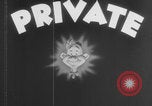
Cartoon animation “Private Snafu” depicts living conditions for soldiers posted in the Aleutian islands during WWII
Private Snafu Title Sequence. Cartoon animation “Private Snafu” depicts living conditions for soldiers posted in the Aleutian Islands during World War II. A view of Alaska and the Aleutian Islands. A Japanese soldier hops on the Aleutian Islands after emerging from the Pacific Ocean, only for a strong American soldier to stomp his feet when he opened “the backdoor to the United States”. Japanese soldier hops and dives back to the Pacific Ocean. View of Tokyo, Japan from the “Back door to the United States”. The cartoon depicts how harsh and challenging the environment in Aleutian Islands- having rain, snow, thunder and whirlwind gales. A seal resembling The Great Schnozzola (Jimmy Durante) replies with the Lower East Side accent, “Nevertheless, that’s the conditions that prevail.” View of a GI camp in the Aleutian Islands. Private Snafu sets out on an important mission, he changes his outfit according to weather. View of the vegetation of the Aleutian Islands, only grass in the tundra environment. After the narrator stated, “There are no trees”, a rabbit replied sarcastically “You’re telling me!”. United States Army Camp in Aleutian Islands covered in thick, gummy, mud. A serviceman is riding on two servicemen submerged in the mud. Inside a Quonset hut, American soldiers are playing dice. An earthquake rattles the Quonset hut and changes the position of the dice. Strong winds in the Aleutian Islands uproot Quonset huts, military installations and even the mountains. Soldiers struggle walking through a “Williwaw” (or strong winds in the Aleutian Islands) until it stopped, causing the soldiers to fall to the ground and the eggs a soldier was carrying to break. Private Snafu walks in the Aleutian Islands through different weather conditions in different outfits. Soldier drives a military jeep with skis in the snow. A cartoon B-17 covered in snow as it flies above the Aleutian Islands. An Eskimo sits around an ice fishing hole in the snow-covered B-17 wing. Private Snafu is wearing a steam whistle as he walks. Private Snafu changes his outfits according to weather condition while walking. Airmen run out of the Briefing Hut and dive in the watery air strip. Private Snafu dons a scuba diving suit to retrieve a B-17 submerged in the watery air strip. Private Snafu inside aircraft with fish. Private Snafu ejects the fish out of the aircraft. The fish activates a parachute to fall safely, only for it to drop into the gaping maw of the Schnozzola seal. The Schnozzola seal repeats his earlier dialogue to describe life in the Aleutian Islands.
CRITICALPAST.COM: About Us | Contact Us | FAQs - How to Order | License Agreement | My Account | My Lightboxes | Shopping Cart | Advanced Search | Featured Collections | Website Terms & Conditions | Privacy Policy ©2026 CriticalPast LLC.
License Agreement |
Terms & Conditions |
Privacy Policy
©2026 CriticalPast LLC.