


 Francais
 Deutsch
 Italiano
Refine Your Search
Ohio-State-football stock footage and images
- Showing 13621 to 13626 of 24492 results more
more Hide
Hide
Wedding ceremony of U.S. Senator Charles Percy's daughter Sharon Lee Percy and John Davison Rockefeller IV in Chicago, Illinois.
A wedding ceremony in Chicago, Illinois. United States Senator Charles H. Percy's daughter Sharon Lee Percy marries John Davidson “Jay” Rockefeller IV at the Rockefeller Chapel (5850 S Woodlawn Ave, Chicago, IL 60637, United States). The married couple walks together. Dignitaries and officials gathered for the wedding ceremony. The couple kisses.
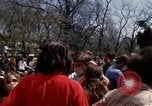
Earth Day demonstrators outside Department of the Interior building in Washington DC protest against oil drilling in the Gulf.
Earth Day in Washington D.C. (part of a series of clips in a row). Environmental activists and demonstrators protest against oil drilling in the Gulf and elsewhere. A large crowd of environmentalists and concerned citizens gathered on the street. They march holding banners. One demonstrator flashes the Peace sign and a clenched fist 'fight the power' sign at the same time. Banners seen include 'God is not dead he is polluted on earth' , 'R.I.P. 1990 A.D.', 'Standard Oil is Spouting Off', and 'No Oil Drilling in the Gulf' The people gather outside the United States Department of the Interior building. They protest against the oil drilling and attendant pollution. Senator Gaylord Nelson, organizer of Earthday, is seen in the crowd. A flag, similar to the United States flag, but with green stripes, flutters in the wind atop a flagpole. Oil that has been spilled on the sidewalk is seen.
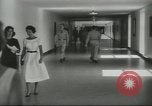
Soldier tours shops at the Pentagon and attends an army band and chorus performance during a concert in Washington DC.
The Pentagon in Arlington Virginia, just outside Washington DC. Soldier walks through the Pentagon building. A signboard on a wall reads 'North Atlantic Treaty Organization, Standing Group'. Officials greet a head of staff and the soldier. The soldier tours shops in concourse including Walgreens drug store and the National Bank of Arlington at the Pentagon. View of a shoe repair or cobbler services area. He gets a haircut by Donald Abbate at Joe Abbate's barber shop. Many military personnel seen getting haircuts. He eats at a cafeteria. He attends an United States Army band and Army Chorus performance during a concert in the Pentagon courtyard. People gathered applaud. Singer Steve Lawrence sings "Up a Lazy River" with "Pershing's Own" United States Army Band.
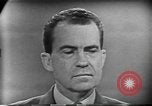
During a debate in Chicago, Illinois Nixon talks about his major recommendations which were adopted by the administration.
The first Kennedy-Nixon Presidential Debate in Chicago, Illinois. Stuart Novins from CBS News asks Republican candidate U.S. Vice President Richard M. Nixon about his major proposals in last eight years that have been adopted by the administration. Nixon answers and states that his major recommendations and proposals that have being adopted by the administration include: increase in the exchange programs like exchange of persons of leaders in the labor and information field. He further talks about his proposals like setting up of separate inter-American lending agency, his recommendations for the Hungarian refugee situation and price stability and economic growth that had been adopted. Democratic candidate Senator John F. Kennedy states his points on that question. He says that he disagrees with progress figures used by Nixon in his speech regarding the Truman Administration. He disagrees with the recommendations made by Nixon like price stability, exchange of students and labor unions being adopted by the administration.
Presidential election debate in Washington DC. Richard Nixon, debating John F. Kennedy, speaks about the spread of Communism.
The second Kennedy-Nixon Presidential Debate in Washington DC, United States. Moderator Frank McGee introduces the candidates - Republican candidate U.S. Vice President Richard M. Nixon and Democratic candidate Senator John F Kennedy. The Moderator tells the rules to the candidates regarding questioning by the reporters. The reporters include Paul Niven, Edward P. Morgan, Alvin Spivak, and Harold R. Levy. Paul Niven asks Nixon to comment on whether Truman Administration was responsible for the loss of China to the Communists. Nixon answers and says that he disagrees with Senator Kennedy's statement that Cuba is lost and certainly China was lost because of Truman Administration. He talks about the decrease in the number of dictators in Southern and Central America in the past years. He speaks about Kennedy's book 'The Strategy for Peace' which prohibits the Americans from interfering in internal affairs of any other state. Kennedy presents his views and says that he never suggested that Cuba was lost. He criticized Nixon because in his press conference in Havana in 1955, he praised the competence and stability of the Batista dictatorship. He criticized the failure of the administration to use its great influence to persuade the Cuban government to hold free elections. He hopes that some day Cuba would rise if the U.S. changes its policies towards it.
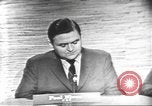
During a presidential election debate in Washington DC, Kennedy mentions the reasons for the decline of U.S. power and prestige.
The second Kennedy-Nixon Presidential Debate in Washington DC, United States. Paul Niven of CBS asks Democratic candidate Senator John F Kennedy whether he blames President Eisenhower and Vice President Nixon for the decline of American power and prestige in the last eight years. Kennedy disagrees with Nixon's statements regarding increase in American power and prestige. He talks about Nixon's experience in the administration and inability of the administration in not meeting its responsibilities which has led to decline in American power against that of the Communists. Republican candidate U.S. Vice President Richard M Nixon states that he has participated in discussions leading to decisions in his administration. He compares his programs with those of Kennedy. He also compares the economic progress of the U.S. in the Truman Administration with that of in the Eisenhower Administration. He concludes and asks Kennedy to differentiate his own programs from programs adopted by the Truman Administration
CRITICALPAST.COM: About Us | Contact Us | FAQs - How to Order | License Agreement | My Account | My Lightboxes | Shopping Cart | Advanced Search | Featured Collections | Website Terms & Conditions | Privacy Policy ©2026 CriticalPast LLC.
License Agreement |
Terms & Conditions |
Privacy Policy
©2026 CriticalPast LLC.