


 Francais
 Deutsch
 Italiano
Refine Your Search
Ohio-State-football stock footage and images
- Showing 1411 to 1416 of 24493 results more
more Hide
Hide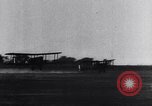
United States Army Air Service being built up before America's entry into World War I
While World War 1 was already underway in Europe, before the United States Air Service began to build up. Two U.S. DeHavilland DH-4 aircraft taking off. A formation of DH-4s in flight. A DH-4 upside down on the ground with soldiers all around it, including one sitting on a rock. Airplanes attacking a barrage balloon aloft, which burns and plummets to earth trailing dark black smoke. A candidate United States pilot undergoing physical testing. He is placed in a spinning chair and spun at high speed. Another pilot candidate performs a visual test with an array of lights on a panel being lit. Prospective Army pilots in U.S. Army uniforms marching and on a flight line with JN-4 Jenny training aircraft. Cadet turns propeller of a Curtiss JN-4 training airplane and the engine starts. Formation of DH-4 aircraft in flight. Lumberjacks in American northwest area of Oregon or Washington state felling a giant spruce tree after cutting it with a two man saw in the Cascade mountain forests. Massive Logs being transported by railroad to logging mills for eventual use in airplane factories. Men and many women war production workers busy working at an American airplane fabricating plant or factory during World War 1.
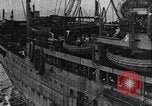
Soldiers march on streets holding rifles during World War I and veterans return to farming and dairying in United States.
A United States troop transport ship at sea during the first World War. U.S. Army troops (aka dough boys) aboard the ship. U.S. Army soldiers march in formation in a large city square area in Europe (likely France) holding rifles during World War 1. United States troop ships being loaded with American soldiers for World War I, and scenes of U.S. troops in WWI marching in the streets of a European city. Scenes from earlier during combat in the war. World War I allied soldiers on battle front in France. Soldiers run to a bomb crater area for shelter when crossing no man's land. Soldiers fire artillery. Artillery shells explode. Allied soldiers running across a battlefield as tanks run beside them toward the German enemy. People wave U.S. flags as First World War war ends with Armistice. Large crowd gathers in New York celebrating WWI armistice. Newspaper held high by a man with headline "Germany Surrenders". Views in the United States of hard times in American towns after World War I ended and war industries were no longer providing money. View of forests. Girl draws water from a well. Man and a boy operate a grindstone sharpening a saw. Farmers plowing fields with horse drawn plows during great depression era. People do agricultural works at fields. White farmer tilling a field. African American farmers working in fields and harvesting hay with help of a horse. African American farmers at cotton office. Cattle in field. Man and a woman milk cows with hands. Man pours milk in vessels. Milk processing before bottling including pouring milk through a cooling device. Men on tractor at fields. A board reads 'For the common defense'. Views of a factory. A man operates a switch on a switchboard for generating electricity. Views of a power generation plant. Narrator describes how America will prevent a slide into hard financial times again after World War 2 ends. From a 1942 production with footage from 1917 through 1942.
Motorcycle patrolman patrols on highways, unsnarls traffic jams; Snow removal from highways in winters, in the United States.
Maryland State Police motorcycle patrolmen at their post, with sign "Maryland State Police - Substation A". A police patrolman notices a moving violation by a motorist and gets on his motorcycle to pursue. The police officer pulls over the motorist and is seen writing a ticket for the woman driver in the car. A police officer on foot stands at a busy intersection and gives hand commands to control traffic at a bend on highway. Winter time views show a a big snow plow as it removes snow from highways during winters. Many 1920's and 1930's automobiles, including cars, trucks, and buses are seen on American roads and highways. A car passes on a bridge. Cars drive on a four lane. Next scene shows the Statue of Liberty as seen up close from an approaching boat. Final scene shows Bandmaster and United States Marine Corps band as they play. The conductor turns and takes a bow.
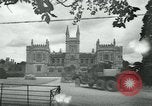
Military vehicles and supplies from the United States arrive in United Kingdom warehouses and bases (WW2)
Trucks arrive at Toddington Manor (Toddington, Cheltenham GL54 5DN, United Kingdom) in Gloucestershire, England. British children playing jump rope as vehicles transport tanks on the road. Rows of aircraft are transported by vehicles into town. The preparations for the D-Day invasion of France by Allied Forces, during World War II. A crane moves boxes. Boxes move in conveyer belts. Sacks, boxes, and crates stored at a distribution point. A man drives a forklift transporting boxes inside a warehouse. Military supplies arriving in Britain from the United States. Piles of tires, barbed wires, concrete tubes stored in docks and warehouses. Cranes move oil barrels into a pile. Military locomotives and freight cars bound for continental Europe at a railway yard. Soldiers open a crate containing a United States Army truck. A crane lowers a tank. A man inspects a row of military trucks. Rows of M3 half-track armored personnel carriers and M4 Tractors in England. A man helps a tank back up. Rows of tanks, artillery, and guns from the United States. Men stocking shells inside an underground storage. Piles of shells outdoors. A truck transports shell. Rows of fighters at an airfield. A man moves a search light at night. Anti-aircraft guns fire at German night bombers attempting to attack bases in the United Kingdom. Barrage balloons fly above warships. A sailor drops an anti-ship mine in the sea. Minesweepers seek and destroy such mines from the sea. Consolidated PBY-5A attacks a German ship.
16 million men register themselves in United States for the WWII draft, and President Roosevelt addresses from White House.
As World War II heats up, 16,500,000 men between ages 21 to 36 register themselves throughout the United States, signing up during the first peacetime conscription in U.S. history. (This was triggered by passage of the Selective Training and Service Act of 1940, also known as the Burke-Wadsworth Act, the genesis of "Selective Service.") Opening scene shows men lining up to register for the draft before the United States entered World War 2. Views of men filing out their registration forms. At 00:22 famous prize fighter, Barney Ross, is being registered. (He jokes that the registrar shaking his hand has too strong a grip.) At 00:34 Hollywood cowboy Gene Autry is seen registering. Close up view of street signs at Chinatown intersection of Bayard Street and Mott Street in New York City. Sign below it notes "School Street. Drive Slowly. Make no unnecessary noise." Line of many registrants of Chinese-American descent waiting in line, and processing paperwork. Scene changes to another area of the city, where a line of mostly African American men wait outside a registration building. Some cheer and wave for the camera. A police officer at the entrance hustles them inside, pulling some of them along. View of the exterior of the White House in Washington DC. United States President Franklin D Roosevelt addresses the nation's men of draft age, telling them that the call up of 800,000 men for training in year one, and less than one million men in each subsequent year, is a program of defensive preparation only. Roosevelt says to the registrants that "Democracy is your cause. The cause of youth." ( Note: clip is silent except for President Roosevelt speaking at the end.)
Various farming instruments and techniques involved in terraced farming in the northeastern United States
Terracing in the northeast United States for more effective farming. Various farming instruments involved in terraced farming in Northeastern states of the United States. Agriculture experts in a village measure level and various properties of field using instruments. A farmer uses divine sticks to detect underground water. Farmers plow the field using a tractor. Early Caterpillar and Case tractors shown. Tractors pull plows and plow the fields. Various farming equipment used by farmers. A pair of mules pull a plow. CASE tractor with a large spinning bit plows, spraying soil inward. View of plowed fields.
CRITICALPAST.COM: About Us | Contact Us | FAQs - How to Order | License Agreement | My Account | My Lightboxes | Shopping Cart | Advanced Search | Featured Collections | Website Terms & Conditions | Privacy Policy ©2026 CriticalPast LLC.
License Agreement |
Terms & Conditions |
Privacy Policy
©2026 CriticalPast LLC.