


 Francais
 Deutsch
 Italiano
Refine Your Search
Ohio-State-football stock footage and images
- Showing 14473 to 14478 of 24492 results more
more Hide
Hide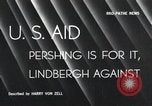
Retired General Pershing supports destroyers for bases deal; Charles Lindbergh supports U.S.neutrality in World War 2.
Prominent Americans with opposing pro-war versus anti-war messages early in World War 2. Retired U.S. General of the Army, John J. Pershing and Colonel Charles A. Lindbergh, express opposing sentiments in public statements. The 79 years old U.S. Army officer General John J. Pershing seated at a desk and speaks into a microphone. He speaks in support of the so-called "Destroyers for Bases" initiative of the Roosevelt administration (without using that term). Among his opening remarks, he states,"With democracy and liberty overthrown on the Continent of Europe, only the British are left to defend democracy and liberty ...." In contrast, speaking at a rally at Soldier Field in Chicago, sponsored by the "Committee to Keep America Out of War," Colonel Charles A. Lindbergh argues against American involvement in World War II.
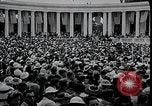
Franklin D. Roosevelt at Arlington National Cemetery together with John J. Pershing on Armistice Day 1936.
Activities in Arlington National Cemetery, Arlington, Virginia, United States during Armistice Day commemorations on November 11, 1936. U.S. President Franklin D. Roosevelt at Arlington Cemetery, standing beside U.S. Navy Admiral Arthur J. Hepburn. A large crowd gathered at the amphitheater near Tomb of the Unknown Soldier. U.S. Army General John Pershing speaks at amphitheater in Arlington.
Men are taught different safety measure like how to tie a square knot and a granny knot while working in mines in the U.S.
A documentary titled 'Safety in the Mine' depicts the safety measures to be taken by the workers in mines in the United States. Men practice artificial respiration on pretend "victims" to resuscitate them after suffocation in a mine. A man opens and displays first aid packages. A man demonstrates how to tie a square knot and a granny knot.
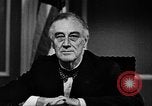
The funeral and interment of President Franklin D. Roosevelt.
President Franklin D. Roosevelt, looking frail, after his election to a 4th term, late in 1944. Newspapers announce his death, on April 12, 1945. View from high above, of funeral procession for Franklin D. Roosevelt. Crowds of mourners line sidewalks in Washington, DC, along the funeral route. Members of the military, in the crowd, salute as the flag-covered coffin of the President passes. Military pallbearers carry the coffin into the White House for a funeral service in the East Room. On April 15, 1945, Pallbearers carry Roosevelt’s coffin to a gravesite at the Roosevelt family home, Springwood, in Hyde Park, New York. Eleanor Roosevelt at President Roosevelt’s gravesite (4097 Albany Post Rd, Hyde Park, NY 12538, United States) with her children, including sons, James and Elliott, both in military uniforms.
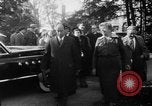
Eleanor Roosevelt in her final years
Eleanor Roosevelt championing Illinois Governor Adlai Stevenson II, as Democratic candidate for President, in 1960, in spite of two prior defeats at the polls. She is seen at an intimate gathering speaking with Stevenson and others. After Stevenson fails to gain the nomination, she supports the Democratic candidate, John F. Kennedy (JFK), with whom she is seen. In another scene, Mrs. Roosevelt stands with Kennedy, and Theodore Sorenson, his advisor and speechwriter. She sits with JFK as his political advisers stand behind them. October 31, 1962, Adlai Stevenson is seen informing the public that Mrs. Roosevelt is gravely ill. She dies on November 7, 1962. On November 10th 1962, mourners, including: Laura Delano, Nelson Rockefeller, Adlai Stevenson, former President Dwight D. Eisenhower, Ralph Bunche,Theodore Sorenson, and Robert Wagner are seen walking across a snowy churchyard in Hyde Park,at her funeral. They are followed by Former President, Harry Truman, with wife, Bess and daughter, Margaret. A moment later, President John F. Kennedy and Mrs. Kennedy arrive, accompanied by Secret Service Agents. A NY State Trooper salutes as they walk past to enter the chapel. Mourners gather around the bier as clergy officiate for the burial at Springwood, in Hyde Park. Closeup shows President Kennedy, Vice-President Lyndon Johnson, and former President Truman standing together. The eulogy by Adlai Stevenson is heard as a montage of Eleanor Roosevelt images is seen. On April 23, 1963, signs Congressional Act, chartering the Eleanor Roosevelt Memorial Foundation. He speaks about it outside the White House.
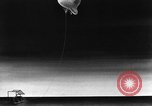
Animation shows the function of upper and lower link attached on a cable as enemy airplane hits the cable (WW2)
A World War II training film depicts the use of barrage balloon to damage enemy airplanes flying at low altitude during a war in the United States. Animation shows the function of upper link attached in the wire cable as an enemy airplane hits the cable. Animation shows the function of the lower link as the airplane hits the cable. The flying cable is cut. The parachute opens. The balloons attached with wire cables in sky. The results of the cable armament operation. An enemy airplane burns. Soldiers look at the airplane as it burns. The soldiers retrieve the balloon. A soldier folds the links of cable. Another soldier holds a link in his hand.
CRITICALPAST.COM: About Us | Contact Us | FAQs - How to Order | License Agreement | My Account | My Lightboxes | Shopping Cart | Advanced Search | Featured Collections | Website Terms & Conditions | Privacy Policy ©2026 CriticalPast LLC.
License Agreement |
Terms & Conditions |
Privacy Policy
©2026 CriticalPast LLC.