


 Francais
 Deutsch
 Italiano
Refine Your Search
Ohio-State-football stock footage and images
- Showing 15721 to 15726 of 24492 results more
more Hide
Hide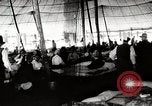
At the National Memorial Reunion and Peace Jubilee for Civil War veterans, former soldiers picnic and socialize.
Scenes from Vicksburg, Mississippi at the National Memorial Reunion and Peace Jubilee for United States Civil War veterans. Veterans sit beside their bedding under a huge tent shelter. Men wash up. Men wait for meals to be served. Men have meal. Men drink from mugs. Union and Confederate soldiers are seen together.
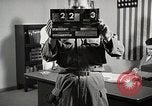
U.S. Consul Thomas H. Murfin, in Naha, Okinawa, informs Mr. Jan Hajdukiewiez of approval to enter the U.S.A.
Mr Hajdukiewiez, a former member of a Neutral Nation Inspection Team, enters the office of U.S. Consul, Thomas H. Murfin, in Naha, Okinawa, where Murfin best informs him that the U.S. Government has approved his entry into the United States. Murfin extends his wishes for a pleasant trip and the start a new life. American flag is displayed on the wall and picture of President Dwight D. Eisenhower beside it.
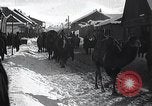
Russian troops moving supplies on camels during the Caucasus Campaign of World War I
Slate states: "Transportation difficulties are solved by Bactrian camels as they withstand the intense cold remarkably well. " Russian Army camel caravan moving supplies through a snow-covered village during the battle of the Caucasus, in World War 1. Later, they are seen moving across deserted field of snow, with partially pine-covered mountain in background.
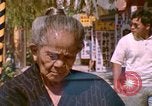
Native inhabitants of Okinawa Island, Japan
Native people of Okinawa. Japanese civilians walk on road. An elderly Okinawan woman on the street. An Okinawan man carrying a pole. A young woman and elderly woman in front of a watch shop. A Japanese woman in kimono crosses the road. Smiling Japanese men and women. Okinawan farmer tending pineapple plants. American Air Force non-commissioned officers at a bank window in a bank. Car drives past "Italian Food House Restaurant." An Okinawan farmer works on a farm. A Shinto shrine in Okinawa. Two Japanese men fix a boat. Truck at a mining site. Public union demonstrators demonstrate against United States air bases carrying red flags with Japanese writing.
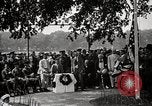
Dedication of the temporary Zero milestone marker at start of the 1919 Transcontinental Motor Convoy
Location is the Ellipse, south of the White House, in Washington, DC. The occasion is the dedication of a temporary Zero milestone in ceremonies at the start of the U.S. Army Motor Transport Corps'so-called "Truck Train," a convoy of military vehicles that is to travel the "Lincoln Highway" across the United States, to San Francisco, California. The ceremony begins with a flag raising, where all stand and uniformed Army officers salute. Congressman Julius Kahn, of California, salutes with his hat over his heart. The temporary marker is covered with white cloth and two wreaths, which officials remove and Secretary of War Newton D. Baker, begins his speech accepting the temporary marker. (A permanent marker needed an act of Congress for approval. So a temporary one was approved to allow the launch of the Army cross-country convoy.) The Washington Monument is visible in the background, as Mr. Baker delivers his remarks.
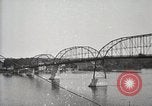
U.S. Army Transcontinental Motor Convoy crosses Mississippi River on the Lyons-Fulton Bridge from Illinois to Iowa
The 1919 Motor Transport Corps convoy en route from Washington, D.C., to San Francisco, California. The Convoy of U.S. Army trucks is seen moving slowly, over the Lyons-Fulton Bridge across the Mississippi River at Clinton, Iowa. While crossing the bridge, the convoy is led by an open car displaying an American flag, followed by a bicyclist. Pedestrians walk along side walkway crossing the bridge in the opposite direction. The convoy of Army trucks driving along a highway after crossing the Mississippi. Sign at side of road reads: "Bay State." Sign on one truck reads: "Frisco." Trucks display logo of U.S. Army Corps of engineers. The convoy driving along a road parallel to a railroad line. Next sequence shows one truck attempting to pull another that has been mired down in mud, in Nebraska. After some effort, the truck is successfully pulled out of the mud.
CRITICALPAST.COM: About Us | Contact Us | FAQs - How to Order | License Agreement | My Account | My Lightboxes | Shopping Cart | Advanced Search | Featured Collections | Website Terms & Conditions | Privacy Policy ©2026 CriticalPast LLC.
License Agreement |
Terms & Conditions |
Privacy Policy
©2026 CriticalPast LLC.