


 Francais
 Deutsch
 Italiano
Refine Your Search
Ohio-State-football stock footage and images
- Showing 15715 to 15720 of 24492 results more
more Hide
Hide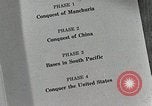
Japanese aggression in China and various events leading to Japanese attack on U.S. at Pearl Harbor (WW2)
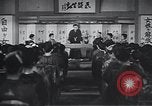
A hand writes check marks beside “Bases in the South Pacific” and “Conquer the United States” on the summary report purporting to reflect phases of Japanese so-called "Tanaka Plan". Animated map shows pressure by German forces in offensive against Soviet Union and illustrates German air war against Britain. Scenes of bombing destruction in Britain, including overturned double-decker bus in ruins of buildings. A Nelson Class British battleship viewed from dead ahead. She is followed by the aircraft carrier HMS Illustrious. The U.S. Capitol building in Washington, DC. American newspaper headline reads: "Navy Bill Passes House." and "Huge Sum Voted for Two Ocean Navy." A line of U.S. Navy battleships underway, led by the USS Mississippi (BB-41). A field full of U.S. M3 Lee tanks moving in formation, as they are overflown by several Douglas B-18 bombers. Assembled Japanese leaders in a forum. Japanese Naval officers in a planning conference. Closeup shows Admirals Shigeyoshi Inoue and Raizō Tanaka pointing at a chart and conversing as other officers look on. Next, bomb bursts and black smoke rises as the attack on Pearl Harbor is underway. The USS West Virginia, USS Tennessee, and the USS Arizona, burning on Battleship row, during the attack. Generalissimo Chiang Kai-Shek with staff officers walks to a waiting car. Forces allied with China, including American troops marching; British troops marching; and Dutch Colonial troops marching (in Batavia, the Capital of the Dutch East Indies). Japanese troops continuing their conquest of China, firing a field piece, and infantry charging. Newspapers announce Japanese advances into Malay Peninsula and Hong Kong. Others cite the Fall of Singapore and the Fall of Corregidor in the Philippines (6 May, 1942). Animated map shows Japanese occupation encompassing Indochina, Thailand, and Burma (with loss of the Burma Road) all of which compounded China's war efforts.
U.S. Lieutenant General Daniel Sultan explains Japanese aggression in China and need for troops in India and Burma during WW2
World War II film about the China, Burma, India (CBI) Theater of Operations. A soldier is seen filling out a form seeking information about him and inviting him to write in questions about anything he hadn't learned through normal information channels. Scene shifts to Information and Education Department of the Burma-India Command, where it is being processed by a soldier. Lieutenant General Dan I. Sultan, commander of Burma-India Theater, is seen next, seated at a desk, with wall map of the region behind him. He is appearing in an information film intended to inform troops under his command. He notes that more than half the troops who filled out the information form, asked why American troops were stationed in India and Burma. He refers to the recent recall of General Stillwell and the splitting of CBI into two theaters (China and India/Burma). He states that the purpose is a path toward Japan. An animated map shows China (that narrator notes has been fighting Japan since 1937). Animation shows Japan walling off China from the outside world, by seizing her ports, and then concentrating its grip on the Eastern part of the country. Without access by sea, the allies had only one option to assist China in the fight against Japan. That was to open the Burma Road. Film shifts to scenes of Japanese bombing of Shanghai and Chinese civilians abandoning the city in 1937 during Second Sino-Japanese War. Wounded and injured Chinese fighting fires while tending casualties in an open area. Glimpse of Chinese soldiers near one of their few large artillery pieces. A gun crew manning one of her few antiaircraft guns. Chinese jam road in trek to the unoccupied provinces of the country. Chinese carrying casualties on stretchers, making do without ambulances. Chinese coping in the face of all kinds of shortages. In contrast, well supplied Japanese troops are shown in formation. Japanese troops, military vehicles and equipment are seen. Japanese firing machine guns and heavy artillery against Chinese positions. Japanese armor and long lines of troops engaged against the Chinese, who continue to resist in spite of shortages and hardship. Chinese soldiers without shoes, marching in a column.
Documentary on status of women in Japan. Contrasts progressive efforts to past practices affecting lives of women.
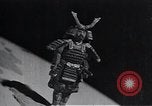
Documentary on the status of women in Japan. It begins with a group of "progressive" women working to improve women's lot. Images of Meiji statesmen Fukuzawa Yukichi and Mori Arinori are shown with comment that they recognized the importance of women and worked towards their equality. The narrator states that in spite of their efforts, attitudes towards women were slow to change. The narrator cites centuries of repression of women as a reason for this. (In the Nara period, however, songs from the anthology called the Manyoshu, indicate men and women had a more equal relationship, which is illustrated by a couple relaxing in a park, while girls dance in the background.) With that exception, women are shown to have had generally difficult lives in the past. scenes of women being supressed are reenacted, such as one where a man eats dinner while his wife sits quietly behind him. Another shows a woman being scolded by her husband. A woman pulling a heavily laden cart up a hill. Women bowing low while a Samurai passes them.
Tracing the opening of Japan to the outside world, from the time of the Shogun, to the modern era.
Symbolically Japanese Shogun secured the island empire from the outside world, as illustrated by a model with a fence around Japan. A model of early steamship and figures represent the visit to Japan of Commodore Matthew Perry, of the United States, in 1853, which resulted in a treaty opening Japan to broader commerce with the outside world. Japanese women read newspapers. Japanese Prime minister Hideki Tojo. Japanese Women as recruits. Japanese troops march. Japanese men and women queue up to vote.1950.
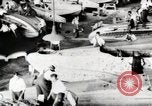
Views inside Curtiss aircraft factory where NC class seaplanes are being manufactured
Views inside Curtiss airplane factory at Garden City, Long Island, New York, in the United States, where workers are assembling Curtiss NC class seaplanes. The framework of a seaplane seen from above during assembly. a seaplane Hull seen from below as it is moved by traveling crane above the work area. A crane carries a V-12 Liberty engine to a cradle in the assembly area.

General Douglas MacArthur returns to the Philippines (WW2)
General MacArthur returns to the Philippines in World War II. Gun footage show Allied airplanes bombard Japanese ships in Mindanao, Philippines. Allied airplane in dogfight with a Japanese airplane. Japanese airplane gets hit and goes down. Allied airplanes attack a Japanese anti-aircraft tower. Allied airplanes bombard Japanese airfield on Mindanao. Allied ships bombard Leyte in Philippines and carrier-based plane bombard the Island. United States prisoners of war captured by the Japanese. General Douglas MacArthur and General Jonathan Mayhew 'Skinny' Wainwright VI and Admiral William Frederick Halsey can be seen. General Douglas MacArthur and his men after landing on Leyte beach.
CRITICALPAST.COM: About Us | Contact Us | FAQs - How to Order | License Agreement | My Account | My Lightboxes | Shopping Cart | Advanced Search | Featured Collections | Website Terms & Conditions | Privacy Policy ©2026 CriticalPast LLC.
License Agreement |
Terms & Conditions |
Privacy Policy
©2026 CriticalPast LLC.