


 Francais
 Deutsch
 Italiano
Refine Your Search
Ohio-State-football stock footage and images
- Showing 16135 to 16140 of 24492 results more
more Hide
Hide
People move in front of the decorated flowers during the National Flower and Garden Show in Seattle, Washington
The 22nd National Flower and Garden Show in Seattle, Washington. Cars driven in line in front of the Civic Auditorium (321 Mercer St, Seattle, WA 98109, United States) in Seattle. The board at the entrance of the building reads 'National Flower and Garden Show'. People move in front of the decorated flowers. Dramatization: women enjoy in the gardens. Women clean the gardens and water the plants. Woman moves around amidst flowers. American flag formed by the flowers. Different formations of flowers. A woman holds flowers and laughs.
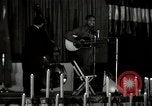
Joshua Daniel White, an American singer plays guitar and sings in New York City during Paul Robeson's 46th birthday tribute.
Joshua Daniel White in New York City, United States, performing at the 17th Regiment Armory (then at 34th Street and Park Avenue) during a celebration of Paul Robeson’s 46th birthday and the anniversary of the Council on African Affairs. During the 5 hours of entertainment, American singer Josh White plays guitar and sings 'The house I live in'. Another performer plays an instrument. Candles lit in front of stage. Audience claps.
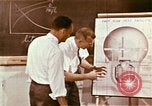
Atomic Energy Commission officials speak about a breeder reactor and a rehabilitation program in Richland, Washington.
Activities of the Atomic Energy Commission on the Hanford Project in Richland, Washington. Scientists work on various equipment for constructing a plutonium breeder reactor. Glenn Theodore Seaborg, the chairman of the United States Atomic Energy Commission(AEC), speaks about the breeder reactor. He points to a picture of the breeder rector in operation at the Atomic Energy Commission testing center. Cars driven towards the AEC center. An aerial view of the AEC center. Donald G. Williams, the manager of the AEC Richland, speaks about the Richland plant. Vehicles on a road. An aerial view of the township. He speaks about the development of a metropolitan city and about providing jobs to people who would loose their jobs due to the shutting down of a few reactors. A man prints a paper that reads Hanford capabilities. The members of the Tri-City Development Council with other government officials in a conference. Names of the various big organizations involved in the Hanford Project after the General Electric.
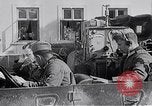
The invasion and siege of Warsaw, Poland by German forces during World War II
The German viewpoint of events during the Polish Campaign in Warsaw, Poland, during World War 2. Ostensibly to spare Warsaw from destruction, German radio operator soldiers wearing headphones, in a mobile communications center, issue an ultimatum from the German High Command, to the Commander of the city of Warsaw, demanding capitulation of defending forces within 12 hours. A German Junkers Ju-52 trimotor transport aircraft parked at a small airport. The aircraft takes off (to disperse handbills with this message.) A German Dornier DO-17 bomber takes off. Next, a German checkpoint is seen clogged with vehicles amd persons attempting to leave the city. Narrator states that only 870 members of the Diplomatic Corps and 1200 foreigners elected to leave. They are seen departing along a road set aside for that purpose by the German High Command. German officers supervise their departure. One, carrying Japanese envoys or diplomatic delegation, bears a large Japanese flag on its roof. Next, the siege of Warsaw begins, with German gunners loading and firing a 305mm siege mortar. They take refuge in a trench behind the weapon when it fires. Other German field artillery firing, including a 75mm field piece, a 15 cm sfh18 german heavy field howitzer and others not seen. German gunners using periscopic range finding equipment and looking through binoculars to direct artillery. A freight train hit by gunfire. More German 15cm sFH 18 guns firing. German troops watching the artillery barrages from a trench. Smoke rising in distance. More sfh18s firing. Smoke clouds forming above the city. Adolf Hitler observing the artillery siege through periscopic binoculars. Tops of the heads of his officer entourage (their uniform caps) as they crowd around Hitler. More smoke rising as the artillery barrages continue. Adolf Hitler holding binoculars as he stands in the company of army officers. He, and they, look up at sound of aircraft overhead. View of Ju-87 Stuka dive bombers low overhead. Aerial view of smoke on ground and formed into billowing clouds above the city. View from cockpit of observation plane, of smoke rising from Warsaw citadel.

U.S.and Soviet efforts at disarmament during Reagan-Gorbachev era
Film opens with U.S.President Ronald Reagan commenting about mistrust between America and the Soviet Union. View of President Ronald Reagan and Soviet General Secretary Mikhail Gorbachev signing the arms control agreement banning the use of intermediate-range nuclear missiles, at the White House in Washington, DC on December 8, 1987. A Soviet RT-2PM Topol mobile ICBM moving on its carrier vehicle. A U.S. intermediate range missile being launched. Another view of U.S.President Reagan and Soviet General Secretary signing the Intermediate-Range Nuclear Forces Treaty (INF Treaty) on December 8, 1987, to become effective on June 1, 1988. Views of ICBMs being test launched from silos. A Soviet Tupolev Tu-95 strategic bomber in flight, seen from the side and from underneath. A U.S. Navy heavy cruiser, armed with cruise missiles. Closeup of a cruise missile rising from the ship and firing across it toward a target. Illustration of a seaborne missile fired from a warship. General Secretary Gorbachev in a group, including his wife, Raisa, visiting a Soviet Navy submarine. Major General William F. Burns, Head of the Arms Control and Disarmament Agency (in civilian clothes), is seen raising doubt about the feasibility of the Soviet suggestion to use scientific methods for checking from a distance about arms control compliance. Artist conception of satellites being shot down in space. Secretary of State, George Schultz and his wife, Helena Maria, descending steps from an airplane upon landing at Moscow, in the Soviet Union to confer with Soviet leaders in Moscow on Nov. 4, 1985, in preparations for the meeting between President Reagan and Mikhail S. Gorbachev, the Soviet leader, later in the month in Geneva, on November 19th and 20th. Negotiating teams assembling in a meeting room in Moscow. Secretary Schultz and Soviet Foreign Minister, Eduard A. Shevardnadze conversing. William F. Burns, saying, " I think we are well on the road to achieving a useful, good, and balanced treaty." Views of civilians killed by chemical weapons in the Iran-Iraq war. Soldiers in protective gear associated with chemical weapons. One soldier decontaminating a tank using a water hose. Tanks moving in Europe. U.S. troops firing an antiaircraft gun. Scenes of World War II showing conventional arms being used on tanks and from landing craft. Afghan fighters carrying a wounded comrade. Glimpse of soldiers in a trench firing a mortar and one firing a machine gun, during the Iran-Iraq war. An armored personnel carrier moving across a muddy field. More views of Reagan and Gorbachev signing the INF treaty in 1987. A U.S. spokesman noting that the USSR has not changed the offensive nature of its force structure and deployment patterns.

Demolition crews at work during a rehabilitation program at Manhattan, New York
The joint city state federal private project on rehabilitation at Manhattan, New York. Demolition crews at work during the rehabilitation program at a cluster of adjacent old-law tenements on East 5th Street (nos. 633–637) just south of Tompkins Square. They take out floors, walls, and windows of a run down building in the lower east side. The prefabricated ("prefab") kitchens and baths are lowered through the roof. Sign describes the project as "Instant Rehab. A demonstration of rapid rehabilitation." Former residents of the building are seen in front of the apartment building. Narrator says 11 families had lived in the tenement, and 15 apartments now are ready for their return. Group of officials including New York Mayor John Lindsay stand near the project. Keys of the new apartment building units are seen hung on a board. A woman enters one of the new apartments and opens a cabinet in the new kitchen.
CRITICALPAST.COM: About Us | Contact Us | FAQs - How to Order | License Agreement | My Account | My Lightboxes | Shopping Cart | Advanced Search | Featured Collections | Website Terms & Conditions | Privacy Policy ©2026 CriticalPast LLC.
License Agreement |
Terms & Conditions |
Privacy Policy
©2026 CriticalPast LLC.