


 Francais
 Deutsch
 Italiano
Refine Your Search
Ohio-State-football stock footage and images
- Showing 16993 to 16998 of 24492 results more
more Hide
Hide
American Expeditionary Forces (AEF) enter a village in France during World War I.
The United States enters World War I. French refugees flee from their homes to safer places. People move along a road. Horse drawn carts carry their belongings. People carry their belongings as they move along a rail road track. American soldiers enter a village as people look on. (World War I; World War 1; WWI; WW1)
Allied soldiers advance and an Allied ammunition dump is blown up in France during World War I.
Allied troops in France during World War I. United States 89th Division ammunition dump blown up by Germans on October 25, 1918 and smoke rises. A huge pillar of smoke rises upwards. Men in the foreground as the smoke from the ammunition depot rises. Artillery being fired by Allies at German enemy position. Explosions occur in a field. Allied infantry and cavalry units advance. Allied soldiers fire artillery. Damaged buildings in the background. Allied troops near a rail road track. Explosions occur and soldiers advance into a forest.
World War I armistice celebrations; Allied soldiers being decorated by General Pershing
People celebrate on the streets of New York after the Germans sign the armistice agreement ending World War 1 on November 11, 1918. People cheer and wave their caps. A French couple thanks Allied soldiers for rescuing them from Germany. Allied soldiers lined up in a field in France as U.S. General John J. Pershing decorates them. Troops of the United States 42nd Division march at a parade as General Pershing reviews them. Soldiers carry American flags at the parade.
U.S. Lieutenant Henry Reuterdahl paints a sign board outside a navy building in Washington D.C. during Liberty Bond drive
Promotion of Liberty Bonds in Washington D.C., United States during World War I. Lieutenant Henry Reuterdahl and another officers paint a sign board outside the Navy Building. Men in foreground with the sign promoting the sale of Liberty Bonds in the background. Lieutenant Reuterdahl paints part of the sign which reads ' Sink the U Boat '. The sign has a separate hard cut-out piece in the shape of a German submarine. It moves along a sliding groove so that it can be shown as sinking into the painted waves. Lt. Reuterdahl moves the end of the U-boat cutout up and down showing its motion.
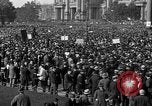
Paul von Hindenburg leads ceremonies in Deutsches Stadion, Berlin, Germany, in World War I
A crowd of German civilians is seen gathered in the Lustgarten. But the scene shifts suddenly to the Berlin Deutsches Stadion (Deutsches Stadion, Olympischer Platz 3, 14053 Berlin) in the Grunewald Racecourse. Men in old-fashioned traditional military uniforms march into the stadium, carrying flags of the various German States. They parade around the perimeter of the stadium. Flag of the German Weimar Republic flies over the principal building in the stands. The flag bearers on the field lower their flags, in salute. Next, Field Marshal Paul von Hindenburg and his deputy, General Erich Ludendorff, enter the field, leading several military officers, together with a civilian, carrying a sign reading: "I.G.I.D." They are followed by a long line of civilians. Spectators are on their feet in the stands where some men wave their hats and some women wave handkerchiefs. (World War I; World War 1; WWI; WW1)
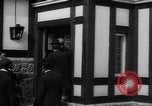
Ladies and gentlemen gather to hear a speaker at a courtyard in Wales, during World War I
British men and women entering a building in Wales, UK. They assemble before a stage at the back of the building. Participants are well dressed and constitute a dignified gathering. A gentleman addresses them. British flags displayed and a sign stretched across the top of the stage reads, in Welsh: "adgofion mebyd ein gwron,gwron y byd." ( childhood memories of our hero, the hero of the world ). The gathering may be of political nature and the sign may allude to David Lloyd George who spent his childhood in Wales.(He was Secretary of State for War and then Prime Minister of the United Kingdom at the head of a wartime coalition government, beginning in 1916.) Following the meeting, participants come out of the front entrance, and pose momentarily for the cinematographer, before continuing on their way.
CRITICALPAST.COM: About Us | Contact Us | FAQs - How to Order | License Agreement | My Account | My Lightboxes | Shopping Cart | Advanced Search | Featured Collections | Website Terms & Conditions | Privacy Policy ©2026 CriticalPast LLC.
License Agreement |
Terms & Conditions |
Privacy Policy
©2026 CriticalPast LLC.