


 Francais
 Deutsch
 Italiano
Refine Your Search
Ohio-State-football stock footage and images
- Showing 17791 to 17796 of 24492 results more
more Hide
Hide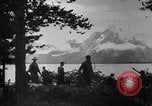
Civilian Conservation Corps at work in Yellowstone National Park
Members of the Civilian Conservation Corps (CCC) make improvements in Yellowstone National Park, Wyoming, United States. Men working with picks, and setting log fencing along paths in Yellowstone Park. The Yellowstone Canyon and falls is seen in distance behind and below them. Crews work on stones at base of falls. "Old Faithful" geyser seen erupting in snowy landscape. (Great Depression period)
American citizens celebrate "I am an American Day" in New York City during World War II.
Opening slate reads “New Americans Celebrate their Citizenship.” Huge Crowd is gathered in New York City’s Central Park, on “I am an American Day,” which also includes newly naturalized American citizens (although they are not featured, as such, in the film). New York Mayor, Fiorello LaGuardia, presides and delivers a speech from a podium. New York clergymen are seated with one another on a front row seat where patriotic bunting is draped. Vice President Henry R. Wallace is also seen in that front row. Various views of U.S. military units parading along 5th Avenue in New York City. The units include huge columns of United States soldiers, including one large group of African American soldiers.
The Pacific War Council and British and American General staffs meet at the White House in Second Washington Conference in World War II
Allies of the Pacific War Council met at the White House on June 25, 1942 Pictured with President Franklin D. Roosevelt and British Prime Minister Winston Churchill (both seated) and Canadian Prime Minister, Mackenzie King, standing immediately behind and between them. Others, standing behind are: Dutch Minister of Foreign Affairs, Eelco N. van Kleffens, Australian representative, Stanley Melbourne Bruce. The tall man behind Prime Minster King, is British Vicount Halifax (Edward Wood). To his left is Chinese Foreign Minister T.V. Soong, and Manuel L. Quezon, President of the Commonwealth of the Philippines. The last person standing at the right, is Walter Nash, New Zealand's minister to the United States. Scene shifts to military leaders of the combined British and American General Staffs, meeting in the so-called Second Washington Conference (Code named Argonaut). Closeup of U.S. Army Chief of Staff, General George S. Marshall, conversing with lieutenant General Henry H (Hap) Arnold, Commanding General of the U.S. Army Air Forces. Another closeup shows U.S. Navy Chief of Naval Operations, Admiral Ernest King, conversing with Admiral William D. Leahy, personal Chief of Staff to President Roosevelt. Glimpse of British Military General Staff members.
Battle of Papua New Guinea in World War II
Animated map shows New Guinea and Papau. Areas occupied by American and Australian Forces , seeking to dislodge Japanese Forces, at Buna and Gona, are shown. General Douglas MacArthur, arrives at Papua. He strolls through an American/Australian milltary camp in the jungle. He is dressed in a perfectly pressed uniform, smoking a cigar. (Narrator states he arrived to take personal charge of the offensive.) Closeup of MacArthur. American troops flown in from Australia, advance toward the Japanese positions at Buna. Another scene shows Australian troops making their way through jungles as they advance over the Owen-Stanley mountain range toward Gona. Australian troops fire mortars and one seen firing a Bren light machine gun. An American soldier firing an M1919 Browning machine gun. More views of Allied soldiers firing rifles and machine guns, including a water-cooled Browning M1917 gun. A bomb or shell explodes at a Japanese position. Scene shifts to Allied Military Headquarters in New Guinea, where staff plot information on large status maps about Japanese reinforcements arriving in the Bismark Sea, to bolster the enemy’s defenses. An Australian pilot runs to his Spitfire airplane, and American pilots rush to their B-25 Mitchell bomber, named “Dirty Dora.” An Australian Douglas A-26 invader airplane taking off. The B-25, Mitchell bomber (Dirty Dora) taking off. A USAAF B-17 Flying Fortress bomber taking off. More Allied aircraft taking off and in flight, including a formation of Australian A-26 invader airplanes. An Australian Airspeed Oxford training aircraft is seen diving . View from cockpit of an A-26 Invader airplane firing machine guns at Japanese ship. View of Allied warplane dropping bombto skip a Japanese ship. Bombs explode. Aircraft strafing Japanese ship. Various views of smoke rising from struck many Japanese ships. (World War II; WW II; World War 2; World War Two)
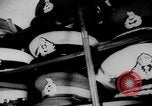
British and American military leaders personnel pose in a room during the Quebec Conference of World War II
Fifteen to twenty military caps on a rack. Allied Military leaders pose, including General Omar N Bradley, General Henry H Arnold, Admiral William D Leahy and Mr Anthony Eden, British Secretary of State for Foreign Affairs. Other military leaders seen include Lord Louis Mountbatten, Admiral Dudley Pound, General Sir Alan Brooke, Sir Charles Portal, General Hastings Ismay, Admiral Percy W. Nelles , Lieutenant General Kenneth Stuart, Field Marshall Sir John Dill, Admiral E.J. King, General George Marshall. Generals seated around table at the Quebec Conference.
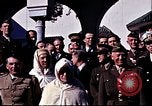
Major General George Patton and U S officers leave in car (WW2)
American and French officers pose for the photographers. United States military officers in Morocco during World War II. Among the group are Major General George S Patton, Major General Hobart R Gay, French General Charles Nogues and Grand Vizier to the Sultan. General Patton and U S officers leave by car. Mohammed V of Morocco is seen. Guards on the steps of building.
CRITICALPAST.COM: About Us | Contact Us | FAQs - How to Order | License Agreement | My Account | My Lightboxes | Shopping Cart | Advanced Search | Featured Collections | Website Terms & Conditions | Privacy Policy ©2026 CriticalPast LLC.
License Agreement |
Terms & Conditions |
Privacy Policy
©2026 CriticalPast LLC.