


 Francais
 Deutsch
 Italiano
Refine Your Search
Ohio-State-football stock footage and images
- Showing 3799 to 3804 of 24494 results more
more Hide
Hide
United States Army Parachute Team demonstrates sky diving techniques
Portion of film titled: 'The Big Picture' about the U.S. Army Parachute Team. Captain James M. Perry, Commander of the team, explains that, as an Agency of the Continental Army Command, the Team represents the Army in Sports Parachute Competition (AKA Skydiving). He talks about the achievements of U.S. Army parachute team. He states that the team has represented the country in International Sports Parachute competitions. He discusses history of the parachute, showing a model of earliest parachute design attributed to Leonardo Da Vinci, noting it was never tested. At a blackboard, he points out illustration of a parachute used successfully by French balloonist, Andre Jacques Garnerin in 1797. He notes that Benjamin Franklin witnessed that event and was influenced to conceive the idea of its military use. Change of scene shows Captain Perry reviewing the members of the Army Parachute Team on the tarmac in front of a C-123 aircraft, which they then board by way of the rear cargo ramp. View of the team inside the aircraft cabin. At altitude, team members exit via the rear cargo door and sky dive toward earth. They execute maneuvers, including some in formation while in free-fall. Smoke seen from smoke grenades as they descend. The team members open their chutes at just above the 2200 foot altitude, and maneuver their checkered chutes to precise landings.
American women war workers leave their children in nursery schools and work in factories in the United States (WW2)
American women work in war materiel factories in the United States during World War II. American women war workers leave their children in nursery schools before going to work. Children play and enjoy in the school. Children seated at a table as they eat food. Women work inside the factories to produce war materiel. They pick their children from the schools and arrive back to their homes.
The experiment conducted by Army signal corps for the towing of an aircraft by another plane in the United States.
The experiments being conducted by the Army Signal Corps for glider tactics in the United States. A man ties a rope to the towing aircraft. The aircraft takes off. The other plane being picked up. The aircraft in flight. People watch the new experiment.
Processing of recycled metal for war effort in United States. Views of largest aluminum plant in the world (WW2)
Processing of war materiel from scrap in the United States. Tin cans saved in scrap metal being loaded onto railroad trains. The train carries the collected metal to processing plants. Exterior view of the largest aluminum plant in the world during World War II. U.S. Navy sailors host a flag outside the plant. People watch the flag hoisting ceremony. Interior of the aluminum plant with war production workers busy. Aluminum is created and rolled out into thin sheets for use in war equipment manufacture, including aircraft bodies, wings, and engines.
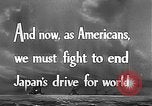
Wartime assembly line production in munitions factories and troops in the United States prepare for war against Japan.
After America declares war on Japan during World War 2, a propaganda piece urging U.S. citizens to be involved in the war effort, praying, working, and fighting for Freedom. Interior of an ammunition factory in the United States. Massive rail gun or naval gun barrel during assembly process. An assembly line with tanks. U.S. Army M2 tanks on proving ground being tested. Destroyer ships and Victory ships being launched. An aircraft factory showing fuselages of bomber aircraft lined up. Engines lined up ready for an assembly line. West Point Army cadets march. U.S. Army General Douglas MacArthur salutes troops. Narrator statement at end is "So wake up America. We must win or die." A large American flag shown waving.

The history and traditions of the U.S. Army in the United States.
An orientation film titled 'The Long Gray Line' for West Point Military Academy's plebes in the United States. The academy's history and traditions are depicted. Exterior of a chapel. Soldiers pray inside the church. They march on a street. U.S. Army Commander-in-Chief George Washington seated at his desk writing a letter. The soldiers march along a road. A statue. The soldiers stand in formation.
CRITICALPAST.COM: About Us | Contact Us | FAQs - How to Order | License Agreement | My Account | My Lightboxes | Shopping Cart | Advanced Search | Featured Collections | Website Terms & Conditions | Privacy Policy ©2026 CriticalPast LLC.
License Agreement |
Terms & Conditions |
Privacy Policy
©2026 CriticalPast LLC.