


 Francais
 Deutsch
 Italiano
Refine Your Search
Okinawa Ryukyu Islands 1944 stock footage and images
- Showing 829 to 834 of 9549 results more
more Hide
Hide
Allied assaults against the German Gustav Line at Monte Cassino, Italy during World War II
Opening scene shows peaceful Italian mountains, including one snow-capped, in Spring, 1944, during World War 2. Camera focuses on the town of Monte Cassino and its historic Monastery, on a mountain above the town. (German forces held the Rapido-Gari, Liri and Garigliano valleys and some of the surrounding peaks and ridges that formed the heavily defended Gustav Line.) Animated relief map shows where, by mid January, 1944, American, Polish, and British forces had cleared the enemy from mountains east of Cassino and drawn up on the east side of the Rapido valley. Map shows progress of subsequent Allied attacks that finally reached Mount Castellone and then up Abbey Hill at Monte cassino, itself. Image of German soldier is superimposed on the scene, using binoculars on Abbey hilltop to observe Allied forces. (Narrator states: On February 9th, 75 yards from the abbey, we were stuck.") U.S. Army Air Forces Douglas A-20 Havoc aircraft are seen starting engines. Closeup of Fifth Army leaflet warning the local people to leave the Monte Cassino Abbey to avoid shelling and bombing. View of U.S. troops packing the leaflets into thin-skinned shells to deliver the warning by artillery fire. Next, 105 howitzer guns are seen under camouflage netting, firing bombardments of warning shells. Formation of A-20 aircraft taking off. Aerial view from high above, of B-25 bomber formation in flight. Formations of B-17s, B-24s, B-26s in flight enroute to bomb Monte Cassino. Bombs dropping from B-25 Mitchell bombers. Bombs exploding on Monte Cassino and the Abbey. Batteries of 155 mm guns firing. Formation of 6 B-25 bombers in formation. More bombs bursting on Monte Cassino. Animated map shows German forces taking up their earlier defenses again following the Allied artillery and air attacks. It also shows supplies streaming in to the German Green Devils Parachute Division (Luftwaffe’s 1st Fallschirmjaeger [Parachute-Hunter] division.) The map illustrates all the locations in the town that they occupied and would defend to the last man. Map also illustrates circling positions of Allied artillery batteries. Camera focuses on Polish troops and M4 Sherman tanks moving forward in an offensive. Glimpse of U.S. Army Air Forces mechanics working on a Douglas bomber engine. M4 prime movers towing 155mm howitzer guns. Gun crews camouflaging their positions with netting. Various views of A 240mm howitzer being put in place by a crane. Soldiers deploy detector microphones to locate enemy gunfire sources. They test them, and then enclose them in water-proof containers, bury and cover them. Sound from the microphones being recorded on film at a machine in the Command Post. The data being plotted on a map and corresponding grid locations phoned to Battalion headquarters. View of bombers resuming attacks again, on March 15, 1944. Formations of Douglas bombers, followed by B-25s, seen dropping bombs that explode in the town of Monte Cassino. Artillery firing. Formation of B-24 Liberator bombers in flight. Formation of B-17s dropping bombs. String of bombs exploding in a line on the town. More views of artillery barrages. More lines of bombs exploding. Allied forces storming the shattered town found German soldiers using destroyed structures as shelters to fire from and rubble obstructing the movements of Allied tanks, so the Allied advance was again stopped. Later, a newspaper headline reports resumption of Allied offensive.
Strafing and attacking ground targets, ME-109 and FW-190, European Theater.
The 8th Fighter Command Operations, European Theater. 27-May-1944; Lieutenant R L Baker of 82nd squadron 78th fighter group flies the aircraft. Attacking the ground targets as seen via gun camera footage. Strafing of two flak towers. A decoy aircraft in flight. 29-May-1944; Captain B L McGratten of 335th squadron 4th fighter group flies the aircraft. Attacking ME-109 and FE-190. Aircraft fly fighter protection for formation of B-17's. Chasing and hitting of FW-190. 30-May-1944; Lieutenant J R Cook of 360th squadron 356 fighter group flies the plane. Strafing of large freighter, schooner and two small targets. (World War II period).
U.S. Army Air Forces Troop Carrier crews assemble for briefing in Italy prior to the invasion of Southern France in World War II
American Troop Carrier crews gather for a briefing on August 14, 1944, the day before the Operation Dragoon invasion of Southern France, in World War 2. The captions then refer to their return to the United Kingdom later that month, and to the United States in October 1944. The air crews are seen assembled outdoors at an airfield in Italy. The weather is hot and some of them are shirtless. Some airmen are seen wearing Khaki shorts or singlets. Views of the Statue of Liberty and Manhattan, New York City skyline, taken when some aircrew members returned to the United States in October 1944.
U.S. shuttle-bombing of German positions and military installations under Operation Frantic during World War II.
Film title slate indicates "Operation Titanic" but it, in fact, depicts "Operation Frantic" with U.S. shuttle bombing operations over Germany from bases in Great Britain, Italy and Russia during World War II. United States Army Air Force B-17 Flying Fortresses in flight. Aerial view of bombers in flight with several aircraft flying in formation leaving behind contrails. View inside bomber aircraft with bombardier preparing to drop bombs. View of bomb bay door opening and closeup of hand near bomb drop switch. Bombs awawy view as bombs are dropped from American aircraft. German defenses are bombed along the invasion coast of France (just prior to D-Day) on June 2, 1944. Aerial views of B-24 and B-17 bombers also in flight bombing German military installations in German-occupied northwestern Europe. Aerial view of a target area. Smoke rising up from bombardment. Two different U.S. Army Air Force B-17 Liberator aircraft are seen falling from the sky toward crashes after being hit by German enemy fire. One of them has smoke trailing from it, and the other is in a free fall. Railroad and marshaling yards are also bombed over Debrecen, Hungary on June 2, 1944, with aircraft continuing on (shuttle bombing) rather than returning to base. United States Army Air Forces B-24 Liberator flying in formation on June 21, 1944. Aerial view as they bomb the Focke-Wulf Fw 190 engine aircraft factory near Basdorf, Germany. German factories are bombed. B-17 aircraft on the same date are seeing in formation and bomb railway stations, freight yards, and factory targets, along with the Nazi German Ministry of War, Ministry of Propaganda, and Gestapo headquarters in Berlin, Germany. Heavy flak bursts seen in the air near the aircraft. Dogfight scenes as several German airplanes are shot down. Machine gunners aboard U.S. bomber aircraft firing at German fighter aircraft and shooting down 43 of them, according to narrator. Aerial view of ball turret rotating below bomber and firing guns at German fighter aircraft. The B-17s and B-24s bombing the targets. Synthetic oil plants and refineries are bombed at Ruhland Germany, east of Leipzig. Planning for the operation was done on December 7, 1943. A document about the operation is typed. Animated map shows Nazi positions and method of shuttle-bombing, allowing American aircraft to bomb from Soviet bases, and allies broadly to bomb German targets from bases in the United Kingdom, Italy, and Soviet Ukraine.
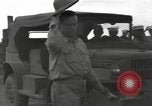
Bob Hope and his USO Troupe visit a U.S. Navy base on Mios Woendi island, Schouten Islands, Papua New Guinea, during World War II.
Bob Hope and members of his USO troupe ride on a PT boat during visit to entertain U.S. Navy personnel during World War 2. In opening scene, Bob Hope doffs his pith helmet as he strolls past the camera to climb aboard a PT boat (PT-331) of U.S. Navy Motor Torpedo Boat Squadron 21, where several naval officers greet him. Members of Hope's USO troupe, Patty Thomas, and Francis Langford, step from jeeps to board the PT boat. Next, the two are seen in the cockpit of the boat next to its captain, Lieutenant Kermit W. Montz, USNR, as the boat speeds along in the water. Among sailors occasionally glimpsed behind them is Radioman 1st Class bill Thielen. In change of scene, Bob Hope climbs out a hatch, holding onto his pith helmet to keep it from blowing off. The boat's number, 331 is clearly displayed on superstructure behind him. Various Navy sailors on deck. (Note: Squadron 21 received a Presidential Unit Citation for outstanding performance during the Huon Peninsula Campaign against Japanese forces from October 1943 to March 1944.)

The Voice of America relay station in Onna Okinawa, begins broadcasting
Voice of America radio studio broadcast facility in Okinawa. Interior of relay station. Close-up view of wall clock with hands pointing at 2 o'clock. A lucite sign beneath the clock begins to flash message "On Air." A sign reading "Voice of America" is seen at base of clock. Wall clock with its hands at 3 o'clock.
CRITICALPAST.COM: About Us | Contact Us | FAQs - How to Order | License Agreement | My Account | My Lightboxes | Shopping Cart | Advanced Search | Featured Collections | Website Terms & Conditions | Privacy Policy ©2026 CriticalPast LLC.
License Agreement |
Terms & Conditions |
Privacy Policy
©2026 CriticalPast LLC.