


 Francais
 Deutsch
 Italiano
Refine Your Search
Okinawa Ryukyu Islands 1944 stock footage and images
- Showing 3277 to 3282 of 9587 results more
more Hide
Hide
U.S. Marines using flame throwers against Japanese, Chinese troops during Sino-Japanese War, aftermath mass suicide of Japanese
A film titled 'The San Jose Project' gives an introduction of chemical warfare tests carried out by U.S. Army on San Jose Island, Panama during World War II. Film opens with scenes of U.S. troops battling Japanese on Pacific islands during World War II. Tank mounted flamethrower being used to burn Japanese from caves. Backpack style handheld flamethrower being used by U.S. Marine at mouth of a cave. A Japanese soldier emerges from a cave and is shot by American soldiers. Scene changes to China, where Chinese troops march near fields during the Sino-Japanese War before World War II. A wounded soldier carried by Chinese troops. Scene changes again to Mariana Islands during World War 2. Piles of bodies of Japanese civilians and soldiers at base of a cliff from which they jumped to commit suicide rather than be captured or killed by American forces. A Japanese civilian jumping off of a cliff. Japanese civilians at waters edge jumping into water.
Thick smoke rises from burning oil storage tanks and a refinery on fire as B-17s drop bombs on Hamburg, Germany.
U.S. Army Air Force Boeing B-17 Flying Fortresses bomb Hamburg, Germany during World War II. View of Heligoland island and its coastline. The B-17s in flight. Aerial views of target island. On Hamburg: Thick smoke rises from burning oil storage tanks and a refinery on fire. Coastal installations on islands. Smoke and fire from a coastal oil depot.
Interview of Capt. William S. Parsons, U.S. Navy, crew member on Enola Gay, after the Hiroshima atomic bombing mission
Setting: North Field, Tinian Island in Mariana Islands, South Pacific, almost a week after the atomic bomb was dropped on Hiroshima Japan, August 8, 1945, during World War II. Public Relations Officer, Major John F. Moynahan (not seen) is interviewing members of the Crew of the B-29, Enola Gay, from which the bomb was dropped. Here he interviews Captain William Sterling "Deke" Parsons of the U.S. Navy who was weaponeer aboard the Enola Gay, during the mission. and who now serves as Scientific Head of the Atomic Bomb Project in the Pacific Theater. Captain Parsons describes the events of the mission from their early morning departure through the actual bombing. He notes that the actual bombing went smoother than earlier practice missions.
Colonel Paul Tibbets, Pilot of the Enola Gay, describes his mission dropping the atomic bomb on Hiroshima Japan.
Crew members of the B-29 Enola Gay are interviewed about their atomic bombing mission over Hiroshima Japan by the United States Army Air Force, during World War II. In this interview at North Field, Tinian Island in Marianas Islands, Public Relations Officer, Major John F. Moynahan (not seen) interviews Colonel Paul W. Tibbets, Jr., Pilot of the Enola Gay Among things Colonel Tibbets mentions, he recounts that he took a steep turn to avoid radiation from the explosion. When he saw the explosion he was surprised about its intensity. The cloud from explosion covered the whole city of Hiroshima.
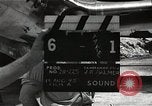
Major Thomas Ferebee, the bombardier aboard Enola Gay shares his experience of the Hiroshima atomic bombing mission
Setting: North Field, Tinian Island, Marianas Islands. Major Thomas Ferebee, the bombardier aboard Enola Gay (B-29 that bombed Hiroshima) is asked about his experiences, by Public Relations Officer John F. Moynahan (not seen). He recalls - His navigator aligned him correctly with the target. Hiroshima was clearly visible to him and so he was able to deliver the bomb. (World War II period).
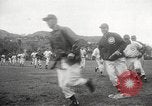
Chicago Cubs get ready for the 1950 baseball season on Catalina Island, California
The Chicago Cubs run onto the field during spring training for the 1950 baseball season. Mountains and tall trees visible in background. General manager Wid Matthews and manager Frankie Frisch confer. Cubs players pose for the camera. Several players warm up throwing arms, including #17 Bob Rush and #53 Johnny Schmitz. More players pose for camera; in shot with three players, man on the left is Hank Sauer, who would win the 1952 National League MVP for the Cubs. Cubs players take practice swings, including outfielders Andy Pafko (#48) and Bill Serena (#6).
CRITICALPAST.COM: About Us | Contact Us | FAQs - How to Order | License Agreement | My Account | My Lightboxes | Shopping Cart | Advanced Search | Featured Collections | Website Terms & Conditions | Privacy Policy ©2026 CriticalPast LLC.
License Agreement |
Terms & Conditions |
Privacy Policy
©2026 CriticalPast LLC.