


 Francais
 Deutsch
 Italiano
Refine Your Search
Okinawa Ryukyu Islands 1944 stock footage and images
- Showing 3289 to 3294 of 9587 results more
more Hide
Hide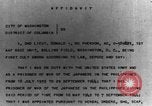
The Fall of Corregidor in World War II
Opening shows affidavits attesting to the authenticity of source films. Views of the island fortress of Corregidor, as Japanese troops occupy it while Americans and Filipinos stand with hands up, in surrender. Japanese and American Army officers having discussions. Scene shifts to Lieutenant General Jonathan Wainwright with members of his staff: Brigadier General Lewis C. Beebe; Lieutenant Colonel John R. Pugh; Major William Lawrence; and Major Tom Dooley, as they arrive at the Japanese headquarters building on Bataan to discuss surrender. They line up outside the wooden building and are saluted by the Commander of the 14th Japanese Imperial Army, General Masaharu Homma, as he climbs the steps of the building. Next, the Americans are seen seated at a table on the porch, opposite General Homma, who has General Wachi at his left and Colonel Nakayama, to his right. Reporters, an interpreter, newsreel camera men and others are also on the porch. General Homma and Wainwright discuss surrender. (These discussions proved fruitless, as Homma demanded surrender of the entire Philippine Garrison, and Wainwright tried to avoid that, citing lack of authority. Accordingly, Homma curtailed the meeting, and Wainright and staff returned to Corregidor, where, on May 6, 1942, he finally surrendered all forces in the Philippines to Japanese Colonel Sato, commander of the 61st Infantry.) Camera outdoor pans over Corregidor Island. Scenes of prisoners standing in the so-called Garage area of Corregidor, where American and Filipino POWs were interred, following their surrender on May 6th. The remainder of the film shows various scenes of POWs on Bataan, moving under Japanese guard. A makeshift sign points the way to Mariveles, where the infamous Bataan Death March commenced.
Fall of Corregidor to Japanese, during World War 2, Japanese newsreel.
Japanese newsreel documenting fall of Corregidor, Philippines to attacking Japanese forces. Japanese Betty bomber flying overhead. Guns of a Japanese battleship. Japanese animated map showing Corregidor Island at entrance to Manila Bay and the location of Japanese amphibious assault on the island, during World War 2. Aerial view of Corregidor, from Japanese airplane. Aerial view of bombs striking Corregidor. Japanese troops moving from rocky shore, past obstacles, and climbing steep wooden stairs on Corregidor. One of the soldiers carries a flame thrower. Japanese soldiers engaged in firefights with defenders. Americans surrendering. Views of tattoo on sailor. Barrage balloon aloft nearby.U.S. Army Major General George F. Moore conversing with Japanese Commander. Japanese Lieutenant General Masaharu Homma enters a hut and sits with members of his staff, opposite U.S. Lieutenant General Jonathan Wainwright, Major General Moore, and another officer, to discuss terms of surrender.
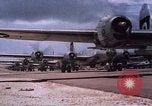
U.S. Army Air Forces B-29s with P-51 fighter escorts, bomb Tokyo, Japan, during World War II.
From "The Last Bomb", showing U.S. Army Air Forces bombing targets in and over Japan during World War 2. B-29s taxi on airfield and take off from runway. Crew in cockpit of aircraft. More B-29s taxi on runway at Tinian airfield. B-29s leave flight lines at Saipan airfield. B-29s taxi and take off from runway. Last B-29 takes off from Saipan airfield. Controller in tower talking into radio. Controller in Guam attends phone call. Take off times of each wing are noted by men at desk. Man attaches copy on report board. B-29 in flight over Pacific Ocean. Crew inside the plane. Navigator marks the chart. Aircraft makes run over Iwo Jima Island. Bulldozer leveling the surface at Sulfur island of Iwo Jima. P51s parked at airfield. Officers discuss around chart. P-51s warm up in flight line. P-51s taking off from airfield. Group of P-51s in flight. Controller at Guam talks over phone. Officer marks positions of each wing on mission board. P-51s fly low over water. Pilot of P-51 speaks. Crewman's hand at instrument panel. P-51s in flight behind B-29s. Smoke marker is dropped from an aircraft. Groups of planes separate. B-29s defend against attacking Japanese planes. A Japanese plane drops phosphorous bomb which explodes in the way of formation of B-29s. P-51 peels off to attack Japanese plane and protect B-29. P-51 fires at Japanese plane. Japanese plane is hit and goes down in flames. Formation of B-29s heading for mission. B-29s dropping bombs on Tokyo.
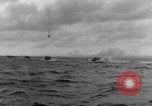
LVT (Landing Vehicle Tracked), LCM (Landing Craft, Mechanized) and LCVP (Landing Craft, Vehicle, Personnel) head for beach.
LVT (Landing Vehicle Tracked) heads toward beach. Flak in sky and smoke rises from island in the background. Battleship fires intermittently. Tail section of LVTR (Landing Vehicle, Tracked, Retriever) underway. LVT loaded with marines, underway through rough water. LVT headed toward island. Machine gun muzzle on LVT. Winch on deck of ship. Small craft comes alongside ship. Winch turning and cable coming off it. Men handle lines. Man operates winch while sitting on control box. LVT hoisted out of hold on AP (Hull Code for Transport Support Ships). LVT lowered over side. AP, LCM (Landing Craft, Mechanized), and LCVP (Landing Craft, Vehicle, Personnel) in water. Marines and Navy personnel watch from ship. Aircraft in sky. Anti-tank lowered into LCVP. Men in LCVP handle lines for loading. Men in AP watch the loading. Jeep hoisted from hold of AP. Sign in jeep reads '5-2'. LCM and LCVP in water. AP at anchor in the far background. Lookouts on mainmast of AP. American flag flies from mast. Small craft in water, men sit on small boat that is hanging from hook in the foreground. (World War II period).
U.S. forces prepare for attack against Japanese forces on Munda, readying supplies, troops, and aircraft.
Planning and moving of U.S. equipment, supplies, aircraft, and soldiers in preparation for attack at Munda Point on New Georgia Islands, Solomon Islands during World War 2. U.S. Marines and infantry massed up on Guadalcanal beach prepare for the invasion of Munda Point. Gasoline barrels are rolled on the beach. Crated food in cargo nets hoisted aboard ships. Equipment is loaded onto ships. U.S. combat aircraft assemble for an aerial offensive. U.S. Army General Douglas MacArthur exits car and talks with another U.S. officer. General MacArthur, U.S. 13th Air Force Lieutenant General Hubert R. Harmon, U.S. Army Air Force General Nathan Twining and U.S. Fleet Admiral William Halsey plan the attack on Munda Point. United States Army Air Force P-40 Warhawk fighters taxi and take off from an airfield. U.S. aircraft including P-40 Warhawk, P-39 Airacobra, U.S. Navy F4F Wildcat, TBF Avenger, B-25 Mitchell and B-24 Liberator aircraft in flight heading to destroy enemy positions on Munda. Japanese aircraft seen taking off and in flight.
General MacArthur, General Hubert R. Harmon, Nathan Twining and Fleet Admiral William Halsey plan an attack on Munda.
The U.S. Army plans an attack at Munda Point on New Georgia group of Islands, Solomon Islands during World War II. U.S. Marines and infantry massed up on Guadalcanal beach prepare for the invasion of Munda Point. Gasoline barrels rolled on the beach. Crated and canned foods in cargo nets hoisted aboard ships. Equipment is loaded onto ships. U.S. combat aircraft assemble for an aerial offensive. U.S. Army General Douglas MacArthur gets out of car and talks with another U.S. officer. General MacArthur, U.S. 13th Air Force Lieutenant General Hubert R. Harmon, U.S. Army Air Force General Nathan Twining and U.S. Fleet Admiral William Halsey coordinate the attack on Munda Point. U.S. Army Air Force P-40 Warhawk fighter aircraft taxi and take off from an airfield. U.S. planes including P-40 Warhawk, P-39 Airacobra, U.S. Navy F4F Wildcat, TBF Avenger, B-25 Mitchell, and B-24 Liberator aircraft in flight head to destroy Japanese enemy positions on Munda. Japanese aircraft take off and in flight.
CRITICALPAST.COM: About Us | Contact Us | FAQs - How to Order | License Agreement | My Account | My Lightboxes | Shopping Cart | Advanced Search | Featured Collections | Website Terms & Conditions | Privacy Policy ©2026 CriticalPast LLC.
License Agreement |
Terms & Conditions |
Privacy Policy
©2026 CriticalPast LLC.