


 Francais
 Deutsch
 Italiano
Refine Your Search
Okinawa Ryukyu Islands 1944 stock footage and images
- Showing 3487 to 3492 of 9587 results more
more Hide
Hide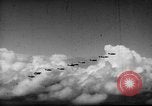
P-47s of the U.S. 318th Fighter Group return to the Aslito Airfield, Saipan, after Tinian raid in World War II
Twelve P-47 Thunderbolt aircraft, of the USAAF 318th Fighter Group, returning to Aslito Airfield (Insley Field) after completing strike missions over Tinian Island. Airfield showing dispersal area for the aircraft buildings surrounding area. New runway under construction at airfield. Aircraft spotter looking through binoculars. P-47s approaching airfield for landing. P-47s landing on airfield.
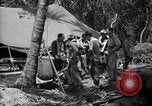
Royal New Zealand Air Force P-40 aircraft operating on Torokina Air Strip, Bougainville in World War II
Allied flight operations at Torokina Air Strip on Bougainville Island during World War 2. Pilots of the Royal New Zealand Air Force (RNZAF) gather near a tent on Bougainville, Papua, New Guinea, during World War 2. Two drink cups of water from a canvas Lister bag. View of control tower silhouetted against light sky background with tents clustered on ground below. A P-40, with RNZAF markings, taxis past the camera and is then seen on the active runway. A ground crewman waves on three more RNZAF P-40s as they taxi.
U.S. Marines inspect Japanese flag and unload LCVT in Bougainville, New Guinea during World War II.
United States Marines in Bougainville, New Guinea during World War II. Three Marines inspect a Japanese flag. A Marine attaches a bayonet to Japanese rifle and fires the rifle. Wounded marine on a stretcher being unloaded from a jeep. Marine being carried to a medical center. Another Marine lights up a cigarette for him. Landing area, lagoon and off shore islands. LVT-3 (Landing Vehicle Tracked) off shore as Marines unload a LCVT (Landing Craft Vehicle Tracked) in the foreground.
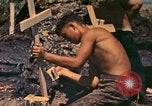
U.S. Marines dig graves and paint crosses at a graveyard in Bougainville, New Guinea during World War II.
United States Marines in Bougainville, New Guinea during World War II. A Marine paints a white cross for a burial yard. A cross at the cemetery bearing a sign that reads' Cemetery no.1' A105 mm Howitzer in foreground on an island. A truck tows a 155 mm Howitzer on a carriage. Landing area and artillery dugout on the shore. Three anti aircraft gun and mount dug in off the shore. Three shell cases lying on ground. Cemetery as men dig graves. A M3A1 tank moves into a jungle. Turret of M3 Stuart tank.
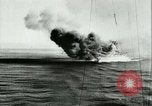
Pacific campaigns in World War 2; U.S. ships under kamikaze attack by Japanese aircraft during the Battle of Midway.
Pictures taken by military and news cameramen during World War II. The Battle of Midway, June 1942: A fleet of U.S. warships underway off the Midway Island. U.S. aircraft bomb the Island. A Japanese ship is hit. The ship on fire. Black smoke rises from the wreckage. U.S. soldiers fire deck guns at Japanese aircraft. Pacific Theater: U.S. Army Air Force C-47 Skytrains or Dakotas in flight over the battlefield. Allied parachute troops and supplies dropped from the aircraft in New Guinea. Parachute troops descend towards the ground. Allied aircraft carriers underway. U.S. aircraft on a carrier deck. Airmen prepare the aircraft for take off. The aircraft taxi and take off. U.S. B-24 Liberators drop bombs. Explosions as deck guns are fired. Explosions near a ship in the water. A U.S. carrier under kamikaze attack by a Japanese aircraft. The hit aircraft descends towards the ship and into the water.
Fire and heavy smoke rises from targets strafed by aircraft of U.S. Army Air Force around Tarumizu in Kyushu Japan
Gun camera footage of U.S. Army Air Force 19th Fighter Squadron, 318th Fighter Group Aircraft commanded by a Captain Vogt, strafing target buildings and ships in area of harbor at Tarumizu in Kyushu Japan. Fire and explosions on bay area of the Island. Heavy smoke rises. Aircraft strafes over open field areas and factories, and then strikes ships in harbor. 34th Fighter Squadron Aircraft drop bombs over harbor in Kyushu, Japan. Fire and explosions on bay area of the Island. Heavy smoke rises. Aircraft strafes over open field areas, houses on ground. Tracers fired on Japanese ships on water surface. Fire and explosion from the ship. (World War II period).
CRITICALPAST.COM: About Us | Contact Us | FAQs - How to Order | License Agreement | My Account | My Lightboxes | Shopping Cart | Advanced Search | Featured Collections | Website Terms & Conditions | Privacy Policy ©2026 CriticalPast LLC.
License Agreement |
Terms & Conditions |
Privacy Policy
©2026 CriticalPast LLC.