


 Francais
 Deutsch
 Italiano
Refine Your Search
Okinawa Ryukyu Islands 1972 stock footage and images
- Showing 2755 to 2760 of 4623 results more
more Hide
Hide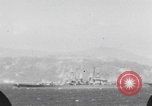
U.S. Naval and Air Forces bombard Corregidor during World War II
Battle of Corregidor in the Pacific Campaign of World War 2 in Philippines. U.S. Light Cruisers bombarding Corregidor Island. Smoke rising from numerous shell strikes. U.S. aircraft flying overhead toward the island. Bombs exploding in upper parts of hill on island. Smoke rising all along the shoreline. U.S. light cruisers bombarding the island, from close in. Closeup of St. Louis Class light cruiser firing on the island. A Cleveland Class light cruiser (with single stack) firing at the island.
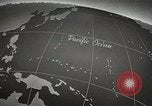
Battle of Saipan in the Pacific during World War II.
Animated map shows U.S. forces extending control in the Pacific to the Mariana Islands islands in the Pacific during World War 2. It shows chain of airfields linking island of Truk to homeland, Japan. Map focuses on island of Truk, in Micronesia, showing concentration of Japanese aircraft, ships, and troops there. Paths of U.S. air and naval attacks on Truk are shown. Map shows Japanese fleet withdrawing and U.S. forces by-passing Truk to concentrate on the Mariana islands. U.S. naval task force is seen off the island of Saipan on June 11, 1944. Two U.S. battleships are followed by two escort aircraft carriers/ Barrels of battleship triple guns firing at Saipan. Landing Craft Tank: Rocket LCT(R) firing salvos of rockets. Glimpse from aircraft, overhead, of landing craft leaving white wakes during amphibious assault. Closeups of U.S. troops in landing craft. View from shore of American troops storming ashore through surf, from landing craft, under heavy enemy fire. Closeup of soldier hunkered down in sand. Soldier dropping down from side of beached landing vehicle tracked (LVT). A dead U.S. soldier floating in the water. Troops firing from their LVTs. Shells striking on sandy shore. Marines running with stretcher over their shoulders Fletcher class destroyer firing her guns to port. Brooklyn class light cruiser firing guns to port. View from ships flying Japanese flags, of Japanese warships headed to engage U.S. fleet. Japanese aircraft carriers and Aichi Kokuki KK dive bomber (Val) taking off from a carrier. Aerial closeup of Japanese Val aircraft in flight, with pilot clearly visible before he banks his plane to the left. Formations of Japanese Val aircraft in flight. Formation of American Grumman TBF Avenger aircraft engaging the Japanese. Gun camera film showing Japanese aircraft being shot down. A Japanese aircraft crashing into the sea. Sailors of U.S. ship firing batteries of Bofors 40mm anti aircraft guns. and 20mm anti aircraft guns. Black flak clouds in the sky. A Japanese plane crashing into the sea. Aerial view of formation of Japanese Val aircraft in flight. Closeup of a Japanese Kawasaki Ki-61 (Hien) aircraft maneuvering to attack. More views of Japanese Val aircraft in formation. American dive bombers dropping bombs on, Japanese held, Orote airfield. View from the air of bombs striking and smoke clouds. Fires burning on the airfield. An American navy F6F hellcat plane diving. Gun camera film showing Japanese aircraft being downed. A plane director on deck of U.S. aircraft carrier. Two Grumman TBF aircraft taking off from a carrier. View toward tail of one taking off. U.S. aircraft in formation overhead, and then peeling off in trail formation to attack a target. Japanese ships being strafed. U.S. infantry continuing heavy fighting on Saipan.
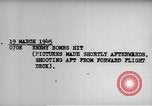
Violent explosions and fire fighting as Japanese bombs hit USS Franklin (CV-13) in Pacific Ocean during World War II.
Opening Slate reads: 19 March 1945, Enemy bombs hit (pictures made shortly afterwards shooting aft from forward deck). It refers to Japanese bombs striking the American Aircraft Carrier USS Franklin (CV-13). Heavy billowing smoke obscures the view for a moment. Then sailors are seen on the flight deck of the Franklin fighting a fire with hoses. More fire breaks out and smoke billows from the deck. Fire fighters continue efforts with hoses. New fire breaks out near the edge of the deck opposite the ship's island superstructure. View from other direction shows sailors all over the deck near the island trying to contain the fire. A slate appears reading: A series of violent explosions begin (made from USS Hickok - DD-673). This refers to filming from the USS Hickok. The USS Franklin is seen consumed by fire and covered by dense black smoke rising high into the sky. The smoke turns more white. A new view from the Hickok shows fire and smoke coming from the area of the carrier's island and blowing aft. A different view shows both white and dense black smoke enveloping the Franklin. Next, firefighters are seen again, on the Franklin's flight deck, forward of the island, continuing to battle the fires that see concentrated amidship. Slate reads: USS Miller alongside (refers to the destroyer, USS Miller, DD-535).View of the USS Miller close-by. Another view of sailors fighting the fire on the Franklin's flight deck. Brief view, from a parapet on the island, shows smoke. Also seen are water intakes stretched out from the ship, presumably providing water for firefighting. Back on the Franklin's flight deck, firefighters work against a backdrop of white smoke. a closeup shows portions of the flight deck broken and tilted into the hangar deck. More views of sailors on deck, forward of the island, fighting the fires. Glimpse of hangar deck below, where large section of flight deck has fallen. Firefighters with hoses working there.
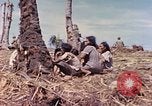
Group of natives and children in foxhole, sunken Japanese barges and corpse during a battle of Eniwetok in Eniwetok Atoll
Battle of Eniwetok during World War II. A group of natives and children in foxhole. Children and an old woman on island. Sunken Japanese barges and a dead body of a man on it. Burnt dead bodies of Japanese on island. Burned out medium U.S. tank. A soldier near a tank.
Activities on the Enewetak Atoll just before the Operation Sandstone atomic bomb tests.
Covers the events just before the atomic bomb tests (Operation Sandstone) on the Enewetak Atoll (sometimes spelled Eniwetok or Eniewetok) in the Marshall Islands. U.S. parachute troopers board a transport plane. Scenes of men working on communication systems. Tests and experiments are conducted in the laboratories and valuable data collected. Light aircraft is used to ferry scientists from one point to another. An air laboratory inside a plane to collect valuable information. Men prepare to leave Eniwetok. Scientists and technicians make a last minute inspection of all the necessary instruments before leaving the island. U.S. ships loaded with men move to safer water. Unmanned B-17 drone aircraft takes off to capture traces of the atomic cloud. Men prepare to trigger the atomic bomb on the Eniwetok atoll.
Aircraft carriers and ships during battle of Saipan in the Pacific War (WW2)
Aircraft carriers and ships during battle of Saipan in the Pacific War (World War II). Animation of map of Saipan. Ships progressing in sea. Firing and bombardment at ships. Guns firing. Marines in landing barges. Bombs dropped on the ships. Marines advance on island. Bombing on the island. Tanks advancing. Scene of artillery fire. Wreckage of planes. A plane taxiing. Scene of U.S. flag. Soldiers taking a wounded soldier on stretcher. Medical men trying to save soldiers. women and children are removed to safety at prisoners of war depot. A soldier taking a child in lap.
CRITICALPAST.COM: About Us | Contact Us | FAQs - How to Order | License Agreement | My Account | My Lightboxes | Shopping Cart | Advanced Search | Featured Collections | Website Terms & Conditions | Privacy Policy ©2026 CriticalPast LLC.
License Agreement |
Terms & Conditions |
Privacy Policy
©2026 CriticalPast LLC.