


 Francais
 Deutsch
 Italiano
Refine Your Search
Okinawa Ryukyu Islands 1972 stock footage and images
- Showing 2761 to 2766 of 4623 results more
more Hide
Hide
Activities on the Enewetak Atoll just before the Operation Sandstone atomic bomb tests.
Covers the events just before the atomic bomb tests (Operation Sandstone) on the Enewetak Atoll (sometimes spelled Eniwetok or Eniewetok) in the Marshall Islands. U.S. parachute troopers board a transport plane. Scenes of men working on communication systems. Tests and experiments are conducted in the laboratories and valuable data collected. Light aircraft is used to ferry scientists from one point to another. An air laboratory inside a plane to collect valuable information. Men prepare to leave Eniwetok. Scientists and technicians make a last minute inspection of all the necessary instruments before leaving the island. U.S. ships loaded with men move to safer water. Unmanned B-17 drone aircraft takes off to capture traces of the atomic cloud. Men prepare to trigger the atomic bomb on the Eniwetok atoll.

Aircraft carriers and ships during battle of Saipan in the Pacific War (WW2)
Aircraft carriers and ships during battle of Saipan in the Pacific War (World War II). Animation of map of Saipan. Ships progressing in sea. Firing and bombardment at ships. Guns firing. Marines in landing barges. Bombs dropped on the ships. Marines advance on island. Bombing on the island. Tanks advancing. Scene of artillery fire. Wreckage of planes. A plane taxiing. Scene of U.S. flag. Soldiers taking a wounded soldier on stretcher. Medical men trying to save soldiers. women and children are removed to safety at prisoners of war depot. A soldier taking a child in lap.
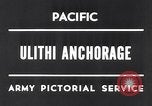
United States 5th fleet ships anchored at Ulithi in West Caroline during World War 2
A film titled 'Ulithi Anchorage' shows United States 5th fleet ships anchored at Ulithi, a group of coral islands, in West Caroline in the Pacific during World War II. An aircraft flies over the ships. An island with an airstrip is seen. All kinds of ships - carriers loaded with bombers, mother ship and its destroyer, dry dock for repairs and a hospital ship are seen.
Wounded U.S. soldiers being transferred to USS Harris (APA-2) off Attu in the Aleutians, during World War II
Sailors aboard the troop transport ship, USS Harris (APA-2), receive wounded American soldiers evacuated during the battle of Attu Island in the Aleutians, during World War 2. The wounded, strapped on a platform, are raised from a Higgins boat, by rope slings, and placed on the ship's deck. A sailor carries one wounded soldier on his back. Another helps him onto a litter. Scene shifts to Attu Island, where an American soldier mans a 40 mm Bofors anti aircraft gun at a high point overlooking a harbor. A quonset hut and radio station, with tall antenna, are in background. What appears to be a steel pier extends into the bay below. Snow covers mountains in far background.
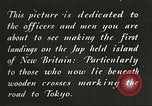
Allies prepare to fight the Japanese in New Britain, New Guinea during World War II.
A film about the Allied campaign in New Britain, New Guinea during World War II. A man opens an envelope and reads a letter with a secret mark on it. A sign on the letter reads 'Overpower'. A map of New Britain. A jungle on the island of New Britain. The sun sets behind the trees. The Allied task force soldiers board trucks and move to staging area on Goodenough island. Two other task forces comprising of U.S. Marines take their positions in staging areas. Equipment, artillery, cables, and food arrive at the areas.
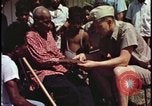
United States Army doctor examines Cold War atom bomb fallout victims near Bikini Atoll
United States Army doctor examine radiation sickness patients for fallout and radiation effects, including hair loss, likely after the disastrous atomic bomb BRAVO test at Bikini Atoll March 1, 1954 during the Cold War. U.S. Army doctor examines the eyes and teeth of an elderly Micronesian man and a little girl, as locals watch the procedure in Marshall Islands, near Bikini atoll. Army doctor examines scalp of a little boy and shows hair that has fallen out during the examination. Army doctor examines the scalp and skin of a Micronesian young woman. Micronesian young woman’s inner elbow show discoloration from radiation due to fallout. Army doctor examines the neck of a Micronesian woman. Likely residents of Rongelap Island or Utrik Atoll, which was engulfed in nuclear fallout after the BRAVO test.
CRITICALPAST.COM: About Us | Contact Us | FAQs - How to Order | License Agreement | My Account | My Lightboxes | Shopping Cart | Advanced Search | Featured Collections | Website Terms & Conditions | Privacy Policy ©2026 CriticalPast LLC.
License Agreement |
Terms & Conditions |
Privacy Policy
©2026 CriticalPast LLC.