


 Francais
 Deutsch
 Italiano
Refine Your Search
Phu Cat Air Base Vietnam 1969 stock footage and images
- Showing 9007 to 9012 of 13375 results more
more Hide
Hide
A 1942-1943 film report to the American public about the progress of World War II in Europe and the Pacific.
Opening slate at start of film reads: "1942--1943 The Turn of the Tide." A column of British armor enters Bengazi, Libya, led by several troops in tankettes. Next seen are a Lee Medium Tank, M3 followed by an infantry tank, a jeep, another infantry tank and another Lee M3 Medium tank. Closeup of local people greeting the troops with upraised hands giving the "V" for victory sign. Another Lee M3 tank passes close by the camera. Black smoke is rising in the background. Scene changes to a half sunken ship near another burning in the harbor. Another view of this from further away above port buildings. Closeup of three smiling British soldiers leaning over a cartoon on a tank, of Winston Churchill (As a bulldog smoking a cigar and wearing a cap with the word "Victory" written on it). A crumpled captured flag with swastika on it. British Field Marshal Bernard Montgomery stands atop a vehicle (unseen) and looks through binoculars. Below, a column of British supply vehicles is making its way along a path in the desert. Two tanks coming toward the camera through sand. Animated map shows Nazi territory being threatened by the Allies from the Mediterranean, the USSR, and the English Channel. Views of Soviet infantry advancing against German forces in the snow of winter on the eastern front. Soviet troops firing updated 76-mm divisional gun model 1902 hidden in woods. Shells exploding in snow-covered field as Soviet BT series tanks advance. Various Soviet artillery firing from fixed gun batteries and from woods. A shell striking in distance. Fallen German soldiers lying on snowy field. Makeshift battlefield crosses marking graves of fallen German soldiers. German steel helmets lined up in the snow. A sign, posted on a birch tree, lists the names and birth dates of 16 German soldiers from the 3rd Panzer Division (3Pz-Pi-BH.39) buried at this site on November 28, 1941. Scene shifts to Joseph Stalin addressing Soviet troops in Red Square, Moscow, Russia. All the soldiers in formation seem to be singing (unheard). Film switches to animated map again. This time delineating the Eastern front being pressed by the USSR, and showing area of the 2nd Soviet winter offensive in 1943. Change of scene from Europe to the War in Asia, against Japan, shows General Douglas MacArthur after arriving by a B-17 bomber at a Pacific island American base. He ascends a steep hill in a jungle area, accompanied by other officers. Closeup of MacArthur. American infantry moving in single file in New Guinea, as a field piece fires a round in the direction they are headed. U.S. artillerymen load shells into a 105mm howitzer gun. A fire burns as mop-up operations begin on New Guinea. An Australian soldier is seen firing a Bren gun in jungles. Other Australian soldiers fire a mortar that explodes, raising earth and dust. More views of shells exploding near Allied soldier advancing. A soldier with fixed bayonet makes a fake charge toward the camera. Views of Japanese prisoners of war guarded in an outdoor compound. Japanese dead soldiers on Guadalcanal. An animated map shows new battle lines in the Pacific, closing in on Japan, with pressure from China, the USSR, and the Pacific islands being captured by the U.S. Arrows are added showing new pressure from American naval fleets and from British and American bombers out of Australia and captured islands.

French troops in trenches and tending to wounded during World War I
A group of French soldiers is seen standing in a trench during World War 1. Several make their way along the trench to the hulk of a German tank, turned on its side. Camera pans the exposed bottom of the overturned tank with one tread visible. Two French soldiers stand next to it. Several fallen German soldiers are seen on the ground nearby. Next, four French medical corpsmen are seen carrying a wounded soldier at shoulder height on a litter. Two soldiers move body of fallen comrade using a two-wheeled cart. Change of scene to French soldiers near their trenches at base of a steep hill, partially covered with boards. Several soldiers walk past them transporting fallen on a cart. Wounded being assisted as they leave a damaged building, possibly serving as a field first aid center. Several French soldiers standing near a comrade with a bandaged foot who leans on a large board. Behind them are shell or bomb-damaged buildings.
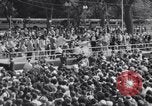
Americans gather on grounds of Washington Monument and Joan Baez and Odetta sing in front of Civil Rights marchers
A large number of Americans gather to participate in the Civil Rights march in Washington DC known as the March on Washington for Jobs and Freedom. People gather at the grounds of the Washington Monument. Singer Joan Baez sings "We Shall Overcome" with a guitar in front of the crowd. People sit with boards and placards. Vehicles parked in the background. Flags in the background and the Washington Monument base visible. Vehicles move on the street including many buses arriving. Singer Odetta (Odetta Holmes) plays a guitar and sings "I'm On My Way". Crowd includes young and old, and African American and white citizens. Crowd cheers and applauds.

Bob Feller and Jackie Robinson inducted into baseball Hall of Fame; scenes from careers of Feller and Robinson
People gather at baseball's Hall of Fame in Cooperstown New York. Announcer notes Cleveland Indians pitcher Bob Feller and Brooklyn Dodgers second baseman Jackie Robinson have been inducted into the Hall of Fame. Scenes from the careers of both players. Bob Feller greeting kids on field, holding a child. Bob Feller pitching at Polo Grounds in New York, date unknown. Jackie Robinson seen removing baseball bat from rack. Announcer notes he is the first African American man admitted to the Hall of Fame. Robinson seen hitting ball to outfield wall and sliding into second base for a double. Robinson successfully steals home against New York Yankees pitcher Whitey Ford in the opening game of the 1955 World Series -- although catcher Yogi Berra disagrees vehemently with the umpire's call.
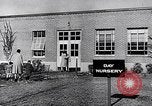
Factory work by American women producing war materials in the United States (WW2)
War production work by American women contributing to the war effort in World War II. Women work in factories and other places producing war materials. View of nursery schools and personal services like banks, ration card issuance, driver's license issuance, and beauty shops open at longer hours in and near war production plants to help working women. Women meet their children in the schools. They enjoy meals in a women's dining rooms. Women enjoy leisure time bowling in a bowling alley. On the job in a factory, a view of several women welders in uniform, welding for war production. They produce soldiers' helmets and other war materials. They work on machines in manufacturing plants and factories. Women and men workers boarding buses at the end of a workday. Women using drill presses and driving trucks and forklifts. A ship blown up at sea during a World War 2 attack. View of Soviet soldiers helping a child and then a woman with a baby emerge from an underground bomb shelter in Europe. A woman on stage at a rally in Italy holds a small child. Italian Fascist leader Benito Mussolini steps forward and kisses the child. Women assembling tail assemblies and airplane fuselage in America for an aircraft. Smoking ruins of a leveled European city soon after a bombing raid. A body of a soldier floating in water at the edge of the ocean. A ticker tape parade in New York city with ticker tape streaming down. A view of the Statue of Liberty as seen from near its base, looking upward.

How American women contributed to U.S. war efforts during World War II as well as World War I
Film begins showing women looking at a bulletin board advertising free war training classes, during World War 2. Women are seen in a classroom learning to be quality control inspectors in factories. Their instructor uses a large-scale model of a micrometer to illustrate its use. A giant slide rule is mounted on the wall in the background. Women are shown working in an aircraft factory drafting room, preparing drawings for parts. Scene changes to women war production workers being trained as welders. A woman is seen teaching another to operate a drill press. Another woman is being trained to us a metal turning lathe in a machine shop. An employee patch on her right shoulder reads: "Bendix Aviation." Next, a woman is seen guiding a DC-3 commercial airplane into its parking place on an airport. A crew of women works to clean and maintain commercial aircraft in a hangar. Another crew of women climbs aboard a steam locomotive to clean and otherwise maintain it. A woman working as a commercial bus driver, picks up a passenger. Women serving in a messenger service company. A woman running an elevator in an office building. A woman making milk deliveries to a home. Women driving tractors on the large farms of the Midwest. Others run a harvester pulled by a team of 20 mules. A few men express reservations about the ability of women to work outside the home while still caring for families. Complete change of scene shows newsreels from World War 1 with men in uniforms marching. Nurses served overseas at base hospitals. But teams of women also supplemented for missing men in other occupations. One scene shows them shoveling debris into railroad open cars. Another showed women working in a lumber yard and also plowing fields on a farm. So-called Yeomanettes (World War I version of later era Waves) are seen on parade in uniform. Old newsreel shows U.S. Secretary of the Navy, Josephus Daniels, reviewing Yeomanettes, as his assistant Secretary, Franklin D. Roosevelt, converses with Vice Admiral William Sims. Film shifts back to World War II showing women in Army uniforms parading, glimpse of others who appear to be pilots. Film ends with montage of views seen earlier in the film.
CRITICALPAST.COM: About Us | Contact Us | FAQs - How to Order | License Agreement | My Account | My Lightboxes | Shopping Cart | Advanced Search | Featured Collections | Website Terms & Conditions | Privacy Policy ©2026 CriticalPast LLC.
License Agreement |
Terms & Conditions |
Privacy Policy
©2026 CriticalPast LLC.