


 Francais
 Deutsch
 Italiano
Refine Your Search
Phu Cat Air Base Vietnam 1969 stock footage and images
- Showing 9985 to 9990 of 13374 results more
more Hide
Hide
Pathfinder flare bombs in England.
Activities of RAF (Royal Air Force) Pathfinder Squadron, air arm of the British Armed Forces in England. Pathfinder flares bombs. Various view of Pathfinder. (World War II period).
Pathfinder flare bombs dropped in England.
Activities of Pathfinder Squadron of RAF (Royal Air Force), air arm of the British Armed Forces in England. Pathfinder flare bombs dropped. (World War II period).
Battle of the Ardennes and Battle of the Bulge, in World War II
Film starts showing silhouettes of British tanks on the move, including one with a bulldozer blade. View from Allied warplane as bombs explode on the ground below. In November, 1944, infantry of the First Canadian Army, with Polish and British units fire Bren guns as they advance in Belgium and secure the Scheldt Estuary, to open a shipping route to Antwerp for the Allies. They traverse a river and cross rail lines while advancing. View of destroyed steel bridge across the Maas (Meuse) river with several British troops wading in water nearby. Silhouettes of German prisoners of war marching single file. View from rear of German prisoners walking under guard with hands resting on their heads. British troops running beside the Scheldt river at Antwerp on September 4, 1944, as huge explosions occur in the river behind them. A column of British troops, marching on tree-lined road, enters outskirts of Antwerp, as local people cheer them. Views of the troops being greeted in the city itself. Columns of Belgian refugees are seen returning to their homes. One,injured, is carried by friends in a wooden cart. A contingent of British troops marching in the city. Glimpses of derricks in the Antwerp port and a ship under construction in a shipyard. An animated map shows German counter offensive through Belgium and Luxemburg on September 4, 1944. Refugees leaving again, ahead of the returning German forces. View of a road sign reading: "Bastogne." American military police checking credentials of some refugees as they leave. American soldiers jammed together atop a Sherman tank parked at a checkpoint. After delaying further German advance, through the Ardennes, on September 16th, American troops are forced back and seen leaving , in trucks and Sherman tanks, from Bastogne, past a road leading to Martelange. As weather cleared on September 22nd, a formation of British Hawker Typhoon ground attack aircraft are seen in flight and diving to attack lines of communication with machine gun fire and rockets. Several different views of the aircraft firing and smoke rising from the ground. Animated map of German advance depicts the so-called "Bulge" extending 60 miles into Allied territory. Captured German films show German troops,one carrying a rifle and another a Sig 44 machine gun, as they pass columns of burning Allied trucks, other vehicles and armor. Closeup of German soldier waving to others to follow him, as he runs ahead past burning Allied equipment. Several German soldiers hunker under a knocked out Allied tank, as a German Jagdpanzer 38(t) Hetzer light tank destroyer passes their position. Closeup of German soldier smoking captured American cigarette. German infantry, walk past barrel of destroyed Allied tank. Several gather and smoke American cigarettes. One of them, with a belt of ammunition around his neck, is Hans Tragarsky aka Walter Armbrusch, of German Kampfgruppe Hansen, a battle group formed during the Battle of the Bulge from SS-Panzergrenadierdivision Regiment 2, an infantry regiment of SS Pz Rgt 2 "Das Reich". (This image is well known but his identity is subject to debate.) Glimpse of German officer walking with a soldier at the front, with background engulfed in flames.. Scene shifts to a formation of U.S. Army Air Forces C-47 transport planes seen, in flight, dropping food and ammunition to beleaguered American troops caught in the Battle of the Bulge. Change of scene to German Jagdpanzer IV tank destroyer moving; Panzer IV tanks firing 7.5 cm KwK 37 L/24 guns; and troops riding on a Tiger tank ( Panzerkampfwagen Tiger Ausf. B). German soldiers riding in a streamlined Volkswagen Kübelwagen. German soldier in an open single seat courier car spattered with mud. Close-ups of him smoking a cigar. German soldiers looking at formation of American C-47 aircraft overhead. A U.S. Army Air Corps B-25 bomber in flight. View from Allied bomber dropping bombs that strike ground with many explosions. View from above of a B-24 Liberator bomber in flight. View on ground of shells and bombs exploding in wooded area and low level black flak clouds. Captured 88mm gun being fired by Allied forces. British soldiers in a Landing Vehicle Tracked, cross a stream and climb up a steep bank. View from British "Wasp" flame-throwing Bren-gun carrier, as it fires and resulting inferno of fires. Views from a long distance of other flame-throwers firing across the stream. Closeup view of one firing with fires burning on the opposite shore.
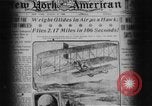
Newspaper headlines Wilbur Wright sustained demonstration flight in France.
Headline of the newspaper 'New York American' reads 'Wright Glides in Air as a Hawk, Flies 2.17 miles in 106 seconds'. Pictures of the Wright Model A Flyer under the headlines. Wright Model A Flyer being readied for flight at the Hunaudieres horse racing track near Le Mans, France. A horse-drawn wagon pulls the flyer into a field. Crew of men pull rope to raise a launching weight in a tower. The plane is catapulted along a rail and into the air, when the men release the weight. Spectators in a grandstand look through binoculars. Louis Bleriot is seen. Views of the Wright plane in flight, where it attained an altitude of 360 feet.
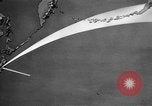
The story of U.S. Navy Seabees on Guadalcanal during World War II.
Activities of the Seabees on Guadalcanal, Solomon Islands, during World War II. Seabees seen salvaging ships damaged and sunk during the Japanese December 7, 1941 attack on Pearl Harbor.Seabees seen on the deck of the USS California (BB-44). U.S. warship fires guns at Guadalcanal. U.S. Marines land on Guadalcanal and advance in long line across the island. Marines firing heavy field artillery. Seabees begin rebuilding Henderson Field, surrounded by fire and smoke of battle. Ground and aerial views of Henderson field, with destroyed U.S. fighter bombers seen. From the air, many small airplanes and several B-17s can be seen. Seabees filling shell and bomb craters on the field. U.S. Marines firing firing antiaircraft weapons against attacking Japanese airplanes. Two Japanese airplanes plunging in flames. An empty life vest floating in the water. The Seabees continue rebuilding and expanding Henderson Field using Marston matting (pierced steel planking). A Navy Douglas SBD Dauntless dive bomber lands at the newly repaired field. U.S. Air Force B-17s take off from Henderson Field. and
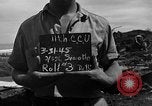
Remains of crashed B-29 at crash site on Tinian in the Northern Mariana Islands in World War II
Remains of United States Army Air Forces B-29 Superfortress that crashed in Tinian, Northern Marianas Islands during World War 2. It was B-29 number 42-65283, nicknamed "Big Wheel," from the 9th Bomb Group, 99th Bomb Squadron. Opening scene shows remains of two engines and bent propellers from the crashed B-29. Ocean and a B-29 coming in for a landing are seen in background. Two destroyed engines and props along with partially intact empennage, are the only recognizable parts of the airplane. Aircraft debris is scattered close to the beach. Three U.S. Army Air Force personnel stand looking over the wreckage.
CRITICALPAST.COM: About Us | Contact Us | FAQs - How to Order | License Agreement | My Account | My Lightboxes | Shopping Cart | Advanced Search | Featured Collections | Website Terms & Conditions | Privacy Policy ©2026 CriticalPast LLC.
License Agreement |
Terms & Conditions |
Privacy Policy
©2026 CriticalPast LLC.