


 Francais
 Deutsch
 Italiano
Refine Your Search
Phu Cat Air Base Vietnam 1969 stock footage and images
- Showing 10279 to 10284 of 13374 results more
more Hide
Hide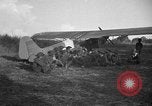
Indian Punjab soldiers freed from Japanese prison camp are interviewed by Australian soldiers in Senai, New Guinea, during World War II
Indian Punjabi soldiers freed from Japanese prison camp, are seated in shade under wing of a U.S. Army Air Corps L-4 Grasshopper airplane, at an air field in Senai, Papua New Guinea, during World War 2. They are being interviewed by an Australian Sergeant and an officer. The Punjab former prisoners have been provided uniforms including ranger hats. (They have short hair and no beards, so they may include Sikhs, Dogras, Pathans, and Punjabi Muslims, but haven't yet obtained material for their traditional turbans.) The Sergeant makes notes and sketches on a pad as the escaped POWs provide information about their experiences and information of possible value regarding Japanese forces. Scene shifts to the Punjab soldiers sitting in a grass-roofed hut, with the native Chief of Senai. Several of them sit in in front of the hut, smoking long-stemmed native pipes. The Senai Chief poses with a Punjab Sergeant. Two Stinson L-5 airplanes take off from the Senai field. A group of liberated prisoners prepares and eats a meal.
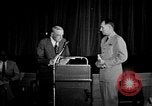
Secretary of State John Dulles addresses CAP Cadets during International Cadets Exchange Program in Maryland,United States.
International Civil Air Patrol (CAP) Cadets Exchange Program in,Maryland, United States. Officer invites Secretary of State John Foster Dulles on podium. Dulles begins his talk with Civil Air Patrol Cadets. Gathering applauds.
Prototype wingless Ciera C.30 autogiro being tested in England.
Prototype C.30 (G-ACFI) Cierva wingless autogiro comes in for a landing at Hanworth Air Park (London Air Park), England. It touches down momentarily and rises again. A man is seen standing next to designated landing are marked by a large white ring and a smoke flare. The autogiro approaches the spot, and is pursued by the man on the ground who runs and fastens a satchel to a line from the autogiro. Flyer in the front seat of the autogiro reels the satchel into his cockpit. Pilot of the autogiro shuts down his forward engine and proceeds to execute an autorotation landing.
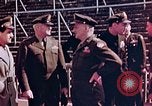
USAAF General Henry H General Arnold decorates and hand shakes with officers in the European Theater during World War II.
U.S. General decorates officers in the European Theater during World War II. United States Army Air Forces (USAAF) General Henry H Arnold and cortege at field. United States Air Force (USAF) General Carl Andrew Spaatz and General Lee interact. General Arnold decorates officers. Officers salute. General shakes hands with officers. Staff in the background. General Spaatz shakes hands with fellow officers. General Arnold salutes as band march past. Honor guard holding American flag march past.
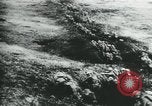
Numerous scenes showing evolution of mechanized warfare emphasizing World War I. but including footage as late as 1934
Montage of scenes illustrating development of mechanized warfare beginning with American Expeditionary Forces (AEF) engaged in World War I. U.S. Army infantry soldiers moving out of trenches going "over the top" into "no man's land" and advancing on battlefield. U.S. troops firing Browning M1917 machine gun,1903 Springfield rifles, and Stokes mortar from trench positions. Soldiers firing mortar are wearing gas masks. AEF trucks and other vehicles ostensibly an improvement over horses, but seen having difficulty in mud. A truck pulling a large artillery gun. A German 80cm K (E) rail gun (developed in 1934) shown at the Rugenwalde Test Range in Germany. It moves along curving rails and is elevated to its maximum elevation (65 degrees). Two World War 1 rail guns firing. An American World War I Naval 14-inch rail gun firing. Allied heavy howitzers firing in World War 1 (one with gun crew in gas masks). American gunners with a French 75 field piece and caisson. French soldier advancing in no-mans-land. The Wright brothers brought warfare into the air with their Wright Flyer airplane, seen being maneuvered on the ground by U.S. Army personnel at Fort Myer, Virginia in July 1909. A De Havilland DH-4 airplane taking off in World War I. A German Fokker D.VIII aircraft in flight. Three U.S. Army Air Service Curtiss P-1B Hawk pursuit aircraft in flight, circa 1926. Aerial dogfight scene including view from behind a pilot in open cockpit biplane (from feature film, circa 1927). Brief view of Renault FT tank maneuvering in World War I. Narrative and clips shift to historical perspective of warfare, showing use of horse and chariot, starting in ancient Assyria and use of elephants in later years by Hannibal. Pictures of mounted soldiers, in the middle ages, waging war in armor, and being transported in a wagon. Shift to World War I showing British Mark IV tanks maneuvering in a field.
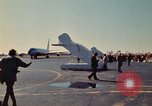
A large crowd greets President Richard Nixon upon his arrival at Tri-City Airport in Saginaw, Michigan.
U.S. President Richard Nixon arrives at Tri-City Airport in Saginaw, Michigan. A U.S. Air Force VC-137C SAM 26000 aircraft (Air Force One) taxis on a field. The phrase 'Spirit of 76' printed on the aircraft. President Nixon emerges from the aircraft and waves to a crowd. Nixon greets dignitaries and walk over to greet the crowd. A band plays. American flags held by the crowd.
CRITICALPAST.COM: About Us | Contact Us | FAQs - How to Order | License Agreement | My Account | My Lightboxes | Shopping Cart | Advanced Search | Featured Collections | Website Terms & Conditions | Privacy Policy ©2026 CriticalPast LLC.
License Agreement |
Terms & Conditions |
Privacy Policy
©2026 CriticalPast LLC.