


 Francais
 Deutsch
 Italiano
Refine Your Search
Phu Cat Air Base Vietnam 1969 stock footage and images
- Showing 10849 to 10854 of 13374 results more
more Hide
Hide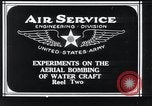
Aerial bombing experiments on the battleship Ostfriesland and Brig Gen Mitchell with Secretary of war John Weeks.
Experiments on the aerial bombing of water crafts off Virginia Capes in the United States. July 20 and 21, 1921: Latest type First Line battleship, the heavily armored Ostfriesland at sea. Specifications of the ship. Handley Page 0/400 bombers in flight. The Ostfriesland under bombing attack. Explosions on and around the ship. Three 1,100 bombs hit the ship directly. View of the deck and bow. A 2000lb bomb caves in the starboard quarter. The ship tilted to one side and sinking. A final bomb dropped on the ship. Brigadier General William Mitchell congratulates the pilots and bombers. Secretary of War John W Weeks and U.S. Army General John J Pershing inspect Langley Field with other officers. Brigadier General Mitchell explains the NBS-1 bomber to Secretary Weeks. The group of Air Service pilots pose for a photographer in front of hangers.
The Castro-led revolution in Cuba.
Film opens with bongo drummer playing and other Cuban musicians playing instruments while dancers in fetching costumes dance and enjoy themselves. Scene shifts to view from water of Havana skyline and then to automobile traffic on a busy street in a commercial district of the city. A Busy street crowded with pedestrians on sidewalks. Cuban workers leaving an industrial plant at shift end. Smoke pouring from three tall smoke stacks in background. Large machines employed in a factory. A construction worker in the cab of earth moving equipment. A field worker rotating a long wooden boom by hand. Men cutting sugar cane with machetes. A farmer opening gate to allow water into an irrigation network. View of water rushing into the irrigation ditches and entering the area of crops. A farmer using cattle to pull his plow. Cattle entering a stockyard. Shoppers at an open-air market filled with all kinds of fruits, vegetables and other agricultural products. Families of poorer people in rural areas outside of Havana. They live in shacks ahd are photographed with their small children. Next, two uniformed members of the Cuban National Police (Policia Nacional de Cuba) are seen. (The narrator mentions that Cuban people lived for 60 years under a succession of corrupt and often dictatorial leaders.) View of men in a line being monitored by a National policeman. Fulgencio Batista y Zaldívar is seen next to his wife, Marta Fernández Miranda, as they cast ballots in the 1952 Presidential election. Glimpse of several Cuban National Police lined up looking over a wall. Next, members of Fidel Castro's resistance movement are seen silhouetted against the sky, as they walk, carrying arms, in the mountain regions of Cuba. Fidel, himself is silhouetted as his men walk past him. Views of Castro's men moving through the rugged mountain terrain as shots are being fired. The combat becomes more intense. The views are from the Castro forces as they engage in fire fights with Batista forces (unseen). Machine guns are heard, and an explosion occurs. More views of the Castro forces using a machine gun and small arms. Scene shifts to a public square in Havana as it fills with people celebrating the downfall of Batista on 1s of January, 1959. Crowds surround Fidel Castro as he arrives in Havana. The crowds cheer him wildly. as the hero, and liberator of the Cuban people. Castro addresses the crowds from a balcony, promising them elections, land reform,freedom and the rights guaranteed under the Cuban Constitution of 1940. Glimpse of a copy of that document. View of Manuel Urrutia raising his hands to acknowledge the crowd, when he was named President on January 3rd, 1959. Fidel Castro arriving in New York City and greeted as a Cuban Nationalist hero. Castro waving to crowds of admirers. In Washington,DC, he is seen placing a memorial wreath at the Statue of Abraham Lincoln in the Lincoln memorial. Castro speaking at a press conference in Washington,DC. Speaking from a podium, in English, he states emphatically that he is not a communist. Castro is seen later, back in Havana at a large political gathering, where he and Che Guevara along with other revolutionaries, engage others in publicly broadcast discussions and debates. A barefoot boy is brought into the center of the proceedings, where he points an accusing finger toward someone (not clear who that person is). View inside a newspaper printing plant, as Narrator states Castro began attacks on the Press resulting in the demise of the Free Press, and its takeover by government run newspaper "HOY." View of Hoy sign in front of a newspaper building. Communist propaganda seen dominating papers and magazines at a news stand. Small bust of Lenin seen for sale.
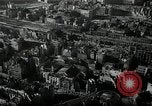
Aerial views of war damage in Berlin, Germany.
War damage in Berlin, Germany as seen from the air. Various buildings destroyed in the Berlin Mitte district. Aerial view of the Potsdamer Platz, the Reich Chancellery (Reichskanzlei Wilhelmstraße 77 Berlin, Germany), and the Reichstag building (Platz der Republik 1, 11011 Berlin, Germany), showing further damage caused by bombing. Aerial view of Mitte district, with heavy damage from bombing. View of the Ministry of Aviation building (now known as the Detlev-Rohwedder-Haus Wilhelmstraße 97, 10117 Berlin, Germany).
President Dwight D. Eisenhower chairs National Field Day and Plowing Conests
President Dwight D. Eisenhower and Mrs. Eisenhower arrive at the National Field Day and Plowing Matches, while band plays "Hail to the Chief." The president speaks about soil conservation. He speaks of the plow as an instrument of peace. He mentions meeting with the Advisory committee on Agriculture. In closing he acknowledges the Women's Air Force Band.
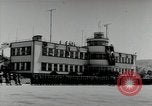
Dignitaries visit Ankara Turkey and lay wreath at mausoleum of Atatürk
Several foreign dignitaries arrive at Ankara Airport, Turkey, via U.S. Air Force C-47. A few are seen wearing the traditional Fez hat. They are met by an honor guard and escorted by officials. They visit the Anıtkabir or mausoleum of Mustafa Kemal Atatürk (Yücetepe, Akdeniz Cd. No:31, 06570 Çankaya/Ankara, Turkey), where they ceremoniously lay a wreath. They visit the Turkish Grand National Assembly (Republic Museum, Doğanbey, Cumhuriyet Cd. No:7, 06050 Altındağ/Ankara, Turkey).
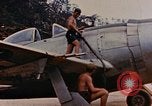
USAAF 464th Fighter Squadron crew members refuel P-47N on Ie Shima, near end of World War II
Shirtless U.S. Army Air Forces ground crew members refuel a 464th Fighter Squadron, 507th Fighter Group, P-47N airplane, on Ie Shima Island, Ryukyu Islands, preparing to attack Kyushu, in final days of World War 2. Picture of a girl and the words 'Winkie Jean' painted on the nose of the P-47.
CRITICALPAST.COM: About Us | Contact Us | FAQs - How to Order | License Agreement | My Account | My Lightboxes | Shopping Cart | Advanced Search | Featured Collections | Website Terms & Conditions | Privacy Policy ©2026 CriticalPast LLC.
License Agreement |
Terms & Conditions |
Privacy Policy
©2026 CriticalPast LLC.