


 Francais
 Deutsch
 Italiano
Refine Your Search
Pleiku South Vietnam 1966 stock footage and images
- Showing 1735 to 1740 of 5965 results more
more Hide
Hide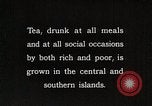
Tea ceremony in Japan
Japan as a tea drinking country. Japanese women picking tea leaves in Central or South Japan. Woman uses a Hishaku bamboo ladle to scoop tea from pot during a traditional tea ceremony. She pours tea into a bowl. She bows to another woman as part of the tea ceremony. She serves tea for the woman. The other woman drinks the tea.
Contrast between Chinese and Japanese national aspirations before Second Sino-Japanese War and WW2
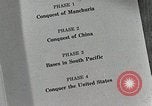
Film reviews China's four thousand years of history. Scenes showing mountains, woods, and a farmer plowing with oxen in rural China. A mass of Chinese people tightly packed together as they walk along a narrow alleyway in a town. Fleeting glimpses of two Chinese soldiers; a child; a woman; a woman and child; and numerous other Chinese people in a montage splayed across a background of moving crowds. An open book of Chinese characters. Mariners compass superimposed on an moving image of an ocean liner. Views of several large-scale astrolabes and world globes. A Chinese worker placing porcelainware in an oven for glazing. A man spooning gunpowder into a dish, followed by glimpse of a Chinese firework igniting. Chinese paper Dragon and street celebrations. A book entitled: "Analects of Confucius," in which, on page 105, is found the admonition: "What you do not want done to yourself, do not do to others." Ancient statues of two men and of two riderless horses behind them. Tall Chinese pagodas. Chinese artillery field pieces firing. Chinese troops advancing in several situations during conflict with Japan. Map of China and illustration of Japanese samurai warrior emblazoned across it. A book entitled: "The Tanaka Memorial, (Japan's Dream of World Empire)." A still photograph of Japanese Foreign Minister Baron Tanaka Giichi in military uniform, with other Japanese officers. Excerpts shown, ostensibly from this book. Emperor Hirohito is seen with Baron Tanaka, and other officers, all in military uniforms, in front of a tent, circa 1928. Automated map ostensibly illustrates the elements of a Japanese plan of conquest, starting with Manchuria for raw materials; the absorption of China for manpower; followed by a sweep South for riches of the Indies and Australia; and lastly a sweep eastward to crush the United States. More views of crowds of Chinese people are followed by an. animated map illustrating early World War II events, including Nazi Operation Barbarossa against Russia, approved by German leader Adolf Hitler in 1940, and the Nazi German occupation of Denmark, Norway, and other European countries. (Note: Actual existence of the so-called "Tanaka Memorial Imperialist Conquest Plan" is a subject of debate among historians.)
China builds Burma Road to carry war materiel and supplies and creates flood of Yellow River to thwart Westward expansion of Japanese occupied territory
Japanese officials meeting in strategy session. Japanese infantry on mission to cut Chinese supply lines during 2nd Sino-Japanese war. Black smoke rises as they move along a river bank. Chinese prisoner-workers are forced to rebuild railroads destroyed by the Chinese people during their great Westward trek. Japanese soldier closely guards workers. A Japanese army armored train underway on the rebuilt railroad, as Japanese soldiers cheer. Animated map shows China's supply lines by sea, to Tsingtao, Hangchow, and Amoy, cut off by Japanese naval blockade. Japanese Navy launch with officers and crew moving near commercial ships as they take over Chinese river ports. War materiel and other supplies destined for China, including trucks, sit idle, unable to be transported to their destinations. Large oil tanks and drums of gasoline are shown, as well as gun barrels and a flightline filled with parked Curtiss P-36 Hawk aircraft. The Imperial Japanese Navy destroyer Asakaze (DD-3) and another, next to it, in a Chinese river port. A Japanese freighter with anchored weighed, secured by long lines to a wharf. Small boats flying Japanese Naval ensigns are next to it. View of map showing china, Burma, Indo-China, and Chungking, with Japanese blockading fleet stationed in the South China Sea. It traces path of narrow gauge rail line from Indo-china to Kumming,China, where it connected to an overland road to Chungking. Next it traced the old Camel Caravan route, across China, from Russia. Narrator notes these were to small to be useful and too close to Japanese-occupied territory. Next, the map traces a railroad that from the port of Rangoon to Lashio, Burma. It is separated from the road to Chungking, by mountains and gorges. Views of the actual mountainous terrain. Animal pack trains moving through the area. Construction engineers in a large drafting room designing a road to transit the area. View of modern road-building caterpillar tractor equipment of the type needed to accomplish this. View of Chinese laborers using manpower instead. They push large rollers and employ pickaxes and other hand-held tools to carve away and dig road beds. Masses of Chinese laborers at work, carving a road along the edge of a mountain. Two-men teams using manual tampers to pound down the roadbed. Children are employed along with adults. A woman with a baby on her back, pounding large rocks into gravel, surrounded by other children doing the same. View from above of the "Burma Road," the product of their labors, winding its way through the mountains and gorges. Many scenes of trucks moving along portions of the Burma Road. P-40 airplanes flying past white cumulus clouds, overhead. Animated map shows continued expansion of Japanese occupied areas to encompass two thirds of the rail lines in China with goal of controlling the remainder, starting at Chengchow, in Summer, 1938. View of Chengchow region, on banks of the Yellow River. Map illustrates flow pattern of the Yellow River. View from past of the Yellow River's Spring floods toward the Sea, with Chinese people throwing rocks onto dikes that keep the river flowing in a more Northerly direction than its former course. Illustration shows how with Japanese encrouching on Chengchow, the Chinese decided to destroy those dikes and allow the river to flood over its former more Southerly course. Japanese soldiers being inundated by the flooding river. Japanese infantry and tanks regrouping on their occupied side of the new (old) path of the Yellow River. Local Chinese residents of Chengchow, wade with belongings as they leave their flooded homes.
Japanese aggression in China and various events leading to Japanese attack on U.S. at Pearl Harbor (WW2)
A hand writes check marks beside “Bases in the South Pacific” and “Conquer the United States” on the summary report purporting to reflect phases of Japanese so-called "Tanaka Plan". Animated map shows pressure by German forces in offensive against Soviet Union and illustrates German air war against Britain. Scenes of bombing destruction in Britain, including overturned double-decker bus in ruins of buildings. A Nelson Class British battleship viewed from dead ahead. She is followed by the aircraft carrier HMS Illustrious. The U.S. Capitol building in Washington, DC. American newspaper headline reads: "Navy Bill Passes House." and "Huge Sum Voted for Two Ocean Navy." A line of U.S. Navy battleships underway, led by the USS Mississippi (BB-41). A field full of U.S. M3 Lee tanks moving in formation, as they are overflown by several Douglas B-18 bombers. Assembled Japanese leaders in a forum. Japanese Naval officers in a planning conference. Closeup shows Admirals Shigeyoshi Inoue and Raizō Tanaka pointing at a chart and conversing as other officers look on. Next, bomb bursts and black smoke rises as the attack on Pearl Harbor is underway. The USS West Virginia, USS Tennessee, and the USS Arizona, burning on Battleship row, during the attack. Generalissimo Chiang Kai-Shek with staff officers walks to a waiting car. Forces allied with China, including American troops marching; British troops marching; and Dutch Colonial troops marching (in Batavia, the Capital of the Dutch East Indies). Japanese troops continuing their conquest of China, firing a field piece, and infantry charging. Newspapers announce Japanese advances into Malay Peninsula and Hong Kong. Others cite the Fall of Singapore and the Fall of Corregidor in the Philippines (6 May, 1942). Animated map shows Japanese occupation encompassing Indochina, Thailand, and Burma (with loss of the Burma Road) all of which compounded China's war efforts.
Montage of scenes related to the China-India-Burma theater during World War II
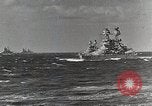
Two U.S. Pennsylvania class battleships underway at sea, with other warships in background, during World War 2. One fires to starboard with her 14-inch guns from the forward triple turrets. U.S. Army Air Forces B-24 Liberator bombers flying in formation over mountains. Glimpse of General Douglas MacArthur with General Joseph (Vinegar Joe) Stilwell in gunner's station of a bomber. Montage of brief glimpses showing U.S. forces engaging Japanese forces in: amphibious assaults; firing weapons in New Guinea and other Pacific islands. U.S. warship firing naval guns. U.S. ship firing at attacking Japanese aircraft, with sky full of black flak clouds. Admiral William (Bull) Halsey. Mitsubishi A6M Zero kamikaze aircraft blown up close to flight deck of U.S. aircraft carrier. It misses the ship and crashes in flames, exploding in the water, astern. U.S. General Joseph Stilwell, Madame Chiang Kai-Shek, British Allied commander Lord Louis Mountbatten, and Chinese Generalissimo Chiang Kai-Shek, photographed together in India. Chinese Generalissimo Chiang Kai-Shek seated for a picture with U.S. President Franklin D. Roosevelt. Camera moves back revealing British Prime Minister Winston Churchill, and Madame Chiang Kai-Shek, also seated. Behind them stand key allied military leaders, including (from the right) Field Marshal Archibald Percival Wavell, Commander-in-chief in India; Admiral Louis Mountbatten, Supreme Allied Commander of South-East Asia forces; George Giffard — commander of Eleventh Army Group; U.S. General Daniel Isom Sultan, deputy to General Stilwell; General Joseph Stilwell, Commander China-Burma-India (CBI) Command; and General Albert Coady Wedemeyer, Chiang Kai-Shek's Chief of Staff. General Joseph Stillwell is seen stepping from a military cargo plane, and being greeted by another officer. Stilwell is wearing a campaign hat. He has the CBI patch on his jacket shouder. A B-24 Liberator bomber takes off from a Chinese base at Liuchow, or possibly, Luiliang, China. (ostensibly carrying Chinese soldiers to India for training). U.S. marked P-40 aircraft are parked beside the runway. They display the shark teeth nose art of the Flying Tiger All volunteer Group of Claire Chennault. But this is 1944 and the aircraft are from the U.S. 23rd Fighter Group. Chinese soldiers are seen being armed and trained in India, with modern small arms. They are also seen fording a river with military supplies and moving in jeeps through jungle-like settings. Various views of Ledo Road construction in Burma. bulldozers, trucks, caterpillar tractors, explosives and men are shown in construction work. A jeep rides along a muddy section of the new road while U.S. and Chinese soldiers patrol on either side to protect it. Allied soldiers firing a small field piece. A C-47 aircraft airdrops supplies to the road builders. General Stilwell, standing with a Chinese officer, looks skyward at the aircraft. A C-46 Commando plane taking off from a field in India carrying supplies. Men loading a jeep aboard a C-46, plus ammunition and other supplies. Rare sight of supplies being loaded into nose cargo compartment of the one-of-a-kind XC-108A transport plane (modified B-17 bomber, tail number 41-2593). A formation of USAAF C-45 transport aircraft flying "over the Hump." Chinese P-36 Hawk aircraft in formation demonstrate firepower. Newly trained Chinese pilots marching and walking on flightline where solid-nose B-25s and P-40s are parked. Chinese and American pilots wave to each other from their P-40 aircraft. A B-25 takes off flanked by two P-40s. Bombs being dropped by Chinese B-25s. Japanese ship being strafed by Chinese fighter plane. Chinese laborers at work building an airfield without machinery. A large group pull a paving roller by hand. Chinese troops in combat with Japanese forces. One firing a Czech ZB vz. 26 light machine gun. Madame Chiang Kai-Shek addressing the U.S. Congress, 18 February, 1943.

Native American Indian Chief Aims Back introduces himself to tribal council
Chief "Aims Back" introduces himself to tribal council using sign language. He belongs to tribe Blackfeet or Southern Piegan who belong to Montana, USA. Chief Aims Back wears a feather headdress. Chief Back uses hand signals for passing his message to other delegates.