


 Francais
 Deutsch
 Italiano
Refine Your Search
Pleiku South Vietnam 1966 stock footage and images
- Showing 1741 to 1746 of 5965 results more
more Hide
Hide
Chief Foolish Woman introduces himself to Native American Indian tribal council
Chief Foolish Woman introduces himself to Indian tribal council. He belongs to Mandan Indian tribe.Mandan reside along the banks of Missouri river and two of its tributaries the Heart and Knife rivers in North and South Dakota.4 September 1930.
Native American Indian Chief Tom White Horse introduces himself to Indian tribal council
Chief Tom White Horse introduces himself to Indian tribal council. He belongs to Arapahoe tribe. He wears a feather headdress and a chest plate. He uses sign language to introduce himself. Arapahoe has two divisions Northern Arapahoe and Southern Arapahoe people. Arapaho is a Algonquian language spoken by Arapahoe people.
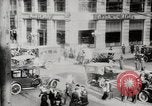
Early efforts at controlling traffic in American cities crowded with automobiles, trucks, streetcars, and pedestrians
Automobiles, pedestrians, and street cars, attempt to negotiate the completely uncontrolled intersection of South Broadway and 7th Street in Los Angeles, California, in the early to mid 1920s. Bank of Italy (later the Bank of America) occupies the northeast corner of the S Broadway and 7th Street intersection. Scene shifts to New York City where a mounted police officer controls traffic at a busy intersection. He stops traffic in one direction, allowing crowds of pedestrians to cross and cars and street cars to proceed in other direction. In a quieter city, cars are parked in center of roadway and along curbs. pedestrians move on sidewalks and traffic moves easily. In a major city, Police officer stands in center of street and stops traffic for very large group of school children waiting to cross. They all run across when he gives them the OK. At another location, a policeman is posted at an intersection with a signal device to indicate "Stop" and "go." Scene shifts to an intersection in city of Detroit, with "Stop" and "Go" signal at corner. A woman crossing the street is almost hit by a car, but pulled out of its way, by a Detroit City Policemen posted in the center of the street. In another town, a policeman is seen in an elevated post at center of a street, with "Stop" and "go" signals under his control. Sign at front of the post reads: "Drive Safely Walk Right." Truck (with cyclist hitching a ride on the tailgate) proceeds with other vehicles on the "go" signal.
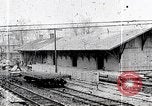
Train passing by and on bridge in Ohio, United States.
Railroad train operations in South Charleston Ohio and Glen Jean (Waverly) Ohio. View of railway cart on tracks and a building. Steam locomotive passes by the building pulling a passenger train. View of Charleston train station building. View from last train caboose or bogey shows a Ford Model T milk van carrying milk cans cross the railway tracks. Train on bridge and view of bridge from last train caboose at it crosses the bridge.
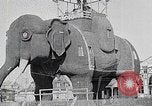
Lucy, the elephant building made of wood and tin, seen near Atlantic City in Margate, New Jersey, United States
Structure of a giant, hollow wooden elephant building. Dubbed Lucy, this building was built in 1882. It weighs 90 tons and has a substructure of wood and skin made of hammered tin. Men and women tourists go inside the elephant building through a door in the elephants leg at bottom. It is located near the Atlantic coast, in Margate, New Jersey, United States, two miles south of Atlantic City, New Jersey.

Historical views of The White House grounds and interiors, in the United States.
The White House past and the present. Aerial view of The White House in Washington DC in the late 1950s. Scene with 1950s cars parked and moving in parking areas and roads in front of the White House. Visitors walking on the White House grounds near the North Portico. View of a Birch tree planted by wife of President Calvin Coolidge and Magnolia trees by President Andrew Jackson. View of the south portico entrance and the north entrance of the White House. Plans and sketches of of The White House. Portraits of President John Adams and his wife Abigail Smith. Portrait of President Thomas Jefferson. Plan of the east and the west wing of The White House. Illustration of British attack on The White House. Portraits of President James Madison and his wife Alley. Portrait of President George Washington. Portrait of President James Monroe. Picture of President Abraham Lincoln. Footage of President Lincoln's study room, and his bedroom with its custom bed over 8 feet in length. Sketch of President Benjamin Harrison taking oath. Still images of ornate furnishings in the White House during Harrison's tenure. Still images of more simplified furnishings in the White House under Theodore Roosevelt. Picture of President Theodore Roosevelt with sons. Aerial view of the new west wing area enlarged for White House office use. Still photo of Theodore Roosevelt writing. Footage of President Woodrow Wilson signing a bill at his desk, with a crowd of officials standing by. Footage of United States Military officers and French General Ferdinand Foch and other French military officers entering the White House to meet with President Harding on October 29, 1921. (Foch was touring the U.S. and being officially thanked for his leadership in World War I.)
CRITICALPAST.COM: About Us | Contact Us | FAQs - How to Order | License Agreement | My Account | My Lightboxes | Shopping Cart | Advanced Search | Featured Collections | Website Terms & Conditions | Privacy Policy ©2026 CriticalPast LLC.
License Agreement |
Terms & Conditions |
Privacy Policy
©2026 CriticalPast LLC.