


 Francais
 Deutsch
 Italiano
Refine Your Search
Prison physical examination. stock footage and images
- Showing 745 to 750 of 3715 results more
more Hide
Hide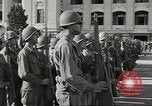
V-J day is celebrated by liberated Allied soldiers, freed from Japanese prison camps at end of World War 2 in the Pacific
Scenes of Allied soldiers celebrating Victory over Japan at the end of World War 2. Most scenes show liberated Allied prisoners of war as they celebrate being freed from Japanese prison camps. Many of the former POW soldiers are emaciated, starved, and thin, and show signs of abuse. Smiling liberated prisoners gather at a dock beside a prison camp compound and cheer an approaching relief boat. Letters painted atop bombed out building include "US Army Come After Us" alerting allies to the presence of their prison camp. Freed prisoners in another camp pose together, smiling and cheering. Freed prisoners pass around a flask of booze and share drinks in celebration. Views of a prison complex and prison grounds, after liberation, with U.S. Army and other Allied soldiers eating food and washing. Many are emaciated. U.S. Army officer interviews a liberated prisoner and takes notes. Two freed prisoners hold up a bat that was used to beat prisoners, among various atrocities committed by Japanese guards. A soldier holds up his burned and battered hands. His right hand is possibly also missing the thumb. Interior view of a barren prison barracks is shown, with only thin blankets on floors. An Americna soldier stacks up boxes of Red Cross supplies that had been sent to the camps for the prisoners, but which were stolen by Japanese guards. Liberated prisoners stand beside the graves of several dead soldiers. Final scene shows three Japanese former prison guards bowing before two liberated prisoners as the freed soldiers exit the Ofuna prison camp, near Yokohama, Japan.
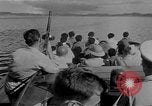
Japanese prisoners on PT boats and being marched under American guards in Guadalcanal, Solomon islands.
Captured Japanese aviators by U.S. Marines in Guadalcanal, Solomon islands during World War II. Japanese aviators captured, in PT (Patrol Torpedo) boats enroute to Guadalcanal. Stern of PT boats with wake and guards. Japanese prisoners on PT boats. Japanese prisoners disembark from Higgins boat. Japanese prisoners stand about. American give Japanese prisoners cigarette and a light. Japanese prisoners march to stockade. Japanese prisoners wait for a boat. Prisoners being marched to boat. Guards with tommy guns as they watch prisoners on boats. Prisoners sit idly. Prisoners seated on stern of a PT boat. Prisoners march on road. Prisoners stand idle. Prisoners stand in a group as Marines guard them. Prisoners stand in a double line as Marines guard them.
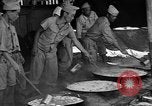
Japanese prisoners in a wire-fenced enclosure, working on fence, and engaged in games, in Okinawa, Japan during WWII.
Japanese prisoners in Okinawa, Japan, during World War II. The Japanese prisoners of war (POW) preparing soups in huge vessels. The soup being served to the prisoners. The prisoners, in a wire-fenced enclosure, having the soup from bowls. The prisoners unloading ration supplies from trucks. The prisoners stacking the supplies inside the enclosure. 'PW' written on the backs of the prisoners' shirts. Prisoners working on the wire fencing. Prisoners having bath. Prisoners having haircut and shave. Two prisoners playing a board game. A few prisoners watching. Two prisoners engaged in a judo match. Other prisoners seated in a circle around them and watch as they wrestle.
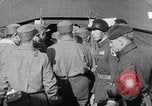
Defecting, former Chinese prisoners reach Incheon harbor during trip to Taiwan.
Liberated Chinese prisoners from Korean War prison camps, getting onto U.S. trucks to reach Incheon harbor in Seoul, en route to Taiwan where they are defecting from Communist China. They were known as "Anti-communist Heroes." The United Nations Transportation Corps and the United Nations officials take care of transportation process. Chinese Ambassador to Korea and other officials bid farewell to the Chinese prisoners. Trucks loaded with Chinese prisoners move along road. Chinese prisoners hold flags on trucks. Trucks stop in between before reaching Incheon. Prisoners have soup. Trucks loaded with prisoners begin the journey. Incheon city streets decorated to welcome Chinese Prisoners. South Korean civilians line up streets. Chinese prisoners greeted by 47th Overseas Chinese Organization members and the United Nations band. Crowd with flags and banners welcomes the Chinese prisoners. Chinese opera with people in colorful dresses. Freed Chinese prisoners march in Incheon harbor. Chinese prisoners holding the Chinese flags march along pier. Crowd cheers at harbor. Stick points out sea route from Incheon to Taipei, Taiwan. Convoy of warships and planes escorts liberated Chinese prisoners heading to new life in Taiwan, Republic of China (ROC).
U.S. troops take the Japanese prisoners in trucks, to be enclosed, in Okinawa, Japan during WWII.
Japanese prisoners in Okinawa, Japan, during World War II. U.S. troops with a few Japanese prisoners of war (POW) on a marshy area. The group of prisoners on a field. The prisoners, in columns, are marched along a path in the area by U.S. troops. Wounded prisoners in the group. Two men on either side of a wounded prisoner, help him to walk. A few prisoners seated on the ground. Partially clothed prisoners, in a group on the field. A few of them standing and a few others sitting. The prisoners moving in columns. Two U.S. soldiers attend to a wounded prisoner. A few wounded prisoners are loaded into a truck. A jeep loaded with prisoners. The vehicles move along a road and reaches the war prisoners' enclosure.
Brutalities against prisoners, officials gathered in 1949 in Palace of Nations for Third Geneva Convention; discussion of Geneva Conventions.
Film from 1965 shows scenes that span from early 1940s through mid 1960s. Film opens showing armed conflict in Laos and South America. Soldiers firing rifles in jungle areas. Armed men running across a field and in a town in Cyprus. Heavy armor engaged in conflict and buildings burning in undisclosed location. Riots in Congo with a crowd of men beating another man. Armed Republic of South Vietnam soldiers (ARVN) moving through jungle in Vietnam War. A Viet Cong fighter shot as ARVN troops attack a hut. People fleeing in streets of Cuba as government soldiers engage armed revolutionaries under Castro. A civilian woman suffering a seizure as Red Cross workers attempt to carry her. Burned body of dead tank crew soldier atop a tank. Medical corps persons moving wounded on a stretcher. Various views of ARVN with captured Viet Cong in Vietnam. Narrator discussion about Geneva Conventions and Counterinsurgency. View of the Palace of Nations building in Geneva Switzerland. Scene shifts to inside, in 1949, where delegates of 59 nations are gathered to develop new rules expanding the original 1929 Geneva Conventions, in order to better protect prisoners of war, wounded prisoners, noncombatants and others caught up such internal conflicts. View from ground of German paratroopers during World War 2, jumping from Junkers Ju-52 trimotor transport planes. Closeup of German soldiers leaping from a plane and descending in parachutes. Japanese soldiers surrendering to Americans on a Pacific Island in World War 2. Several scenes of massacre victims lying on the ground, victims of Nazi German brutality in Europe during World War II. Survivors of a Nazi concentration camp near the time of its liberation in 1945. A U.S. Army medical corpsmen help one to a stretcher. Executed prisoners of war. Courtroom of the Nuremberg trials. Seen in the front row of Nazi leaders are: Hermann Göring, Rudolf Hess, Joachim von Ribbentrop, Wilhelm Keitel, Ernst Kaltenbrunner, Alfred Rosenberg, Hans Frank, Wilhelm Frick, and Julius Streicher. Seated behind them are: Karl Dönitz, Erich Raeder, Baldur von Schirach, Fritz Sauckel, Alfred Jodl, Franz von Papen, Arthur Seyss-Inquart, Albert Speer, and Konstantin von Neurath. Scene shifts to the postwar trial of Japanese Lieutenant General Masaharu Homma, in the Philippines. Prisoners with hands bound, in an unidentified Asian conflict, being herded into an open truck. Views of the document constituting the 3rd Geneva Convention of 1949, addressing treatment of prisoners and of parts directed to "conflicts not of an international character." Views of a traumatized civilian driver wounded and a female passenger killed in in his car (appears to be in Cuba or Latin America). Armed gunmen have the man leave the car. A man lays the body of the woman beside the car. Scene shifts to a group of surrendered Vietcong fighters with their weapons stacked. Wounded combatants being carried on stretchers. American survivors of a Japanese prison camp receiving a good meal after being rescued - this is possibly in the Philippines in 1945. Many of the American prisoners are gaunt and emaciated and malnourished. Narrator recites list of activities prohibited by Geneva conventions, as images show these activities: A ditch filled with victims of massacre. Hostages being taken in an internal conflict in an African country. Prisoners being beaten by non-uniformed civilians in and humiliated in public. A recently liberated prison with a former prisoner in striped uniform beating a man as a group is marched away (likely a World War 2 concentration camp with a liberated prisoner beating a former Nazi guard). Death sentences being rendered without due process. A court in Cuba. A boy pointing at a lineup of prisoners. A prisoner shot.
CRITICALPAST.COM: About Us | Contact Us | FAQs - How to Order | License Agreement | My Account | My Lightboxes | Shopping Cart | Advanced Search | Featured Collections | Website Terms & Conditions | Privacy Policy ©2026 CriticalPast LLC.
License Agreement |
Terms & Conditions |
Privacy Policy
©2026 CriticalPast LLC.