


 Francais
 Deutsch
 Italiano
Refine Your Search
Prison physical examination. stock footage and images
- Showing 751 to 756 of 3715 results more
more Hide
Hide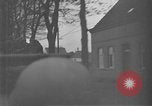
American First and Ninth Army troops and German prisoners of war move along streets in Lippstadt, Germany.
American First and Ninth Army in Lippstadt, Germany after World War II. Streets with houses along their sides. A truck loaded with German prisoners of war moves along a road. Tanks with American First and Ninth Army troops and German prisoners with their belongings move along streets. German prisoners have armbands. U.S. soldiers on a tank wave. Buildings on either side of a street. A wounded German prisoner of war taken by two other Germans. U.S. officers and soldiers march along a street. A German prisoner with a bandaged hand holds his belongings and moves along a road. Two American soldiers watch the prisoner. Other prisoners of war with their belongings on the road. The prisoners of war move inside a building. A battered ex-prisoner of war walks along a street. A prisoner talks to a soldier. A prisoner walks inside the building with a soldier holding a gun behind him. Discarded German guns, a helmet and other equipment. A swastika sign on the helmet.
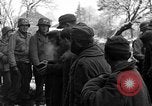
Prisoners of war being moved and searched by U.S. Army Military Police in WW2 and in Korean War
First scenes of clip show United States Military Police (MP) processing German prisoners of war (POW) during World War 2. German prisoners load into a U.S. Army truck under supervision of several MP, in cold winter weather conditions with snow on the ground. Next scene shows German prisoners of war enter a holding area in a large field under MP supervision. Scene changes to Korean War and activities of U.S. 8th Army Military Police. U.S. Army Military Police (MPs) and Korean or Chinese prisoners of war (POW) standing. The POWs board a truck. They are led by MPs. The POWs enter a camp area in a line. An MP frisks a prisoner. Prisoner of War documents being completed by an MP. Prisoner being fingerprinted. Elevated views of mass of prisoners running quickly into large column formation with Military Police watching at the head of the column. Prisoners standing on a road in groups. The MPs stand beside them. They check the identities of the prisoners. The prisoners are being searched by the MPs. Korean civilian refugee families fleeing an area. A young Korean child on a bicycle that is also laden with many belongings as a family evacuates. Families pulling open carts with Korean children laying on the carts bundled in blankets.
U.S. prisoners of war rescued in the Philippines and returning home to the United States at end of World War 2
Families at harbor waiting for the troop transport ships. United States soldiers and liberated prisoners of war on ship. San Francisco's Golden Gate Bridge and harbor in background with Coit Tower atop Telegraph Hill. Troop ships arrive and crowd cheers. Japanese soldiers bonzai cheer and Japanese forces bomb and take control of Corregidor. Japanese planes bombing. Ambulance carries wounded. United States soldier loses his arm during a Japanese aerial attack on Corregidor in 1942. Japanese soldiers guard American prisoner of war soldiers and escort them into prison camp in Manila (soldier narrating says it was Bilibid jail). General Wainwright surrendering in Corregidor in May 1942. United States flag lowered by Japanese soldiers and Japanese flag is hoisted. Wreckage of bombed U.S. facilities in Philippines. Japanese propaganda film showing care for wounded American soldiers on hospital beds. U.S. Army prisoners fo war eat food. Wounded American soldiers walk with crutches on the grounds of the prison camp. Bataan Death March of the emaciated prisoners. American military prisoners at Cabanatuan labor and sleep on open air bunks. Scene of U.S. Army training early in World War 2 with troops in a field setting a machine gun emplacement to fire at rolling trucks relabeled as "Tank". Japanese propaganda newsreels showing Japanese military success in Philippines and Japanese forces in the Aleutian Islands. Aerial view formation of U.S. Army Air Force B-25 bombers in the sky. Aerial side view of American bomber aircraft and bombs away view. Navy bombing from ships. General MacArthur returns to Philippines and wades ashore. Philippine guerrillas and U.S. troops in battle to retake Philippines. U.S. prisoners of war liberated and freed and at 92nd Evacuation Hospital Cebu. Released prisoners on ships to America. WAC women hand out mail. Soldiers write telegram wires announcing arrival. Ship docks in San Francisco. Prisoners reunite with happy families and crowds on streets cheer their arrival. Soldiers and civilians walk on Market Street in San Francisco. Welcome home parade for San Francisco soldiers during WWII. Soldiers waving from buses in parade. Soldier in front of Marina Junior High School, 3500 Fillmore Street. One armed, disabled soldier with parents views photo album.
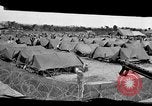
Mopping up operations at end of battle for Okinawa in World War II. Numerous Japanese prisoners of war impounded.
Opening scene shows tents housing more than 1500 Japanese prisoners of war at Kadena, Okinawa during World War 2. The area is surrounded by fencing and, as camera pans, it shows an American soldier overlooking the prison camp as he holds a Browning M1919A6 light machine gun. Another view of the prison compound with warning sign against admittance and another sign reading: "PW inclosure." As narrator refers to "mopping up operations" a jeep carrying more Japanese POWs drives past the signs. Ambulatory Japanese POW entering the prison compound past armed military policeman. View from inside the compound as Japanese POWs enter. A POW being frisked by a U.S. soldier. Closeups of some Japanese prisoners standing behind barbed wire enclosure. American soldier makes notes as he interviews a prisoner. POWs receiving haircuts under a tent in the stockade. Others washing and shaving at an outdoor trough of water. Some seen playing a board game at a tent. POWs in a wrestling contest, surrounded by others watching. Prisoners offloading supplies from a truck and stacking them in their compound. POWs cooking food in large kettles and distributing it to other prisoners. Various views of prisoners in the compound. U.S. medics attending to a wounded POW, administering blood plasma. Numerous Japanese prisoners loosely assembled outdoors. Next, on June 22, 1945, U.S. troops are assembled for a flag raising ceremony. The U.S. flag is raised on a tall flagpole to mark the securing of Okinawa. An unidentified U.S. Army Lieutenant General leads the ceremony, saluting as the colors are raised. (Lieutenant General Simon Bolivar Buckner Jr., Commander, 10th Army that took Okinawa, was killed 4 days earlier, on June 18, 1945.)
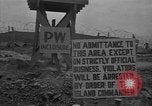
U.S. troops bring the Japanese prisoners in trucks, and put them in wire-fenced enclosure, in Okinawa, Japan during WWII.
Japanese prisoners of war (POW) in Okinawa, Japan, during World War II. The Japanese prisoners are brought in trucks by the U.S. troops to be enclosed. The Japanese prisoners get out of the trucks. U.S. soldiers search the prisoners. The prisoners are sent into a wire-fenced enclosure. The prisoners inside the enclosure. Small tents inside the enclosure. The prisoners standing in lines. The corpsmen attending to wounded prisoners who are laid on stretchers. A prisoner's eye being bandaged by two other prisoners.
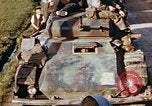
Prisoners aboard German armored vehicles and freed POWs show identification number tattoos on arms in Wiesbaden,Germany
Activities of German military prisoners in Wiesbaden, Germany under U.S. forces, in the last days of World War II in Europe. German soldier prisoners aboard German armored vehicles (including a SdKfz 234 with a Luchs turret) parked along road side. German soldier holds loaves of bread. Charcoal burning automobile on street. Young German soldier (a young boy soldier) behind steering wheel of a truck is seen smiling. Nun talks to a German soldier. German convoy parked on the street. Prisoners lay down on field. United States Army Colonel is talking to a group of liberated prisoners freed from German prison camp. The Army Colonel talks to a young man of African descent who is wearing a prisoner hat and prisoner uniform with an inverted red triangle prison camp badge indicating a political prisoner. Liberated concentration camp prisoners show identification number tattoos on their arms. They are seen smiling.
CRITICALPAST.COM: About Us | Contact Us | FAQs - How to Order | License Agreement | My Account | My Lightboxes | Shopping Cart | Advanced Search | Featured Collections | Website Terms & Conditions | Privacy Policy ©2026 CriticalPast LLC.
License Agreement |
Terms & Conditions |
Privacy Policy
©2026 CriticalPast LLC.