


 Francais
 Deutsch
 Italiano
Refine Your Search
Prison physical examination. stock footage and images
- Showing 1951 to 1956 of 3715 results more
more Hide
Hide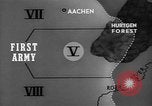
U.S. Army troops and engineers building roads, placing guns, transporting German POWs in Germany near Hurtgen Forest region.
Activities of American First Army from Aachen to Roer River in Germany. Animated map shows First Army entering into Hurtgen Forest and arrive Cologne plain going through the Roer River. 28th Division controls key roadways of Vossenack and Schmidt. Engineers build roads through the Hurtgen Forest. Large tree trunks are laid into place as foundation and then milled wooden planks are nailed atop to quickly create a usable road surface. Jeep passes over the newly built road. U.S. Army forces start a fire for protection against the cold. 28th Division troops with mortar and machine gun support advance (November, 1944) through a wooded area. Infantry columns move to the front. Smoke clouds rise. Ground forces move out from wooded area. German POW's file into an assembly area and are evacuated by truck. U.S. Army soldier hangs a sign around the neck of a Germany prisoner of war that says "200,000th prisoner of war captured by troops of U.S. First Army." Artillery and antitank guns are placed for defense. Soldiers work on telephone tower. Underground emplacements are built as snow falls. (World War II period).
Battle of the Ardennes and Battle of the Bulge, in World War II
Film starts showing silhouettes of British tanks on the move, including one with a bulldozer blade. View from Allied warplane as bombs explode on the ground below. In November, 1944, infantry of the First Canadian Army, with Polish and British units fire Bren guns as they advance in Belgium and secure the Scheldt Estuary, to open a shipping route to Antwerp for the Allies. They traverse a river and cross rail lines while advancing. View of destroyed steel bridge across the Maas (Meuse) river with several British troops wading in water nearby. Silhouettes of German prisoners of war marching single file. View from rear of German prisoners walking under guard with hands resting on their heads. British troops running beside the Scheldt river at Antwerp on September 4, 1944, as huge explosions occur in the river behind them. A column of British troops, marching on tree-lined road, enters outskirts of Antwerp, as local people cheer them. Views of the troops being greeted in the city itself. Columns of Belgian refugees are seen returning to their homes. One,injured, is carried by friends in a wooden cart. A contingent of British troops marching in the city. Glimpses of derricks in the Antwerp port and a ship under construction in a shipyard. An animated map shows German counter offensive through Belgium and Luxemburg on September 4, 1944. Refugees leaving again, ahead of the returning German forces. View of a road sign reading: "Bastogne." American military police checking credentials of some refugees as they leave. American soldiers jammed together atop a Sherman tank parked at a checkpoint. After delaying further German advance, through the Ardennes, on September 16th, American troops are forced back and seen leaving , in trucks and Sherman tanks, from Bastogne, past a road leading to Martelange. As weather cleared on September 22nd, a formation of British Hawker Typhoon ground attack aircraft are seen in flight and diving to attack lines of communication with machine gun fire and rockets. Several different views of the aircraft firing and smoke rising from the ground. Animated map of German advance depicts the so-called "Bulge" extending 60 miles into Allied territory. Captured German films show German troops,one carrying a rifle and another a Sig 44 machine gun, as they pass columns of burning Allied trucks, other vehicles and armor. Closeup of German soldier waving to others to follow him, as he runs ahead past burning Allied equipment. Several German soldiers hunker under a knocked out Allied tank, as a German Jagdpanzer 38(t) Hetzer light tank destroyer passes their position. Closeup of German soldier smoking captured American cigarette. German infantry, walk past barrel of destroyed Allied tank. Several gather and smoke American cigarettes. One of them, with a belt of ammunition around his neck, is Hans Tragarsky aka Walter Armbrusch, of German Kampfgruppe Hansen, a battle group formed during the Battle of the Bulge from SS-Panzergrenadierdivision Regiment 2, an infantry regiment of SS Pz Rgt 2 "Das Reich". (This image is well known but his identity is subject to debate.) Glimpse of German officer walking with a soldier at the front, with background engulfed in flames.. Scene shifts to a formation of U.S. Army Air Forces C-47 transport planes seen, in flight, dropping food and ammunition to beleaguered American troops caught in the Battle of the Bulge. Change of scene to German Jagdpanzer IV tank destroyer moving; Panzer IV tanks firing 7.5 cm KwK 37 L/24 guns; and troops riding on a Tiger tank ( Panzerkampfwagen Tiger Ausf. B). German soldiers riding in a streamlined Volkswagen Kübelwagen. German soldier in an open single seat courier car spattered with mud. Close-ups of him smoking a cigar. German soldiers looking at formation of American C-47 aircraft overhead. A U.S. Army Air Corps B-25 bomber in flight. View from Allied bomber dropping bombs that strike ground with many explosions. View from above of a B-24 Liberator bomber in flight. View on ground of shells and bombs exploding in wooded area and low level black flak clouds. Captured 88mm gun being fired by Allied forces. British soldiers in a Landing Vehicle Tracked, cross a stream and climb up a steep bank. View from British "Wasp" flame-throwing Bren-gun carrier, as it fires and resulting inferno of fires. Views from a long distance of other flame-throwers firing across the stream. Closeup view of one firing with fires burning on the opposite shore.
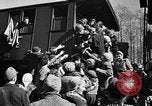
U.S. soldiers distribute food as the group surrounding the soldiers push forward to receive food in Germany.
Freed Jews in Germany. United States soldiers distribute food at railroad tracks. The group surrounding the soldiers push forward to receive meager bits of food. Jewish prisoner along railroad tracks. They stretch out their hands for food. Men, women and children in various stages of emaciation. They express a clue to the suffering they endured. Jewish prisoners in groups along railroad tracks. (World War II period).
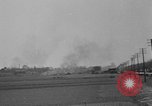
U.S. soldiers fire at a German village across the Elbe river in Germany during world War II.
Freed Jews in Germany during World War II. Village being shelled by German artillery from across the Elbe River. Smoke rises at distance. Jewish prisoner seated on ground near railroad tracks. Jewish prisoners in groups along railroad tracks.
Troops of the U.S. 1st, 3rd, 7th and 9th Infantry Divisions assault German Cities in Saar Basin during World War 2.
Troops of the U.S. 1st, 3rd, 7th and 9th Infantry Divisions assault cities in the Saar Basin, including Zweibruecken, Saarbruecken, Remagen, Bad Godesberg, and Bonn, during World War II. They attack the cities with tanks and rocket launchers mounted on top of tanks. U.S. Army soldiers of the 3rd Division enter the ruined city of Zweibrücken. U.S. Army 3rd Division commander Major General John O'Daniel ("Iron Mike") is seen discussing strategy with officers and soldiers. The troops of the 7th Division of the 7th Army moving forward into devastated and bombed Saarbrücken. A group of captured German soldier prisoners of war is shown in Saarbrücken. Wreckage of plaque mounted on Rathaus St. Johann (city hall) in Saarbrücken commemorating the Saar plebiscite and Saar status referendum results of 1935 which was announced by Hitler at the Rathaus St. Johann (Rathauspl. 1, 66111 Saarbrücken, Germany) in 1935. Army vehicles crossing the Rhine on pontoon bridge at Remagen. U.S. Army forces entering Bad Godesberg, where citizens are seen waving white flags of surrender from windows in the town. German civilians in Bad Godesberg read a poster on a building wall giving instructions from the Allied Military Government. German citizens with weapons stand in a line to turn-in the weapons, by order of the Allies. Scenes in Bonn, where the 1st Division of the 1st Army drives to the wreckage of the bridge at Bonn over the Rhine River. Views of the largely destroyed bridge at Bonn. American Army forces guard captured German military prisoners of war in area of Bonn. Views of captured German POW in uniform.
Soviet Russia mobilizes to defend against German offensive (Operation Barbarossa) in World War II.
Film opens showing Adolf Hitler, in World War 2, with Field Marshal Walther von Brauchitsch, Army Commander-in-Chief, and other top military members, planning for Operation Barbarossa (Attack to the East toward the Soviet Union). As he walks away from the table, he speaks briefly to Grand Admiral Erich Raeder, head of the Kriegsmarine (German Navy). Next Hitler and Marshall Hermann Goering are seen strolling and conversing at the Eastern Front headquarters, "the wolf's lair," (Wolfschanze) near Rastenburg, East Prussia (now Poland). Scene shifts to the Soviet Union, where Joseph Stalin is seen speaking at a podium. A large outdoor audience, including some soldiers, is gathered to listen. Images showing the Soviet people responding to defend against the German Nazi invasion. Closeup of Soviet soldiers with shouldered weapons. The nearest is holding a PPSh-41 submachine gun. Closeups of Soviet women and men in military uniforms. Soviet citizens heading to enlist in the military. Soldiers marching loosely n a city street. Patriotic singing is heard in background. A formation of Soviet women marching. Some carry furled banners. Soviet women carrying simple farm implements, marching in a rural part of Russia and joining others who are working to prepare anti-tank ditches and barriers in the countryside. Views of hundreds of people working on this project. Weapons being provided to rural Soviet guerrillas who will operate behind enemy lines. Anti-aircraft guns being set up overlooking a harbor. Closeup of Soviet soldiers manipulating controls on a camouflaged anti-aircraft gun and others maneuvering a four-barreled anti-aircraft machine gun. Local farm family members on makeshift towers keeping watch over huge fields of wheat. Soviet farmers harvesting the wheat with scythes. An armed farmer shielding his eyes as he searches the skies for German airplanes. Closeup of a man cutting wheat with a scythe as women gather the sheaves behind him. Motorized harvesters at work in a field of wheat. Closeup of a woman operating one. Tractors used in harvesting. Women and children gleaning what remains behind in the harvested fields. Farmers driving their cattle East (away from advancing Germans). Evacuating Soviet people employ a scorched earth policy, burning their homes, barns, and anything that might be of value to advancing German forces. Views of burning houses. Soviet industrial enterprises working around the clock producing war materiel. Seen are petroleum facilities; a large plant expelling coke; coal pouring into a barge; men at work at a steel furnace; ribbons of hot steel moving out of rollers; a huge manufacturing plant in operation. Next, a Soviet Kliment Voroshilov (KV) tank is seen moving across a field. Soviet Russian Polikarpov I-16 fighter planes in flight. A large formation of German Dornier DO 17 bombers in flight high overhead. Soviet forces retreating. Views of fallen German soldiers, fires burning, and remnants of a downed German bomber. German prisoners of war marching under guard and others surrendering with hands in the air. Closeups of some German prisoners. A Russian Petlyakov Pe-2 aircraft parked in snow with engines running. Fallen German soldiers lying in the snow along a roadway, in Winter of 1941-42. A Russian Kliment Voroshilov (KV) tank maneuvering in the snow. Russian Bt-7 Light Cavalry Tanks proceeding toward the front in Springtime, 1942.
CRITICALPAST.COM: About Us | Contact Us | FAQs - How to Order | License Agreement | My Account | My Lightboxes | Shopping Cart | Advanced Search | Featured Collections | Website Terms & Conditions | Privacy Policy ©2026 CriticalPast LLC.
License Agreement |
Terms & Conditions |
Privacy Policy
©2026 CriticalPast LLC.