


 Francais
 Deutsch
 Italiano
Refine Your Search
Prison physical examination. stock footage and images
- Showing 3115 to 3120 of 3715 results more
more Hide
Hide
President Lyndon B Johnson talks about Vietnam in his address at the John Hopkins University in Baltimore.
President Lyndon B Johnson gives a speech at the John Hopkins University (Baltimore, MD 21218, United States) in Baltimore. He talks about U.S. relations with South Vietnam, peace talks and proposes an aid program. He offers to hold diplomatic discussions to end the war in Vietnam. He states the need for an independent South Vietnam. “Such peace demands an independent South Viet-Nam—securely guaranteed and able to shape its own relationships to all others—free from outside interference—tied to no alliance—a military base for no other country.” President Johnson said. The President calls upon South East Asia nations for a co-operative economic drive, and asks the United Nations and nations like the Soviet Union to join in. “For our part I will ask the Congress to join in a billion-dollar American investment in this effort as soon as it is underway. And I would hope that all other industrialized countries, including the Soviet Union, will join in this effort to replace despair with hope, and terror with progress.” President Johnson said. Men working with heavy machinery in a South East Asian industrial plant. View of working men constructing a modern bridge in Vietnam. Vietnamese farmer threshing harvested rice. A doctor examines a Vietnamese man. The crowd applauds the President's speech. Views of Vietnamese people working on farms, in technical and scientific laboratories, and industrialization in Vietnam. A European or American professor teaches a Vietnamese student inside a laboratory. Vietnamese women working inside a textile factory. Vietnamese farmers carrying produce. President Johnson quotes from the book of Deuteronomy in the Bible. “We may well be living in the time foretold many years ago when it was said: “I call heaven and earth to record this day against you, that I have set before you life and death, blessing and cursing: therefore choose life, that both thou and thy seed may live.” Well, we will choose life. In so doing we will prevail over the enemies within man, and over the natural enemies of all mankind.” President Johnson concludes his speech.
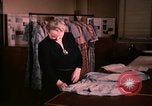
Researchers design functional house dresses and perform experiments for care of clothing.
Domestic arts and sciences and home economics research work by the Bureau of Human Nutrition and Home Economics Service (United States Department of Agriculture). Chief of the Bureau Dr. Hazel K Stiebeling talks about research in the field of textile and clothing. A woman researcher examines a garment on a table. Another researcher uses a machine to measure strength of various button holes. A machine is used to measure stitch strength. Fashion designers and tailors work on functional house dresses and aprons. The clothing specialist works out an idea with muslin on a dress from. She tries out the design on a live model. A designer cuts a pattern and another readies it for a final test. A functional house dress designed by the Bureau. Care of clothing: Testing of various soaps and detergents. A woman reaches for home laundry detergent in a cabinet. Women use a machine designed to soil fabric samples uniformly in order to compare detergents and soaps. Women cut the fabric into strips, light reflection. A researcher prepares the samples for laundry. She puts the samples into the laundrometer.
Steel sheets for tin plates are manufactured at a mill during World War 2
Manufacture of Steel at the time of World War II in the United States. Steel sheeting is run through machine rollers and cleaned specifically for use in tin plate. The sheeting is then stiffened and sheared into convenient lengths. Numerous women war workers at individual work stations of the factory, examine and stack the steel sheets. The women all wear the same type dresses and large protective gloves.
Nose and tail remains of the V-2 Rocket at Holloman AFB in New Mexico.
V-2 rocket fired at Holloman Air Force Base in New Mexico. The damaged nose section spreads on the ground. The demolished tail section parts scattered all over. Person examines the remains. Mountain ridges in the background. (World War II period).

African American children pose in front the school bus along with horse cart and other vehicles in South Carolina, United States.
Disparity between White and African American schools in South Carolina, United States. House in the background. Man examines the standing bus. Children pose in front of the bus. Horse cart. Vehicles stand. Wooden house and barren trees in the background.
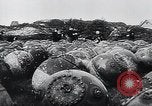
German Navy ordnance disposal experts destroy allied mines that reach the shore during World War II
Gerrnan Navy personnel look over a large number of marine mines piled up on the seashore in World War 2.. Several navy men walk into the surf where they retrieve a large mine floating ashore. A Navy explosives ordnance disposal technician removes parts from the mine. He and another Navy man examine them. Next, they deliberately detonate the mine creating a large blast, on the shore. A Navy Lieutenant is seen removing parts from another mine. Narrator states that he and his enlisted assistant have together destroyed 5,600 mines. His assistant wires up the mine for destruction. View of the mine exploding.
CRITICALPAST.COM: About Us | Contact Us | FAQs - How to Order | License Agreement | My Account | My Lightboxes | Shopping Cart | Advanced Search | Featured Collections | Website Terms & Conditions | Privacy Policy ©2026 CriticalPast LLC.
License Agreement |
Terms & Conditions |
Privacy Policy
©2026 CriticalPast LLC.