


 Francais
 Deutsch
 Italiano
Refine Your Search
Prison physical examination. stock footage and images
- Showing 3121 to 3126 of 3715 results more
more Hide
Hide
Hitler views captured areas in Paris, Dunkirk, and Calais; in Germany Hitler make plans with officers for invading England
'Battle of Britain' from the "Why we Fight" series of propaganda films during World War 2. Adolf Hitler stands with other officers in Paris following Battle of France and views the Eiffel Tower. Elevated view from Eiffel Tower of German troops marching in streets of Paris and under Arc de Triomphe. Damaged buildings in Dunkirk after German invasion. Hitler and staff ride in car through street barely passable with rubble and destroyed buildings on either side. In Calais, view of bombed port area and German soldiers keeping watch from a bunker. Hitler looks through V-shaped rangefinder or sighting binoculars across the English Channel toward Britain. Scenes in Berlin Germany of Reich Chancellery exteriors and interiors where Hitler meets with German officers and plans with other officers for invading England. German soldiers guarding the building exterior; Hitler's staff shown examining maps. Pictorial, animated representation of the first phase of the plan showing attack of England from air by Luftwaffe. Phase two shows attack on coastal areas. Phase three shows the actual attack and the course the German army would take to invade Britain.
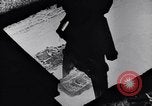
Metal sheets being rolled, shaped and workers weigh pistons at the Ford River Rouge Complex in Dearborn, Michigan.
Activities at the Ford River Rouge Complex in Dearborn, Michigan. A crane removes hot ingot from a soaking pit and places it on the conveyor to a rolling mill. An operator's hand on the machinery controls. The ingot tipping into the rolling machinery . It is being rolled and shaped. It is moved from one machine to another until a long thin sheet of metal emerges. A worker examines a thin sheet of metal as it passes him. The rolling machinery in operation. An aerial view of the plant. A line moving to the motor building center. A piston polishing machinery in operation. Workers finish and weigh pistons. The pistons on an overhead conveyor. The workers assemble sets for motors.
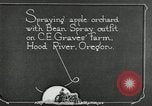
Fordson model F tractor pulls a tank cart at a farm near Hood river in Oregon, United States
Fordson model F tractor on a farm near Hood river in Oregon, United States. Tractor with pump attachment on front. Tractor pulls a tank cart. Workers spray chemicals on trees. Two men examine apple trees. Worker hold a branch loaded with large apples.
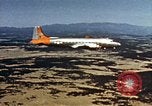
Testing effect of Atomic explosion on aircraft parked at different angles in Nevada, United States
Continental atomic tests Nevada, United States. Air Force C-54 aircraft in flight. Air Force Flight Surgeons wear masks and observe the atomic bomb explosion from an aircraft to test its effect on a pilot's vision. They immediately test their vision, while aboard the airplane, following the atomic blast. A truck drags a P-47 airplane. B-17s, P-47s, and newer aircraft are stationed at different angles. Atomic explosion tesst the effect of this explosion on the aircraft. High-speed cameras record effects of atomic blast. Elevator on tail of a B-17 in flames. Afterwards, technicians examine the damage on the various aircraft. Views of damaged aircraft after explosion on ground. USAF B-57B aircraft in flight. B-47 takes off with JATO. Smoke trails from the boosters.
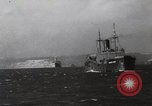
Convoys of Allied ships en route to France with supplies for Alllied Forces, are attacked by German submarines and bombers, in World War II
Ships carrying supplies to Allied forces in France, during World War 2. The deck of one is filled with Lockheed Hudson light bombers displaying British markings. Views of ships in the convoy. Change of scene to Adolf Hitler looking over maps with General Alfred Jodl, Chief of Staff of the German Army and other Generals of the high command. German submarine (U-boat) being launched. German U-boat crews being instructed in hit and run tactics in a classroom. Brief view of map showing disposition of Nazi U-boats to attack allied shipping. Allied convoy seen in aerial view from aircraft overhead. A formation of German Heinkel He 111 bombers seeking Allied convoys to attack. View of crew member at his station inside a bomber. View from a bomber descending to examine an Allied ship, making a low pass over several in the convoy, and ostensibly radioing U-boats to attack with torpedoes. Glimpse of a Heinkel He 111 climbing and a flight of them in formation.
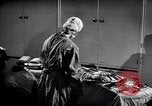
U.S Army Medical Service in Korea. Injured U.S. soldiers evacuated to the United States during the Korean War.
Scenes inside U.S. Army hospital in Japan. Surgeons scrub hand and arms at sinks before surgery. Surgeons prepare for operation on patient. Patients are moved about and treated. Nurse tending bedridden patient. Several soldiers seen leaving to return to duty in Korea. Others are transported to Haneda Air Base, near Tokyo, where the Military Air Transport Command operates long range aircraft in the so-called "Pacific Air Shuttle." A wounded soldier is taken from an ambulance and placed aboard a transport aircraft. Interior of aircraft is shown, with stretchers, medical workers and nurses. Aerial view of Honolulu, Hawaii from aircraft. The aircraft lands at Hawaii where wounded are cared for at Tripler Army Hospital until ready to continue journey to Travis Air Force Base in California. View from cockpit of aircraft landing at Travis Air Force Base. Wounded patients being moved through rear cargo doors of C-97 aircraft. Exterior view of fountains and main entrance at Walter Reed U.S. Army General Hospital in Washington, DC. Captain Zimmerman introduces Lt. Col. S.J. Newsome, who was a surgeon in Korea with the 7th Division. Dr. Newsome emphasizes "speed" as the most important factor in recovery of wounded soldiers. He also mentions the problem of disease affecting soldiers in foreign places like Korea, saying that, "Korea is a disease ridden country" with cases of pnemonia, smallpox, and "orgental diseases we had never seen before." Scenes of Army doctors performing medical examinations on soldier patients. Wounded being placed aboard jeep in Korean War. Soldier firing rifle. Soldiers slogging through mud and water. Soldiers firing artillery in the snow, and evacuating wounded on inflated litter in snow. Combat in jungle. View of civilian people wasing at side of river in India. Civilian dead in streets.
CRITICALPAST.COM: About Us | Contact Us | FAQs - How to Order | License Agreement | My Account | My Lightboxes | Shopping Cart | Advanced Search | Featured Collections | Website Terms & Conditions | Privacy Policy ©2026 CriticalPast LLC.
License Agreement |
Terms & Conditions |
Privacy Policy
©2026 CriticalPast LLC.